Industrial LED Lighting Wattage Guide: From 50W Flood Lights to 240W High Bays

Table of Contents
1. Introduction: The Real Cost of Guessing Your Wattage
A warehouse manager stared at his electricity bill. It had nearly doubled since the new lights went in. The floor had dark spots that drivers complained about every week. He had picked a higher wattage, thinking brighter was always safer. Instead, he got glare, wasted power, and an unhappy crew. This mistake is more common than you think. Choosing industrial lights by wattage alone is one of the costliest errors in facility planning.
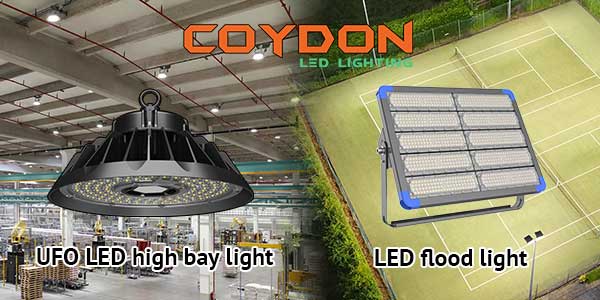
The old rules no longer apply. A 200-watt LED high bay from Coydon Lighting produces more light than a 400-watt metal halide fixture. It does so while consuming less than half the electricity. Wattage tells you nothing about brightness. It only measures power draw. To make the right choice, you need to understand lumens, efficacy, and real-world performance data.
This guide is different from the generic advice you will find elsewhere. We do not offer guesswork or vague ranges. Instead, we share real DIALux simulation results from actual Coydon Lighting projects. You will see how 30 of our 200W UFO high bays compare head-to-head with 400W metal halide lamps in a 2,000-square-meter facility. You will see how our 150W flood lights outperform 1000W halogen units on a six-court tennis complex. Every recommendation is backed by data you can verify.
We cover the full range: from 50W flood lights for building facades to 240W high bays for heavy industrial use. By the end, you will know exactly which wattage fits your space. You will also see how we validate every recommendation with professional DIALux simulation data. No more guessing. No more costly mistakes. Just clear, data-driven lighting decisions.
2. The New Rules of Industrial Lighting: Lumens, Efficacy, and Real Performance
2.1 Why Watts Alone Will Mislead You
Here is something most people get wrong. They buy lights by wattage, thinking a bigger number means a brighter light. This used to be true. It is not true anymore, and believing it will cost you real money. Let me show you two examples from our own testing.
First, high bays. Our 200W UFO high bay produces 28,675 lumens. A standard 400W metal halide lamp only manages 28,030 lumens. We cut the wattage in half and got slightly more light. Nobody expects that, but the data does not lie. Now flood lights. Our 150W LED flood light delivers around 19,500 lumens. A 1000W halogen unit might give you 16,000 lumens on paper. In the real world, it is often even less. One sixth the power, better light on the ground. Let that sink in.
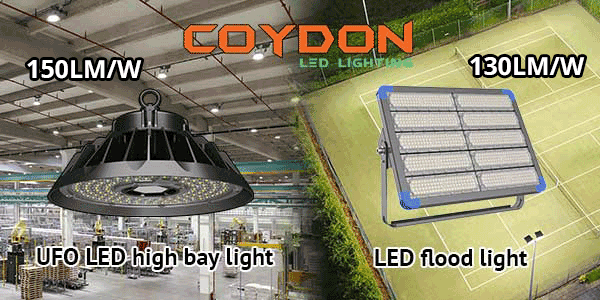
So forget wattage. The number you actually need is efficacy, measured in lumens per watt. It tells you how much light you get for every unit of electricity you pay for. Our KD-HBD high bay series hits 150 lm/W. The KD-FLN and KD-FLM flood light ranges both reach 130 lm/W. Old metal halide lamps sit at 60 to 80 lm/W. Halogen floods are even worse, often below 20 lm/W. Every hour of operation, traditional lights burn electricity as heat rather than useful light. Stop looking at watts. Look at lumens and efficacy instead. Those numbers will guide you to the right decision.
2.2 Understanding System Efficacy (lm/W)
Efficacy is just a fancy word for efficiency. It tells you how much light a fixture makes from each watt of power. The number you look for is lumens per watt, written as lm/W. Higher is always better. Simple as that.
So why does this matter to your bottom line? Two different 150 watt fixtures can light up a room very differently. The one with better efficacy gives you more brightness for the exact same electricity cost. Month after month, year after year, that gap adds up fast.
Our KD-HBD high bay fixtures deliver 150 lumens per watt. The KD-FLN and KD-FLM flood lights both hit 130 lumens per watt. Those are solid, real world numbers from products already out in the field.
Now think about what you might have installed right now. Old metal halide high bays usually do about 60 to 80 lumens per watt when they are new. After a year or two of use, that number drops off a cliff. Halogen flood lights are even more painful. Some barely crack 20 lumens per watt. Almost all the electricity they pull turns into heat instead of light. You pay for that waste every billing cycle without getting anything useful in return.
Later on, we will walk through actual project data. You will see these efficacy numbers come alive in DIALux simulations, with side by side comparisons that make the performance gap impossible to ignore.
3. LED High Bay Wattage Selection Guide
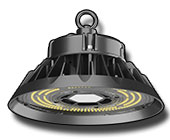
100 Watt
KD-HBD-W100-1
Ø248mm X 129mm
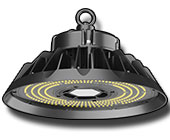
150 Watt
KD-HBD-W150-1
Ø295mm X 140mm
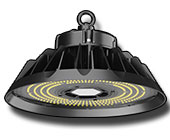
200 Watt / 240 Watt
KD-HBD-W200-1 / KD-HBD-W240-1
Ø320mm X 154mm
3.1 100W-150W High Bays: For Lower Ceilings and Tight Spaces
Not every warehouse has a forty foot ceiling. Plenty of facilities top out at fifteen or twenty feet. Smaller workshops, repair bays, storage rooms, compact manufacturing floors. These spaces need real brightness without the glare that oversized fixtures bring. That is where 100W to 150W high bays shine.
A 100W UFO high bay from our KD-HBD series generates roughly 15,000 lumens. Step up to 150W and you get around 22,500 lumens. Both sit at 150 lumens per watt, so you get serious light output without the electrical bill that used to come with it.
Mount these fixtures at fifteen to twenty feet and the coverage feels natural. Light spreads evenly across the floor, enough to read labels, operate machinery, and move inventory safely. We usually suggest spacing them about twelve to fifteen feet apart in this height range. That spacing keeps the light uniform with no dark corners or harsh hotspots.
Installation is straightforward. The compact UFO design does not need much clearance above the ceiling hook. This helps a lot in tight attics or buildings with low roof decks.
If you are replacing old fluorescent or low watt HID fixtures in these smaller spaces, the KD-HBD-W100-1 and KD-HBD-W150-1 are built for exactly this job. We will look at a real project with these units later in the case study section.
3.2 200W-240W High Bays: The Industrial Workhorse
This is the sweet spot for most industrial projects. Ceilings from thirty to fifty feet high. Wide open floors with forklifts moving pallets all day. Logistics hubs, distribution centers, heavy manufacturing plants. When the space is big and the work never stops, 200W and 240W high bays earn their keep.
A single 200W unit from our KD-HBD series pushes out about 30,000 lumens. The 240W version hits roughly 36,000 lumens. Both run at 150 lumens per watt, which means they light up massive areas without killing your energy budget. For a forty foot ceiling, you are looking at spacing these fixtures around twenty to twenty five feet apart. That kind of coverage keeps the light even across aisles, loading docks, and assembly stations.
What makes these units stand out is how flexible they are. You can add a microwave motion sensor so the lights dim when a zone sits empty. Forklift enters, lights snap back to full brightness. You can also hook them up to a 0-10V dimming system for centralized control across the whole facility.
If you are staring at old 400W metal halide lamps that need constant relamping, the KD-HBD-W200-1 is your direct replacement. For taller ceilings past forty feet, step up to the KD-HBD-W240-1. Both drop right into existing layouts and start saving power from day one. We will break down a real comparison in the case study chapter.
4. LED High Bay Case Studies: Real Data, Direct Comparisons
4.1 150W UFO High Bay: 46 Fixtures in a 2,323m² Warehouse
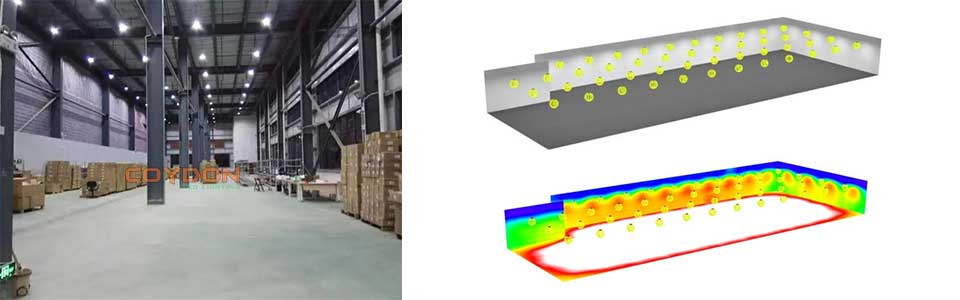
The calculation report: UFO LED high bay lights 150 watt x 46 piece ( Project 02 )
Let me walk you through a real project. The space was a warehouse covering 2,323 square meters. Ceiling height sat at 8 meters, which is about 26 feet. Not extremely tall, but high enough that lighting choice mattered a lot. The goal was simple. Bright, even light across the whole floor without wasting energy.
We ran a full DIALux simulation using 46 units of our KD-HBD-W150-1, the 150W UFO high bay. Mounting height was set at 7 meters. The results came back strong.
Average illuminance across the work plane hit 338 lux. That is well above what most warehouses need for daily operations. Forklift drivers can see clearly. Workers read labels without squinting. The whole space feels bright and safe.
Now look at the efficiency numbers. Power density landed at just 2.90 watts per square meter. System efficacy worked out to roughly 150 lumens per watt. Those figures mean the facility owner pays very little to keep this warehouse lit, month after month.
The light distribution turned out nicely too. No harsh dark spots between fixtures. Walls and ceiling stayed bright enough that the space feels open, not like a cave. That matters more than people realize for worker comfort over a long shift.
Here is the takeaway. A 150W high bay in an 8 meter space delivers all the light you need. You do not have to jump to 200W or beyond. The KD-HBD-W150-1 balances brightness and energy savings perfectly for this ceiling range. We will show you what happens at higher ceilings with the 200W model next.
4.2 200W LED vs. 400W Metal Halide: 30-Fixture Direct Comparison
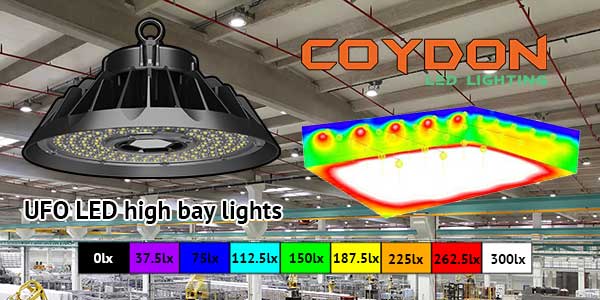
The Dialux Report:
30 PCS 200 Watt UFO LED high bay lights

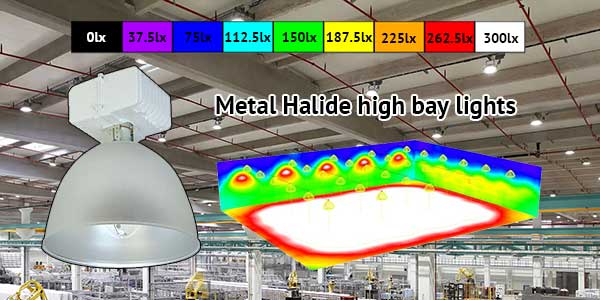
The Dialux Report:
30 PCS 400 Watt Metal Halide high bay lights
This is the comparison that matters most. Same space. Same layout. Different technology. The results speak for themselves.
We took a 2,000 square meter facility with a 10 meter ceiling. Thirty fixtures arranged in a 5 by 6 grid pattern. Spacing set at 5 meters by 6.67 meters. Everything identical except one variable, the light source. On one side, our KD-HBD-W200-1 200W UFO high bay. On the other, a standard 400W metal halide fixture. Both sides ran through the same DIALux simulation.
The 200W LED setup delivered an average of 322 lux across the work plane. Uniformity came in at 0.496. Total power draw for all thirty fixtures was just 6.12 kilowatts. Each unit pulled about 204 watts at full output.
The 400W metal halide setup produced 324 lux. Uniformity measured 0.484. Slightly worse. Total power consumption hit 13.74 kilowatts. Each fixture drew 458 watts once you accounted for ballast losses.
Let those numbers settle. The LED solution matched the metal halide on brightness. It beat it on light uniformity. And it did all that while using less than half the electricity. The savings exceed fifty five percent. Month after month, that gap translates into serious money staying in your pocket instead of going to the utility company.
Here is the part that makes retrofits painless. You can swap these fixtures one for one. Remove the old metal halide unit. Mount the new KD-HBD-W200-1 in the same spot. No rewiring needed. No layout changes. No extra engineering work. The installation crew finishes faster and your downtime shrinks.
Then there is the maintenance factor. Metal halide lamps typically last around 15,000 hours before output drops noticeably. In a busy facility running two shifts, that means replacing lamps every few years. Someone has to rent a scissor lift. Someone has to shut down the area. Someone has to pay for labor and new bulbs. Over and over again. Our LED high bays run past 50,000 hours with minimal lumen depreciation. You install them once and forget about them for well over a decade.
If you are still running old metal halide high bays, the math is clear. The KD-HBD-W200-1 replaces them directly, slashes your energy bill, and eliminates the constant headache of relamping. One decision. Years of savings.
5. LED Flood Light Wattage Selection Guide
5.1 50W-100W Flood Lights: Security, Landscapes, and Small Areas
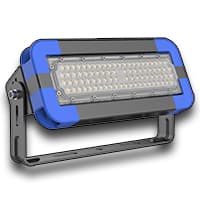
50 Watt
KD-FLN-W50
310mm x 87mm x 170mm
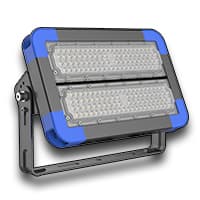
100 Watt
KD-FLN-W100
310mm x 87mm x 228mm
Not every outdoor project needs massive brightness. Sometimes you just want to light up a building entrance. Or keep a backyard safe at night. Or make sure your shop sign stays visible after sunset. Small flood lights handle these jobs without fuss.
A 50W unit from our KD-FLN series puts out around 6,500 lumens. Step up to 100W and you get about 13,000 lumens. Both run at 130 lumens per watt, so power bills stay low. Mount them three to five meters high and the coverage feels natural. Good light spread without blinding glare.
Beam angle is worth thinking about here. A tight beam, maybe 15 or 30 degrees, picks out building features or sign lettering really well. A wider spread, like 60 or 90 degrees, blankets driveways and fence lines evenly. We stock several options. Pick the one that fits your actual situation.
Outdoor fixtures need solid construction. The KD-FLN-W50 and KD-FLN-W100 both carry IP66 ratings. Dust stays out. Heavy rain does not penetrate. Snow piles up and melts away. These units keep working. A 5 year warranty backs each one.
If old halogen floods are driving up your maintenance costs, switching to LED in this range makes sense fast. Cheaper electricity. Zero bulb changes. The savings add up quicker than most people expect. For bigger jobs like parking lots and sports courts, the 150W to 300W range comes next. Those are a different game entirely.
5.2 150W-300W Flood Lights: Parking Lots, Loading Docks, and Facades
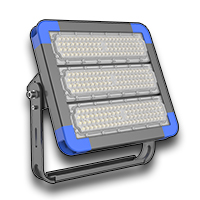
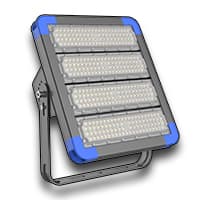
150 Watt
KD-FLN-W150
310mm x 87mm x 309mm
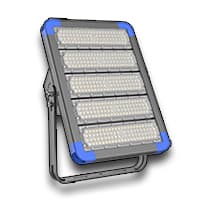
200 Watt
KD-FLN-W200
310mm x 87mm x 382mm
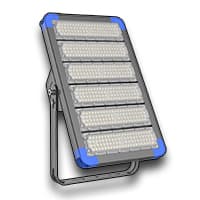
250 Watt
KD-FLN-W250
310mm x 87mm x 459mm
300 Watt
KD-FLN-W300
310mm x 87mm x 539mm
This is the workhorse range for outdoor lighting. If you run a commercial property, manage a warehouse yard, or maintain a sports facility, you will spend most of your time looking at these wattages. They strike the right balance between raw power and running cost.
Let us talk numbers first. A 150W unit from our KD-FLN series delivers roughly 19,500 lumens. The 200W hits about 26,000 lumens. At 250W you get 32,500 lumens. The 300W pushes out around 39,000 lumens. All four run at 130 lumens per watt, so every watt pulls its weight. Typical mounting height sits between five and ten meters. That covers most commercial exteriors without needing tall poles or special rigging.
Where do these fixtures go? Small to medium parking lots need even coverage so customers feel safe walking to their cars at night. Loading docks demand bright, shadow free light for trucks backing in and crews moving freight. Building facades look sharp when lit from below or above, and the right beam angle makes the difference. Community courts and local sports fields also fit here. We have done several tennis court projects with the 150W model, which we will break down later in detail.
Beam angle matters. A 60 degree lens throws light further, good for tall facades or long narrow areas. A 90 degree spread blankets wider zones without leaving dark edges. The KD-FLN-W150 through W300 all carry IP66 ratings and come with a 5 year warranty. If you are nursing old halogen floods along with constant bulb swaps, this range replaces them outright and slashes your energy bill in the process.
5.3 400W-1250W Flood Lights: Stadiums, High Masts, and Extreme Heights
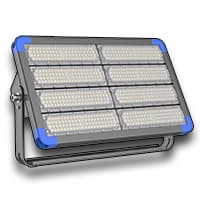
400 Watt
KD-FLN-W400
310mm x 107mm x 388mm
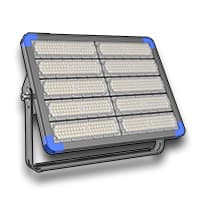
500 Watt
KD-FLN-W500
310mm x 107mm x 461mm
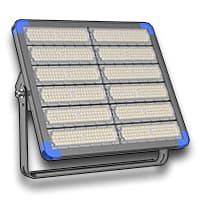
600 Watt
KD-FLN-W600
310mm x 107mm x 529mm
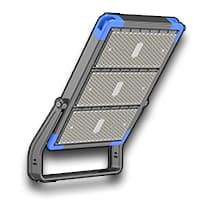
750 Watt
KD-FLM-W750
462mm x 584mm x 111mm
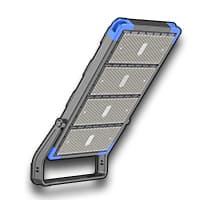
1000 Watt
KD-FLM-W1000
462mm x 761mm x 111mm
1250 Watt
KD-FLM-W1250
502mm x 1072mm x 307mm
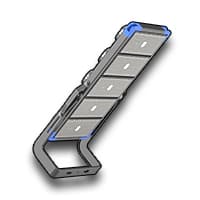
Some jobs need serious firepower. Stadium lights. High mast setups. Port terminals that run through the night. A regular flood light will not cut it. The distances are too great. The required brightness is too high. For these projects, you step into our high output range.
Our lineup splits into two families at this level. The KD-FLN series covers 400W, 500W, and 600W. A 400W unit gives you about 52,000 lumens. The 600W reaches roughly 78,000 lumens. These are single body fixtures. Solid, straightforward, and built for mounting heights from fifteen to thirty meters. Think large parking plazas, tall building facades, regional sports grounds.
Then comes the heavy artillery. The KD-FLM series runs from 750W all the way to 1250W. A 1000W module churns out roughly 130,000 lumens. The 1250W tops out near 162,500 lumens. We designed these for professional stadiums, shipping yards, railway terminals, and mining sites. Places where the lights hang forty or fifty meters up and still need to deliver crisp, usable brightness on the ground.
What really sets the FLM series apart is the modular optical design. Each unit carries independent lens modules. You can choose from standard beam angles like 10, 25, 45, 60, or 90 degrees. Need a rectangular spread for a long narrow area? We offer specialty patterns like 65 by 25 degrees and 130 by 30 degrees. This lets you shape the light precisely onto the target zone. No wasted spill into neighbors’ property. No dark patches where workers or players need clear sight lines.
Every fixture in this range comes with an IP66 rating and a 5 year warranty. Dust, heavy rain, salt spray, freezing temperatures. They just keep running. If your project demands lighting from extreme heights with zero compromise on coverage, this is the range you look at first.
6. LED Flood Light Case Study: Tennis Court Lighting
6.1 150W LED Lights a 6-Court Tennis Complex
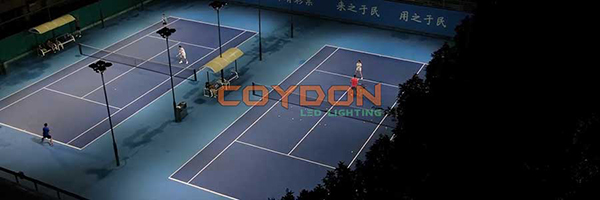
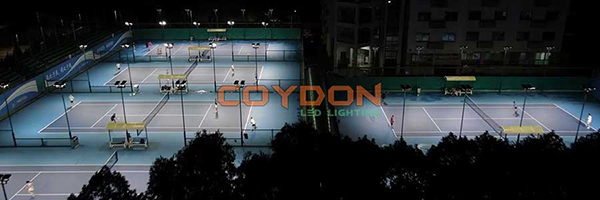
The calculation report: high power LED flood lights 150 watt x 120 piece ( Project 02 )
Tennis lighting is tough. Players need to track a fast moving ball from any spot on the court. Uneven light ruins the game. Shadows create blind spots. Glare makes overhead shots painful. A lot of outdoor courts still run on old halogen floods that fail on all three counts.
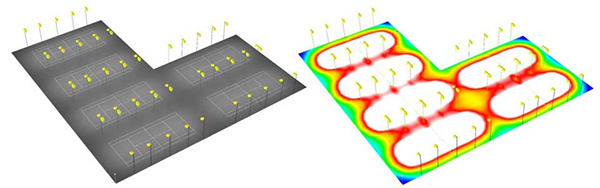
We tackled this problem head on with our KD-FLN-W150 flood lights. The project involved six full size outdoor courts. After running a detailed DIALux simulation, we settled on a layout with 120 fixtures mounted across 40 poles. Each fixture used a 60 degree beam angle. That narrow focus keeps the light tight on the playing surface and out of the neighbors’ windows.
The results were impressive. Every single court got its own independent assessment. Average illuminance ranged from 400 to 443 lux across the six courts. Uniformity, measured as U0, landed between 0.77 and 0.80. Let me put that into context. A uniformity score above 0.7 already meets the standards for competitive play at regional tournaments. Hitting 0.8 puts you into top tier territory for non televised events. Players see the ball clearly from the baseline to the net. No dark corners. No surprise shadows. Just consistent, reliable light.
The pole positions were mapped down to the millimeter in the DIALux report. Installers could take those coordinates straight to the site and mark out every location without guesswork. This level of planning eliminates costly adjustments during construction. You get exactly what the simulation promised.
We will put this LED setup against a 1000W halogen alternative next. The difference is something every facility manager should see before making a buying decision.
6.2 150W LED vs. 1000W Halogen: The Tennis Court Showdown
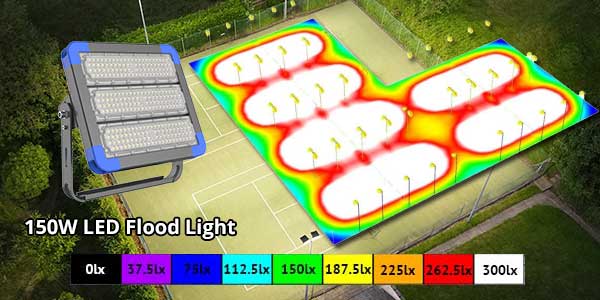
The Dialux Report:
high power LED flood lights 150 watt x 120 piece ( Project 02 )
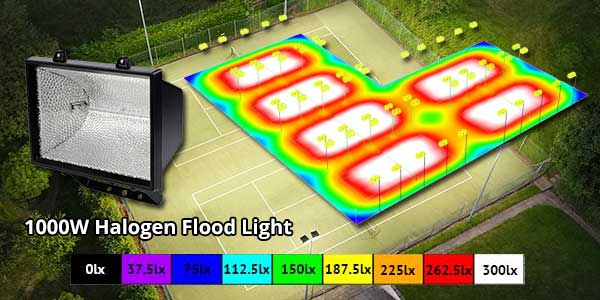
The Dialux Report:
Halogen flood lights 1000 watt x 120 piece
We ran the same six court layout through DIALux twice. Same pole positions. Same beam angles. The only thing we changed was the light source. On one side, our 150W KD-FLN-W150 LED flood lights. On the other, 1000W halogen floods. What came back was not even close.
The LED setup delivered over 400 lux average on every court. Uniformity scores ranged from 0.77 to 0.80. Total power draw across all 120 fixtures sat at 18.53 kilowatts. That is a tidy number for a six court facility running through evening sessions.
Now the halogen side. Average illuminance struggled to reach 300 lux on most courts. Uniformity bounced between 0.61 and 0.82, a big spread that players would definitely feel. Total power consumption hit 120 kilowatts. Read that again. 120 kilowatts versus 18.53. The LEDs used barely fifteen percent of the electricity while producing brighter, cleaner, more consistent light. This is not a small gap. It is an entirely different league of performance.
Then there is everything the numbers do not show. Halogen lamps run scorching hot. That heat is wasted energy. The bulbs burn out quick and need constant replacing. Someone has to lower the poles, swap the lamps, and hope the new ones last through the season. Over and over. Our LED fixtures carry an IP66 rating. They shrug off rain, dust, and whatever else the weather throws at them. Five year warranty included. Maintenance costs drop to nearly zero.
Here is the bottom line. A single 150W LED flood light from Coydon Lighting flat out replaces a 1000W halogen unit. The LED wins on brightness. It wins on light quality. It crushes the halogen on energy savings. If you run a tennis facility and still have old halogen floods, the upgrade path could not be clearer. We already proved it with a real simulation. The next step is putting this same layout on your courts.
7. How to Plan Your Industrial Lighting Layout
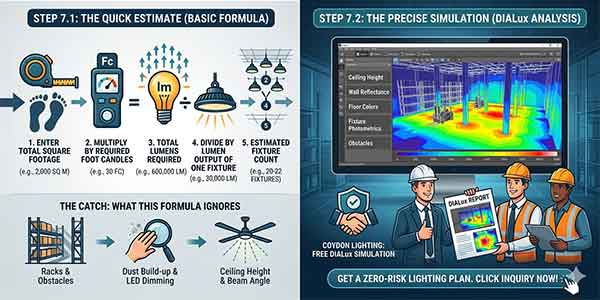
7.1 From Square Footage to Fixture Count
You need a starting point. Here is a simple formula that works for most spaces. Take your total square footage. Multiply it by the foot candles your space requires. That gives you the total lumens you need. Divide that number by the lumen output of one fixture. The result tells you roughly how many lights to install.
Let us run through a real example. Suppose you have a 2,000 square meter warehouse. General storage work needs about 30 foot candles. Total lumens required comes to roughly 600,000. Each of our 200W UFO high bays puts out about 30,000 lumens. Divide 600,000 by 30,000 and you land on roughly 20 to 22 fixtures. That sounds about right for a quick estimate.
But here is the catch. This formula ignores a few important things. Ceiling height changes how light spreads. Taller ceilings need more fixtures or narrower beams. Racks, columns, and machinery create shadows that eat up light. Wall and floor colors affect how much light bounces around the room. Dark surfaces soak up lumens. Light surfaces reflect them. The formula also skips over light loss over time. Dust builds up on lenses. LEDs dim very slowly but they do dim.
For a rough budget or a first pass layout, the formula works fine. But if you are spending serious money on a full installation, do not stop here. Getting the exact count and spacing right takes a more detailed approach. That is where a proper DIALux simulation comes in. We cover that next.
7.2 The Value of a DIALux Simulation
A basic formula gives you a rough idea. That is fine for early planning. But if you want to know exactly how your space will look after the lights go up, you need something more precise. That something is a DIALux simulation.
DIALux is professional lighting design software. It does not guess. It calculates. You feed it the exact dimensions of your space. Ceiling height, room width, wall colors, floor reflectance. You add any obstacles. Racks, columns, machinery, partitions. Then you place the fixtures at real mounting heights with real beam angles. The software runs the numbers and produces a detailed photometric map. You see precisely where the light lands, how bright it is, and how evenly it spreads across the floor.
Every case study in this guide came from DIALux reports we ran ourselves. The 46 fixture warehouse setup. The 30 fixture head to head comparison. The six court tennis complex. None of that data was estimated. It was all simulated and verified before a single fixture was installed. That is how we make sure a proposed layout actually works.
Here is the part most lighting suppliers will not tell you. Coydon Lighting offers free DIALux simulations to our customers. You send us your space dimensions and your lighting goals. We build the model. We run the analysis. You get a professional report showing exactly what fixtures you need and where to put them. No charge. No obligation. It takes the risk out of a large lighting investment.
If you are planning a new build or a retrofit, do not rely on rough math alone. A simulation costs you nothing and can save you from expensive layout mistakes. Click Inquiry Now and let us run the numbers for your facility.
8. Conclusion: Confidence in Every Watt
We started with a simple problem. Guessing wattage costs money. It leads to dark spots on the floor, complaints from the crew, and inflated electricity bills that nobody wants to explain. By now, you should see a better way forward.
Stop shopping by watts. Start asking about lumens and efficacy. Our 200W UFO high bay matches a 400W metal halide on brightness while cutting power draw by more than half. Our 150W flood light leaves a 1000W halogen in the dust, delivering brighter and more even light while using a fraction of the energy. These are not marketing claims. They are DIALux simulation results you can verify yourself.
No matter what kind of project sits on your desk, we likely have the right fixture for it. The KD-FLN and KD-FLM flood light families cover everything from a small backyard to a professional stadium, ranging from 50 watts all the way to 1250 watts. The KD-HBD high bay series handles 100 watts through 240 watts for warehouses and production floors of any size. Every unit across every series delivers high system efficacy, IP65 or IP66 rated protection, and a full 5 year warranty.
You do not have to figure this out alone. Tell us the length, width, and height of your space. Let us know the planned mounting height for the fixtures. And describe what kind of work happens there. Our team runs a free DIALux simulation built around your actual dimensions. You get a detailed lighting layout with fixture counts, spacing recommendations, and real performance data before you commit a single dollar. Click the Inquiry Now button and let us earn your confidence with real numbers.
9. Frequently Asked Questions
Can a 150W LED flood light really replace a 1000W halogen?
Absolutely. We proved it with a real tennis court project. Our 150W KD-FLN-W150 flood lights delivered over 400 lux average across six courts. The old 1000W halogen setup could not even reach 300 lux. The LEDs used only 15 percent of the electricity. Brighter light. Better uniformity. Much lower power bills. The numbers speak for themselves.
How do I know if a 200W LED high bay can replace my 400W metal halide?
We ran this exact comparison in DIALux. Same 2,000 square meter space. Same 30 fixture layout. Our 200W UFO LED high bay produced 322 lux. The 400W metal halide managed 324 lux. That is functionally identical brightness. But power draw dropped from 13.74 kilowatts to just 6.12 kilowatts. You can swap them one for one without changing a single wire or bracket. The savings start on day one.
Do you provide DIALux lighting simulation reports?
Yes, and we do it for free. Every case study in this guide came from real DIALux reports we generated for actual projects. You give us your room dimensions, ceiling height, and mounting details. We build the model and run the analysis. You get a professional layout with fixture counts, spacing, and expected lux levels. No cost. No obligation. Click Inquiry Now and we will get started on yours.