What Is High Bay Lighting And Why Is It Used in Warehouses?

Table of Contents
1. Introduction: the unseen engine of warehouse productivity
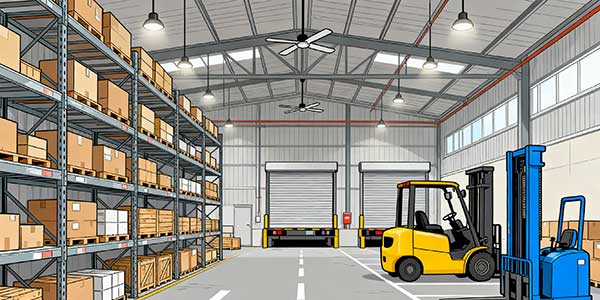
Industrial lighting remains an underrated component in facility management. However, recent energy audits reveal that illumination consumes 30% to 50% of a warehouse’s total operational power budget. This is not just a line item on a monthly utility bill. It represents a core baseline directly tied to daily plant output.
When facility managers install substandard fixtures to save money upfront, operational costs escalate. Dim work areas and blinding glare create immediate plant hazards. Forklift operators experience dangerous blind spots along high-clearance racks. Pickers struggle to read tiny product labels quickly. These poor optical conditions cause picking errors to spike and increase equipment collisions. Furthermore, bad light accelerates worker eye fatigue, slowing down overall facility throughput.
Upgrading to high-efficiency industrial fixtures solves these physical bottlenecks. Proper light layout ensures uniform lux levels in every active aisle. It completely eliminates shadows between high-density storage bays. By investing in commercial-grade systems, logistics directors protect floor personnel while accelerating order fulfillment. Operational efficiency depends heavily on the hardware mounted overhead.
1.1 The Evolving Challenges of Modern Logistics Facilities
The logistics infrastructure landscape is undergoing a massive structural transformation worldwide. High-efficiency e-commerce fulfillment centers are rapidly replacing traditional low-ceiling storage buildings. To maximize inventory capacity, modern warehouse operators expand vertically rather than horizontally. Facilities now routinely install high-density racking systems. These massive industrial structures frequently exceed 20 to 30 feet in height. This smart vertical strategy optimizes expensive footprint square footage effectively. However, tall structures create an incredibly hostile environment for standard lighting configurations.
High-clearance warehouse layouts introduce deep, narrow aisle chasms between dense storage bays. In these specific vertical zones, standard commercial light fixtures fail completely. Conventional office troffers or low-bay lamps scatter light too widely. They distribute lumens across the upper ceiling plane instead of down to the floor. Therefore, the luminous intensity dissipates heavily before reaching the ground level. This wasteful scattering leaves critical vertical rack faces dark and unreadable. Pickers cannot see small product labels on bottom-tier pallets, causing severe inventory picking bottlenecks.
Furthermore, this deep-space environment presents major safety liabilities for heavy equipment operators. Forklift drivers must constantly look upward into dark voids to pull down heavy goods. When moving quickly from bright loading docks into dim aisles, human eyes struggle to adapt. Standard light systems simply lack the directional force to penetrate these narrow storage gaps. Resolving this critical facility bottleneck requires a specialized photometric approach. Warehouse directors must select high-bay hardware engineered specifically for deep vertical light throw.
2. What is high bay lighting? (The technical definition)
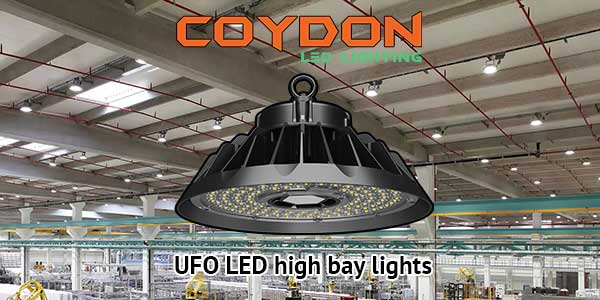
High bay lighting refers to heavy-duty illumination systems designed for tall indoor spaces. Industrial sectors classify these fixtures for mounting heights ranging from 20 to 40 feet. Standard utility bulbs fail completely in these expansive areas. They lack the structural capability to push illumination down to the work plane. Therefore, true high-bay engineering requires a completely different mechanical approach to handle extreme vertical distances.
To ensure performance, these industrial fixtures utilize specialized concentrated lenses. These precision optics control the beam spread at sharp angles like 60 degrees or 90 degrees. This narrow focus forces lumens to travel straight down to the warehouse floor. Without these lenses, light scatters aimlessly across the upper ceiling space. This focused directional control eliminates wasted energy, maximizing operational visibility where technicians actually work.
Furthermore, rugged environments demand heavy-duty housings made of premium die-cast aluminum. This specialized metal shell acts as a high-performance heat sink. It draws destructive thermal energy away from the sensitive LED chips quickly. Proper heat dissipation prevents premature lumen depreciation over long daily shifts. Protecting the internal driver ensures stable, uniform light distribution across massive industrial footprints.
2.1 The industry standard: High bay vs. Low bay lighting
Ceiling height serves as the official structural dividing line between high bay and low bay systems. The global industrial lighting sector fixes this critical architectural threshold at exactly 20 feet or 6 meters. Indoor facilities measuring below this specific clearance mark must utilize standard low bay hardware solutions. Conversely, expansive properties exceeding this clear vertical boundary demand rugged, high-performance high bay units. Selecting the wrong gear completely alters your intended beam distribution patterns. This common layout mistake severely undermines local plant functionality and wastes valuable operational energy.
The underlying engineering variance centers entirely on total lumen package intensity and specific optical beam configurations. Low bay fixtures incorporate wide, highly diffuse beam lenses to distribute softer light across shallow spaces. If you mount a low bay unit above the 20-foot limit, vertical illumination dissolves prematurely. Luminous intensity drops drastically before the light waves ever touch the work plane. This costly miscalculation creates incredibly sparse, dim zones. It leaves critical warehouse warehouse aisles dangerously dark for active workers.
Conversely, industrial high bay lights project intense lumen output through specialized, narrow optical lenses. These unique glass components direct concentrated rays over immense vertical distances without scatter. Utilizing these high-intensity directional beams inside low-ceiling areas causes immediate visual disruptions. The focused light rays bounce aggressively off nearby concrete surfaces, generating blinding operational glare. This severe blinding effect strains technician eyesight, triggers painful headaches, and compromises overall workplace safety margins.
3. Top 5 critical lighting pain points in industrial warehouses
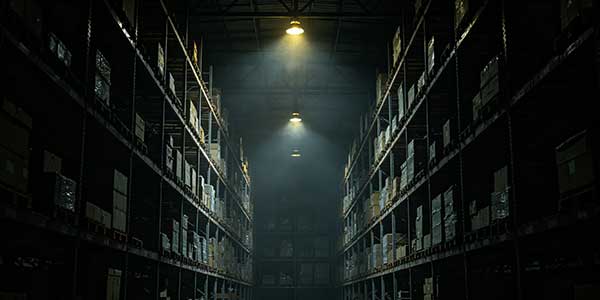
Warehouse operations chiefs face intense pressure to protect tight profit margins while maintaining high facility safety levels. However, legacy facility illumination systems regularly undermine these efforts. Older industrial lighting architectures suffer from massive inefficiency issues. They generate five distinct operational bottlenecks that disrupt daily logistics workflows and drain corporate cash reserves constantly.
- The first critical failure stems from massive energy drain. Traditional high-intensity discharge systems consume excessive amounts of electricity. These legacy fixtures convert most input power into ambient heat instead of visible light. This inefficiency results in astronomical monthly utility bills. Facility operators watch their profits vanish into obsolete overhead hardware that offers poor electrical conversion rates.
- Maintenance downtime presents a second severe operational bottleneck. Replacing a failed bulb high above the floor requires renting expensive scissor lifts. It also forces managers to block active aisles, halting local material handling entirely. This disruptive maintenance process triggers costly labor delays and lowers overall facility throughput. The long-term labor costs to swap old bulbs quickly exceed the original purchase price of the hardware.
- Lumen depreciation constitutes a third hidden threat to industrial spaces. Metal halide lamps lose brightness rapidly within the first few years of installation. This slow degradation darkens active workspaces over time without triggering a total hardware failure. Workers gradually find themselves operating in dim, unsafe environments. This lack of light compromises visibility and slows down inventory processing speeds.
- Furthermore, narrow storage bays suffer from deep shadows in aisles. Standard warehouse layouts feature high-density racking units placed tightly together. Weak conventional fixtures cannot push uniform illumination past these vertical blockages. This directional failure creates dangerous dark zones where pickers struggle to read tiny product labels accurately. Missing these labels drives up fulfillment error rates significantly.
- Finally, older warehouse systems lack intelligent dimming capabilities. These outdated configurations run at full power even when storage zones remain completely empty. Operators waste thousands of dollars illuminating unoccupied areas where no forklift activity occurs. Without smart sensory adaptation, legacy industrial networks remain frozen in an inefficient, costly state.
4. Why is high bay lighting essential for warehouse environments?

Macroscopic logistics efficiency depends heavily on the visual performance of floor personnel. Modern warehousing operations require rapid, continuous inventory movement across vast spaces. High-quality overhead illumination directly influences this workflow speed. When corporate leaders install professional industrial fixtures, they notice immediate operational improvements. Clear visibility allows logistics teams to execute tasks with confidence, eliminating sluggish handling intervals completely.
Most importantly, superior industrial light distribution drives a massive increase in local label reading accuracy. Order pickers must scan alphanumeric barcodes and small shipping labels on distant shelves constantly. Inadequately lit aisles lead to frequent reading missteps and sorting bottlenecks. Proper high-bay output removes these visual barriers entirely. Workers can identify the correct product units quickly, reducing costly return tracking errors significantly.
Consequently, minimizing scanning mistakes accelerates your overall facility throughput efficiency. When staff members spend less time squinting at dim pallets, fulfillment speed spikes. Forklift traffic flows smoothly through aisles without unexpected stopping delays. Optimizing your ceiling hardware transforms a chaotic storage site into a highly productive distribution hub. Investing in quality light networks remains a fundamental step to maximize corporate supply chain performance.
5. The multi-dimensional advantages of LED tech over legacy systems
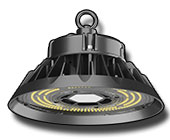
100 Watt
KD-HBD-W100-1
Ø248mm X 129mm
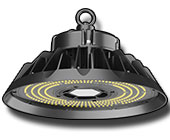
150 Watt
KD-HBD-W150-1
Ø295mm X 140mm
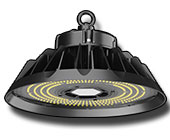
200 Watt / 240 Watt
KD-HBD-W200-1 / KD-HBD-W240-1
Ø320mm X 154mm
| Input Voltage: | AC 90V – 305V |
| Colour Temperature: | 3000K / 4500K / 6000K |
| Color Rendering Index: | 80+ |
| LED Type: | LED SMD 2835 ( OSRAM ) |
| IP Grade: | IP65 |
| Material: | Aluminium + PC Lens |
| Luminous Efficiency: | 150 Lumens per watt |
| Beam Angle: | 60° / 90° / 120° |
| Warranty: | 5 Years |
| Mounting Height: | 100 Watt: 15–20 ft (4.5–6 m) 150 Watt: 20–30 ft (6–9 m) 200 Watt: 30–40 ft (9–12 m) 240 Watt: 40–50 ft (12–15 m) |
Evaluating facility upgrades requires a direct physical comparison between modern solid-state technology and older legacy sources. For decades, conventional industrial sites relied heavily on high-intensity discharge metal halide fixtures or fluorescent tubes. However, these outdated systems introduce massive performance liabilities into busy distribution environments. Modern commercial retrofits replace these fragile options to establish superior baseline facility control.
A primary operational disadvantage of traditional metal halide bulbs involves their lengthy warm-up period. When power flickers, legacy high-intensity lamps require up to fifteen minutes to attain full lumen output. Conversely, advanced industrial units feature true zero startup delays. They deliver immediate, maximum brightness the moment an operator flips the wall switch. This instant-on capability proves essential for fast-paced logistics facilities facing sudden grid fluctuations.
Furthermore, standard fluorescent tubes generate repetitive visual flickering during everyday operation. This rapid modulation causes severe eye strain, driving up employee headache rates during long warehouse shifts. Modern industrial fixtures eliminate this high-frequency flickering entirely to safeguard team health. Removing this optical stress improves worker focus and protects long-term vision. This stable emission performs perfectly across demanding warehouse zones with high forklift traffic.
Finally, legacy systems degrade rapidly under rapid power cycling. Turning older lamps on and off frequently destroys the internal ballasts, spiking maintenance replacement costs. High-performance industrial technology handles constant on-off switching sequences without any structural hardware damage. This absolute switching durability allows facilities to integrate advanced sensory controls seamlessly. Modern operators cut energy waste safely while protecting their hardware investments over time.
5.1 Hard cost savings: Energy and maintenance analysis
Financial auditing reveals the immediate fiscal impact of upgrading to commercial-grade LED system. High-quality industrial systems slash local lighting energy consumption by 60% to 80% compared to legacy setups. This dramatic drop cuts thousands of dollars from monthly factory utility statements. facility buyers rapidly reclaim their initial capital investments through these reliable power budget reductions. Legacy metal halide lamps consume massive secondary energy through inefficient, heat-generating ballasts. Modern solid-state drivers eliminate this parasitic power loss completely, protecting your bottom line.
Furthermore, premium industrial fixtures deliver an exceptional operational lifespan ranging from 50,000 to 100,000 running hours. This extreme hardware durability eliminates the need for recurring bulb replacements over decades of service. Facility managers no longer spend corporate funds on frequent scissor lift rentals or specialized maintenance crews. Eliminating high-altitude lamp servicing lowers corporate workplace liability insurance costs significantly. Furthermore, reducing bulb changes prevents costly production line shutdowns during active manufacturing shifts. Cutting these ongoing material and labor requirements brings your long-term facility upkeep costs down to zero.
5.2 Beyond illumination: Environmental and HVAC benefits
Conventional high-intensity discharge fixtures impact more than just local electrical systems. Legacy metal halide lamps operate like massive industrial heaters inside tightly enclosed warehouse structures. These old bulbs convert a staggering percentage of drawn energy into ambient thermal waste. During hot summer months, this unwanted heat generation severely overburdens facility climate control setups. Plant air conditioning systems must work constantly to neutralize this extra thermal output. Consequently, operators face elevated cooling costs alongside their regular lighting power bills.
Upgrading to premium solid-state commercial fixtures solves this dual budgetary drain cleanly. Modern industrial lights function as genuine cold light sources due to advanced thermal engineering. They project high-intensity illumination without transferring intense infrared heat into your active workspace. This running temperature reduction mitigates the local thermal load on warehouse ventilation equipment. Facility managers can downsize their cooling power usage, capturing hidden savings on mechanical system upkeep over time.
Beyond thermal control, upgrading helps industrial enterprises meet strict international environmental safety requirements. Older fluorescent or mercury tubes contain highly toxic heavy metals like liquid mercury. Disposing of these spent elements demands expensive, tightly regulated hazard management protocols. High-performance industrial units contain zero hazardous chemicals, eliminating corporate environmental liability completely. This clean design perfectly matches the rigid green supply chain benchmarks enforced by global corporations today. Adopting these systems ensures your property passes modern environmental social governance audits smoothly.
6. Case study 1: Optimizing an industrial warehouse with Coydon 150w UFO LED high bays
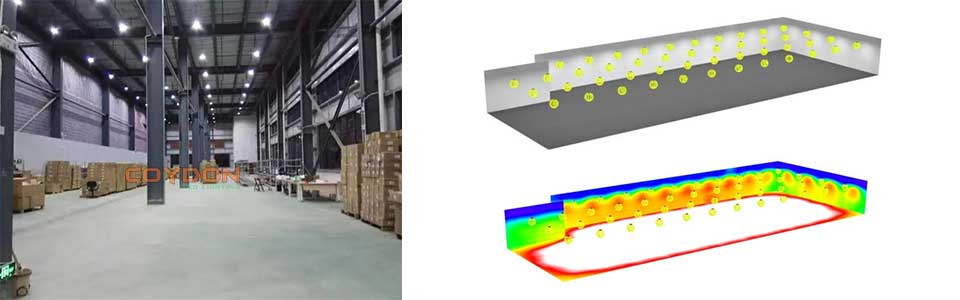
The calculation report: UFO LED high bay lights 150 watt x 46 piece ( Project 02 )
| Engineering metrics: | Project simulation values | Operational & safety impact |
| Fixture model: | Coydon 150W UFO LED High Bay | High-efficiency flagship hardware choice |
| Quantity deployed: | 46 pieces | Precision grid deployment via DIALux planning |
| Fixture unit wattage: | 150W | Direct solid-state replacement for legacy lamps |
| Total network power draw: | 6,729.8W | Controlled system load optimizes plant utility budget |
| Light loss factor (LLF): | 0.8 | Accounts for dust; ensures safe long-term lux levels |
| Total luminous flux: | 1,013,803 lumens (lm) | Massive light volume provides intense spatial clarity |
| Average workplane illuminance: | 338 lx (278 lx direct + 60 lx indirect) | Balanced surface bounce eliminates harsh shadows |
| Average floor illuminance: | 329 lx | High-penetration arrays exceed safety standards |
| Light uniformity: | Excellent (Close workplane-to-floor alignment) | Prevents sudden pupillary changes for forklift drivers |
| Visual blind spots: | 0% (Completely eliminated) | Clear visibility from high rack tiers down to asphalt |
Photometric simulation software removes guesswork from large-scale industrial illumination planning. A recent real-world engineering project demonstrates this mathematical precision clearly. This engineering case study focuses on a modern high-clearance distribution facility. The logistical property required uniform light levels across extensive horizontal and vertical surfaces. To achieve this objective, developers abandoned legacy discharge lamps. They implemented a comprehensive solid-state upgrade utilizing premium commercial hardware instead.
The project layout involved the strategic installation of 46 pieces of Coydon Lighting UFO LED high bay fixtures. Engineers specified the high-efficiency 150-watt model for this specific property footprint. Technicians mapped the physical placement points carefully within the DIALux simulator. This calculated arrangement ensures total spatial coverage across active forklift pathways. It creates an optimized grid that eliminates dark storage gaps entirely.
Furthermore, the entire industrial network demonstrates exceptional electrical efficiency. The total system load measures exactly 6,729.8 watts under full operating conditions. Engineers applied a strict light loss factor of 0.80 for all layout calculations. This conservative value accounts for future environmental dust accumulation over time. It guarantees the facility maintains safe illumination levels during years of continuous operations.
Most importantly, this hardware configuration delivers massive luminous output across the plant. The high-performance system projects a total luminous flux of 1,013,803 lumens. This immense light volume provides intense clarity across deep shelving aisles. Floor crews can read tracking labels easily without experiencing eye fatigue. This case study proves that targeted directional optics maximize workplace safety. Selecting premium solid-state hardware secures long-term operational success for logistics enterprises.
6.1 Uniformity and lux levels
Analyzing raw data from the DIALux software reveals the true defensive power of intentional optical planning. The comprehensive photometric evaluation provides precise verification for this 150-watt system deployment. According to the official project report, the target warehouse workplane achieved an outstanding average illuminance of 338 lux. The software breaks this total down into 278 lux of direct illumination. Additionally, internal surface bounce contributes 60 lux of indirect reflected light. This active reflection proves that high-performance engineering utilizes wall and ceiling surfaces to soften harsh shadows effectively. It turns secondary surfaces into auxiliary light emitters.
Furthermore, the actual facility floor area maintains an impressive average reading of 329 lux. This close statistical alignment between the workplane and the ground level confirms exceptional light uniformity. Achieving these specific luxury targets proves that Coydon fixtures deliver intense structural penetration. The focused light arrays pass through dense racking rows without losing significant volume. This high uniformity prevents sudden pupillary changes for forklift operators moving down long aisles. It minimizes temporary visual adaptation delays during high-speed material handling. This data reassures commercial buyers that the hardware performs flawlessly under demanding field conditions.
Consequently, this scientific layout guarantees perfect spatial coverage from the top rack tiers down to the asphalt. It completely eliminates dark operational zones and dangerous visual blind spots between storage bays. This high-uniformity layout exceeds international industrial safety standards for modern logistics facilities comfortably. Workers can safely navigate heavy forklifts and read inventory manifests without experiencing eye strain. This layout eliminates the inter-reflection shadows caused by tall, bulky storage obstacles. Partnering with Coydon grants warehouse operators access to verified engineering solutions that secure long-term productivity.
7. Case study 2 & technical head-to-head: 200w UFO LED vs. 400w metal halide (MH)
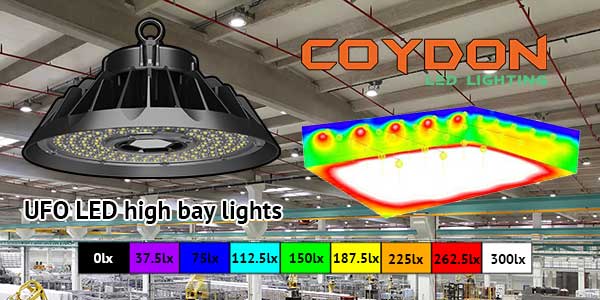
The Dialux Report:
30 PCS 200 Watt UFO LED high bay lights

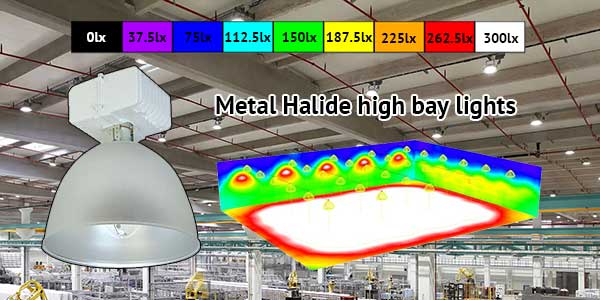
The Dialux Report:
30 PCS 400 Watt Metal Halide high bay lights
| Technical metrics: | Traditional 400W metal halide (MH) | Coydon 200W UFO LED high bay | Performance impact |
| Lamp wattage: | 400W | 200W | 50% direct reduction |
| Ballast power draw: | 50W+ (Magnetic ballast loss) | 0W (High-efficiency driver) | Eliminates parasitic energy waste |
| Total system power draw: | 450W+ per fixture | 200W per fixture | Slashes total consumption over 50% |
| Total layout power (30pcs): | 13,500W+ | 6,000W | Saves thousands on monthly electric bills |
| Optical efficiency: | Low (70% or less due to bounce loss) | High (Exceeds 96%) | Directs all lumens straight to the floor |
| Light distribution: | 360°Omnidirectional | Focused directional lens | Eliminates internal reflector shadows |
| Ground lux levels: | Baseline standard | Significantly higher | Superior structural penetration |
| Light uniformity: | Poor (Creates dark zones) | Excellent (High-uniformity) | Eliminates dangerous visual blind spots |
| Color rendering index (CRI): | Low (Deteriorates over time) | High CRI rating | Improves critical color identification |
| Thermal output: | High (Acts like an industrial heater) | Low (Cold light source) | Minimizes warehouse HVAC cooling loads |
Direct physical testing highlights the massive efficiency gap between legacy discharge lamps and modern solid-state hardware. Traditional warehouse systems rely heavily on 400-watt metal halide fixtures for high-ceiling illumination. However, engineering assessments reveal that a standard 400-watt bulb requires a magnetic ballast to regulate current. This legacy ballast consumes a significant amount of secondary electrical energy during regular operation. Consequently, the actual real-world power draw of a single metal halide fixture often exceeds 450 watts. This hidden energy drain drives up monthly utility expenses quietly across massive industrial sectors. It creates a continuous financial burden for facility managers.
Furthermore, traditional metal halide bulbs suffer from severe optical design limitations. These old lamps feature an omnidirectional 360-degree light source configuration. This design forces emitted lumens to bounce repeatedly inside a large aluminum reflector hood. A massive percentage of this light gets trapped, absorbed, or misdirected before escaping the housing. This multiple internal reflection issue lowers the overall system efficiency to an ineffective 70% or less. This optical scattering wastes extensive power while generating massive amounts of ambient thermal waste within the storage facility. It constantly overburdens your warehouse cooling systems.
To solve this problem, a comprehensive DIALux simulation evaluated a direct one-to-one engineering replacement strategy. The technical assessment compared 30 pieces of traditional 400-watt metal halide fixtures against 30 pieces of Coydon Lighting 200-watt UFO LED high bays. The physical results from this comparative project report show a complete operational transformation. The new 200-watt solid-state network drops total facility power consumption by more than 50% instantly. This targeted upgrade slashes thousands of dollars from the monthly plant operational budget smoothly. It optimizes long-term corporate energy performance.
Most importantly, the 200-watt UFO LED high bays deliver superior on-site lighting metrics across the floor. Coydon LED fixtures achieve an exceptional system optical efficiency rating exceeding 96%. Advanced directional lenses project lumens straight down into active aisles, eliminating reflector bounce losses completely. The data confirms that ground-level lux levels, overall light uniformity, and color rendering index metrics surpass the old metal halide setup completely. High color rendering index values greatly improve critical color identification for workers handling hazardous electrical wiring. It helps warehouse staff read vital safety warning signs accurately under fast pacing conditions. Choosing this advanced commercial hardware maximizes workplace safety while delivering immediate financial return on investment.
7.1 The strategic value of a DIALux simulation report
Industrial facility buyers must never rely on guesswork when planning expensive overhead illumination upgrades. Blindly purchasing commercial fixtures without verification often leads to dark work zones and severe operational layout mistakes. To eliminate this risk, modern project managers utilize professional photometric modeling software before committing financial capital. Presenting detailed charts and spatial grid data provides clear verification for your specific industrial floor configuration. It shifts procurement from speculative estimation into exact mathematical assurance.
Coydon Lighting goes beyond simply manufacturing and distributing heavy-duty industrial fixtures. The enterprise possesses advanced technical capabilities to generate custom DIALux simulation reports for every unique property footprint. These engineering documents analyze mounting heights, wall reflectance, and racking obstacles accurately. This specialized service allows international buyers to preview the real-world lux levels and light uniformity with absolute certainty. You can inspect every aisle footprint on paper prior to shipping the physical inventory.
Consequently, having a precise virtual rendering guarantees successful project completion without unexpected field errors. Industrial procurement teams gain total control over their purchasing journey, eliminating costly post-installation modifications. This technical asset confirms that your facility completely satisfies modern workplace safety standards before installation begins. Investing in verified technical planning protects your corporate capital and secures highly productive distribution hubs seamlessly.
8. Engineering excellence: Inside the Coydon KD-HBD series
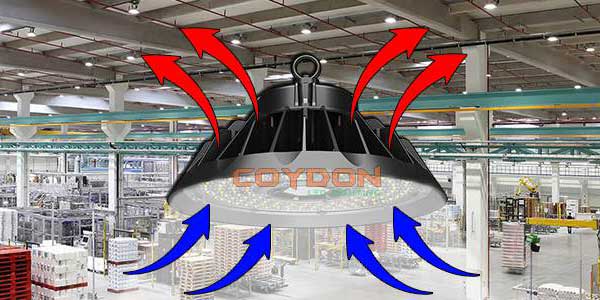
The Coydon Lighting flagship KD-HBD series UFO LED high bay embodies industrial-grade structural perfection. Engineering procurement departments demand proven component superiority when upgrading heavy manufacturing landscapes. This specialized product family incorporates elite physical properties designed to outlast traditional discharge networks comfortably. Examining the internal hardware architecture reveals why this rugged system serves as the definitive standard for severe logistics environments. It sets a new baseline for heavy-duty commercial illumination platforms.
A primary technical milestone involves its exceptional luminous efficacy rating of 150 lumens per watt. This optimized high-output index means the fixture converts electrical power into visible light with minimal heat loss. For warehouse owners, higher efficacy translates directly into delivering maximum floor brightness using significantly less wattage. Under identical luxury target requirements, this efficiency cuts the total quantity of fixtures required for installation. Buying fewer lamps lowers your initial purchasing expenditure and slashes electrical contracting labor costs simultaneously.
Furthermore, harsh industrial applications demand extreme physical protection against continuous environmental threats. The KD-HBD series utilizes a premium die-cast aluminum integrated heat sink for superior thermal management. This specialized metal shell draws destructive heat away from sensitive chips instantly, preventing early lumen depreciation. Additionally, the rugged housing satisfies rigorous IP65 waterproof and dustproof safety standards securely. This tight sealing ensures stable, uniform operations inside heavily airborne dust or high-moisture production zones.
Finally, severe workplace footprints require structural resilience against unexpected mechanical impacts. The flagship series boasts a certified IK08 impact resistance rating across its entire optical lens configuration. This protective reinforcement shields internal light components from accidental forklift contact or swinging material hazards. The thick polycarbonate shield prevents shattering, keeping your production floors safe from broken debris. Investing in this advanced engineering gives global enterprises a dependable, maintenance-free lighting asset that continuously protects corporate bottom lines.
9. Future-proofing with smart controls: Microwave motion sensors & 1-10v dimming
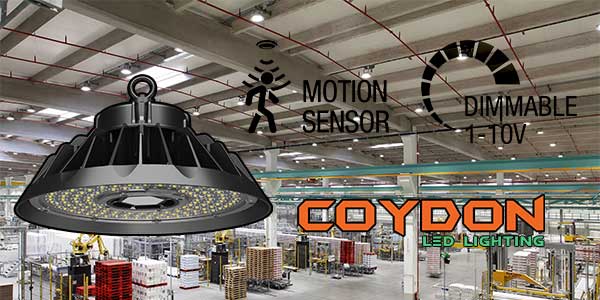
Modern logistics hubs do not require maximum high-intensity output throughout a continuous 24-hour cycle. Automated warehouses running AGV systems or low-frequency storage aisles often remain empty for extended operational blocks. Keeping overhead high bay networks running at full capacity across these unoccupied zones wastes massive capital. Smart enterprise facilities require adaptable control infrastructure to eliminate this ongoing electrical waste. Advanced facilities must integrate interactive sensor networks to maintain profitable utility budgets over time.
To address this challenge, the Coydon KD-HBD series can choose microwave motion sensors or 1-10V dimming hardware. Microwave detection mechanisms offer significant performance upgrades over older passive infrared systems. Traditional PIR hardware relies entirely on heat differentials, failing frequently under fluctuating factory temperatures. Conversely, advanced microwave technology emits high-frequency radar waves to capture fine physical movements effortlessly. These radar waves penetrate thin non-metallic packaging materials, eliminating typical tracking blind spots completely. This superior mechanism reads structural activity over far wider operational scanning areas securely.
This technical integration supports a highly efficient bi-level power output protocol during daily warehouse shifts. When a material handler or automated forklift enters an inactive aisle, the sensor detects movement instantly. The hardware triggers an immediate transition, shifting the fixture up to full illumination speed. Workers receive perfect visual clarity precisely when and where active logistics tasks occur. The responsive grid ensures maximum visibility during critical loading actions without any annoying operational lag.
Once the technician or AGV clears the detection zone, the 1-10V dimming framework initiates automatically. Instead of shutting off completely, the high bay unit dims down gracefully to a low standby level. The system maintains a safe baseline brightness ranging from 10% to 30% power output. Operating at this reduced standby level lowers driver component temperatures significantly, extending capacitor lifespan. This strategic low-light policy preserves basic facility safety while slashing secondary energy costs permanently. Implementing these smart sensory controls drops commercial utility bills down to an absolute minimum level safely.
10. Conclusion: Making the strategic investment in your facility’s future

Upgrading your industrial infrastructure to premium UFO LED high bays represents more than a basic maintenance expense. Forward-thinking executives view this comprehensive illumination overhaul as a highly lucrative capital asset acquisition. The strategic implementation of modern solid-state technology secures immediate operational benefits across your commercial property layout. These advanced high-efficiency fixtures slash ongoing power consumption while practically eliminating recurring hardware replacement labor.
Consequently, industrial enterprise buyers rapidly capture massive utility budget savings following project completion. These continuous energy reductions allow businesses to recover their initial procurement capital exceptionally fast. Lower utility payments transform a standard facility upgrade into a verified, high-ROI corporate investment. Choosing Coydon Lighting safeguards your warehouse workflow and establishes long-term financial profitability for decades to come.
10.1 Request your custom DIALux simulation

Industrial project planners should never risk their operational capital on speculative illumination setups. Blindly guessing your factory wattage or high bay fixture quantities leads to expensive workplace mistakes. Instead, contact the veteran lighting engineering specialists at Coydon Lighting immediately to secure verified structural planning. Our design department stands ready to develop a highly detailed, custom DIALux simulation report for your facility. This specialized digital blueprint maps out your entire commercial layout to guarantee optimal lux performance.
Securing this comprehensive project evaluation requires minimal setup effort from your corporate management team. You simply need to provide our technicians with basic property dimensional data. Share your exact warehouse total area, length, width, and clear ceiling mounting height. Additionally, inform our engineering staff about your specific target illuminance goals or local warehouse safety regulations. Our optimization software processes these inputs to establish a perfectly balanced, custom layout configuration for your brand.
Take complete control over your upcoming industrial facility upgrades right now. Click the designated “Inquiry Now” button on our official website to submit your current project specifications. Our dedicated technical support crew will analyze your data footprint to deliver your complimentary modeling report quickly. Stop wasting enterprise capital on inefficient legacy energy expenses. Let Coydon Lighting engineer a highly productive, sustainable, and perfectly illuminated future for your logistics hub today.