100W vs. 150W vs. 200W vs. 240W: A Warehouse Wattage Comparison Guide

Table of Contents
1. Stop Guessing Your Warehouse Wattage
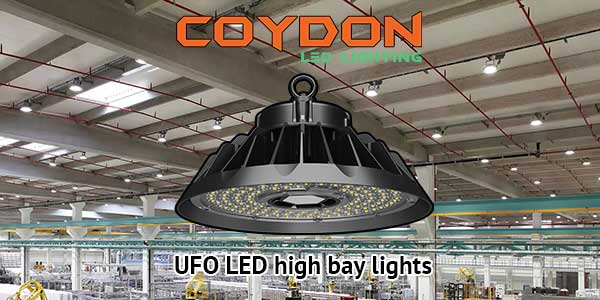
Picking the wrong wattage costs real money. I have seen it happen again and again. Some buyers go too low. Their 100W lights can’t reach the floor from 30 feet up. So they add more fixtures. That doubles the installation cost. It also adds more labor time. Other buyers go too high. They put 300W lights in a 15-foot ceiling. The glare is terrible for workers. People complain about headaches. Electricity bills go up by thousands. One warehouse paid $8,000 extra per year. That was just from oversized LEDs. Another owner used 100W at 30 feet high. His floor looked dark like a basement. He had to buy 20 more lights. Both problems come from guessing. You do not need to guess. You just need the right wattage for your height.
This guide compares four wattages side by side. We look at 100W, 150W, 200W, and 240W. You will learn the best ceiling height for each one. You will see typical lux on your work plane. Lux is the measure of brightness on the floor. You will get spacing tips for your layout. Good spacing means no dark spots between lights. We also show real savings of LED versus metal halide. One test shows 51% less energy use. That saves about $3,100 every year. You will also learn about free Dialux simulations. A Dialux report removes all the guesswork. It shows exactly how many lights you need. It shows where to put each fixture. It shows the expected uniformity. No more trial and error. Just hard data from a real lighting engineer. That is what smart buyers ask for.
Coydon Lighting makes professional UFO LED high bays. Our lights give you 150 lumens per watt. That is top efficiency for warehouses and barns. Cheap LEDs only give 100 to 120 lumens per watt. So our 150 means you buy fewer fixtures. It also means lower electricity bills every month. We also offer microwave sensors as an option. These sensors dim the light when no one moves. You save another 30% to 50% on energy. That adds up fast. We offer 1-10V dimming too. That lets you adjust brightness for different tasks. You can run full power during peak hours. Then dim down for overnight security lighting. Best of all, we give free Dialux simulations. Just send us your room size and ceiling height. Tell us your target lux if you know it. We will send a full lighting plan within 24 hours. No charge. No obligation. Just real help for your project. That is how we earn long-term customers.
2. Why Wattage Alone Is a Lying Number
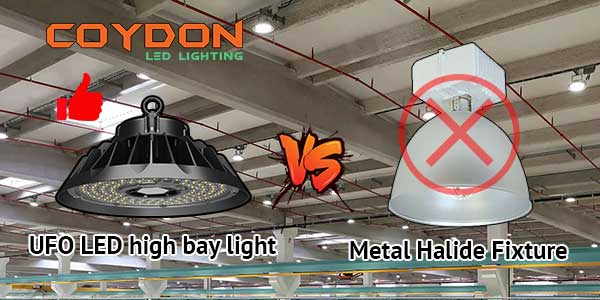
Watts do not equal brightness. That is an old habit from the past. Old lights like metal halide were all similar in efficiency. So higher watts meant more light back then. But LEDs changed everything. Today, two different LED lights can use the same watts but give very different brightness. You need to look at lumens per watt. That number is called efficacy. It tells you how much light you get for each watt of power. A high efficacy means more light for less electricity.
Coydon Lighting UFO LED high bays deliver 150 lumens per watt. That is excellent for industrial lighting. Now compare that to old metal halide lights. A typical 400W metal halide fixture only gives about 70 lumens per watt. That means 28,000 total lumens (400 x 70). Our 200W LED gives 30,000 lumens (200 x 150). The LED uses half the watts. But it produces more light. That is the power of high efficacy. You get better brightness and lower bills at the same time. No trade-off.
Here is a quick comparison table:
| Light Type: | Power: | Lumens per Watt: | Total Lumens: |
| Metal Halide high bay light | 400 Watt | ~70 lm/W | ~28,000 lm |
| Coydon UFO LED high bay light | 200 Watt | 150 lm/W | ~30,000 lm |
The LED saves 200 watts per fixture. It also gives 2,000 more lumens. That is a win-win.
Now let us talk about too much light. Some people think more light is always better. That is not true. Over-lighting causes glare. Glare makes workers squint all day. That leads to eye strain and headaches. Workers feel tired faster. Safety also drops because glare hides shadows. And you waste electricity on light you do not need. Over-lighting is expensive and uncomfortable.
Too little light is also bad. Dark aisles cause picking errors. Workers grab the wrong item. That hurts inventory accuracy. Dark areas also hide trip hazards. Accidents happen more often. Workers feel unsafe. So you need the right amount of light. Not too much. Not too little. Just enough for the task. That is the sweet spot.
There is one more rule you must understand. It is called the inverse square law. It sounds complex but it is simple. When you double the mounting height, the light on the floor drops to one fourth. For example, a light at 10 feet gives 100 lux on the floor. Move that same light to 20 feet high. The floor now gets only 25 lux. That is a huge drop. So a 150W light at 15 feet works great. But at 30 feet, the same light will look dim. You need higher wattage or more fixtures. This is why ceiling height is the first thing you measure. It decides your wattage range. No way around it.
That is the core logic of this whole guide. Different heights need different wattages. You cannot use a 100W light for a 40-foot ceiling. And you should not use a 240W light for a 12-foot ceiling. Match the wattage to your height. Then you get good brightness without waste.
3. Coydon Lighting UFO LED High Bay Series
100 Watt
KD-HBD-W100-1
Ø248mm X 129mm
150 Watt
KD-HBD-W150-1
Ø295mm X 140mm
200 Watt / 240 Watt
KD-HBD-W200-1 / KD-HBD-W240-1
Ø320mm X 154mm
| Input Voltage: | AC 90V – 305V |
| Colour Temperature: | 3000K / 4500K / 6000K |
| Color Rendering Index: | 80+ |
| LED Type: | LED SMD 2835 ( OSRAM ) |
| IP Grade: | IP65 |
| Material: | Aluminium + PC Lens |
| Luminous Efficiency: | 150 Lumens per watt |
| Beam Angle: | 60° / 90° / 120° |
| Warranty: | 5 Years |
| Mounting Height: | 100 Watt: 15–20 ft (4.5–6 m) 150 Watt: 20–30 ft (6–9 m) 200 Watt: 30–40 ft (9–12 m) 240 Watt: 40–50 ft (12–15 m) |
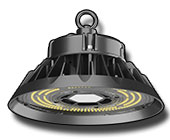
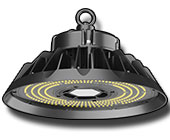
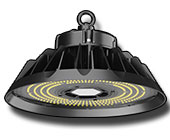
We have four UFO LED high bays. They come in 100W, 150W, 200W, and 240W. All of them are built the same way. Only the power and size change. The 100W unit is Ø248mm x 129mm. The 150W is Ø295mm x 140mm. The 200W and 240W share a bigger housing. That one is Ø320mm x 154mm. Bigger wattage needs more metal to cool down. Makes sense, right?
All four run on AC 90V to 305V. So they work in the US, Europe, and Asia. Pick your color temp. You can get 3000K, 4500K, or 6000K. CRI is 80+ across the board. That means colors look natural. IP65 rating means no dust gets in. Rain or hose spray won’t hurt them either. You also get to choose the beam angle. 60° is for long and narrow aisles. 90° is what most warehouses use. 120° is for wide open spaces with low ceilings. Every light has a 5-year warranty. No fine print tricks.
Here is what matters most. Every wattage uses the same good parts. The LED chips are OSRAM SMD 2835. OSRAM is a real brand from Germany. The housing is aluminum. Aluminum pulls heat away. That keeps the LEDs cool and happy. The lens is PC, not cheap plastic. It won’t turn yellow after two years. And every model hits 150 lumens per watt. So a 100W light puts out 15,000 lumens. A 200W light puts out 30,000 lumens. No funny math. What you see is what you get.
You can also add two smart features. First is a microwave motion sensor. It dims the light when nobody moves. You save another 30% to 50% on power. Second is 1-10V dimming. That lets you hook up to a switch or a computer. Turn the lights up during the busy shift. Turn them down at night for security. Both options work on any wattage. So here is the bottom line. Pick the wattage you need. The quality does not change. No matter which one you choose, you get the same reliable light. That is how Coydon Lighting does things. We don’t cut corners on the small ones.
4. Which Wattage for Your Ceiling Height?
4.1 100W UFO LED high bay light – Ideal for 15-20 ft (4.5-6 m) Ceilings
100 Watt
KD-HBD-W100-1
Ø248mm X 129mm
Let us start with the smallest one. The 100W UFO LED high bay is made for lower ceilings. Think 15 to 20 feet high. That is about 4.5 to 6 meters. Where do you use this model? Small warehouses work well. I am talking about spaces under 2,000 square feet. Retail stores are a good fit too. Think about a tractor supply shop or an auto parts store. Barns and stables also work great. The light is bright but not blinding for animals. Even underground parking garages use this wattage. Any place where the ceiling is not too tall. If you can almost touch the ceiling with a ladder, go with 100W.
What brightness can you expect? On the work plane, you get about 150 to 200 lux. That is plenty for most tasks. Walking around is easy. Reading labels is no problem. Finding boxes on pallets works fine. Not too bright. Not too dark. Just right for general use. Some people ask for 300 lux. But at 15 feet, 300 lux can feel harsh. Stick with 150 to 200 for comfort.
Now let us talk about spacing. Put your lights in a grid pattern. Keep them 8 to 10 feet apart. That is about 2.5 to 3 meters. This spacing gives you even light. No dark spots between fixtures. What beam angle should you pick? Go with 90° or 120°. The wider angle spreads light better at lower heights. One more tip. If you have tall shelves in a small warehouse, think about 60°. That narrow beam focuses light down the aisles. It reaches the bottom shelves better. But for most 15-20 ft ceilings, stick with 90° or 120°. You will be happy with the result. Try one sample light first. Hang it up and see. That is the best way to be sure.
4.2 150W UFO LED high bay light – The Sweet Spot for 20-30 ft (6-9 m) Ceilings
150 Watt
KD-HBD-W150-1
Ø295mm X 140mm
Now we get to the most popular size. The 150W UFO LED high bay is what most people buy. It works for ceilings from 20 to 30 feet high. That is about 6 to 9 meters. Where should you put this model? Medium sized warehouses are a perfect fit. Think 5,000 to 15,000 square feet. Manufacturing shops use them a lot. So do shipping and receiving centers. Any space where people work under high ceilings.
How bright is it? You get about 200 to 300 lux on the floor. The exact number depends on your spacing. Tighter spacing gives more lux. Wider spacing gives less. But 200 to 300 lux handles most jobs well. Picking orders, checking labels, moving pallets. All good.
Spacing is simple. Put your lights 12 to 15 feet apart. That is about 3.7 to 4.6 meters. Use a grid layout again. This keeps the light even across the whole floor. What beam angle works best? For open areas, pick 90°. That is the standard for a reason. It gives good spread without losing too much brightness. If you have long aisles with tall racks, go with 60°. The narrow beam shoots straight down the aisle. It lights up the bottom shelves nicely. The 150W is the sweet spot. Not too small for 30 foot ceilings. Not too big for 20 foot ceilings. It just works.
4.3 200W UFO LED high bay light – High-Bay Powerhouse for 30-40 ft (9-12 m) Ceilings
200 Watt
KD-HBD-W200-1
Ø320mm X 154mm
Now we move up to serious power. The 200W UFO LED high bay is for tall ceilings. We are talking 30 to 40 feet high. That is about 9 to 12 meters. Where do you need this? High bay warehouses with tall racks. Large distribution centers. Even indoor stadiums and gyms. Any place where the roof feels far away.
How bright is the floor? You get about 250 to 350 lux. That is plenty for stacking pallets high up. Forklift drivers will see clearly. No dark shadows between racks. Spacing matters here. Put your lights 15 to 20 feet apart. That is about 4.6 to 6 meters. A square grid works best. But you can also align them with your aisles.
Here is the best part. This 200W LED directly replaces old 400W metal halide lights. You get the same brightness. Sometimes even brighter. But you use less than half the electricity. That means your payback is fast. Usually one to two years. After that, you are just saving money every month. What beam angle should you pick? For open floor areas, go with 90°. For long narrow aisles with high racks, pick 60°. The narrow beam cuts down into the aisle. It lights up the bottom shelves too. The 200W is a workhorse. It does not mess around.
4.4 240W UFO LED high bay light – Extreme Heights (40-50 ft / 12-15 m)
240 Watt
KD-HBD-W240-1
Ø320mm X 154mm
Now we go to the biggest one. The 240W UFO LED high bay is for extreme heights. Think 40 to 50 feet up. That is about 12 to 15 meters. Where do you see ceilings this high? Very tall warehouses. Airplane hangars. Large exhibition halls. Places where a normal ladder won’t reach.
What brightness can you expect? About 250 to 300 lux on the floor. That is solid for such a high ceiling. But you need the right beam angle. Do not use 90° or 120° up here. They spread light too wide. The floor will look dim. You must pick 60°. That narrow beam shoots straight down. It keeps the light focused where you need it.
Spacing is also different. Put your lights 18 to 22 feet apart. That is about 5.5 to 6.7 meters. Any wider and you get dark spots. Any tighter and you waste money. Stick with a grid pattern. Align the fixtures with your main aisles if you have them.
One more thing. If your ceiling is above 50 feet, do not guess. Contact us for a free Dialux simulation. We will design it for you. No charge. Just send us your room size and height. We will tell you exactly how many lights you need. That is the smart way to do extreme heights. The 240W is a beast. But only if you use it right.
5. What Coydon Lighting Can Save You (With Data You Can Trust)
5.1 150W UFO LED high bay light Case Study – 338 Lux on an 8m Ceiling, Uniformity 0.389
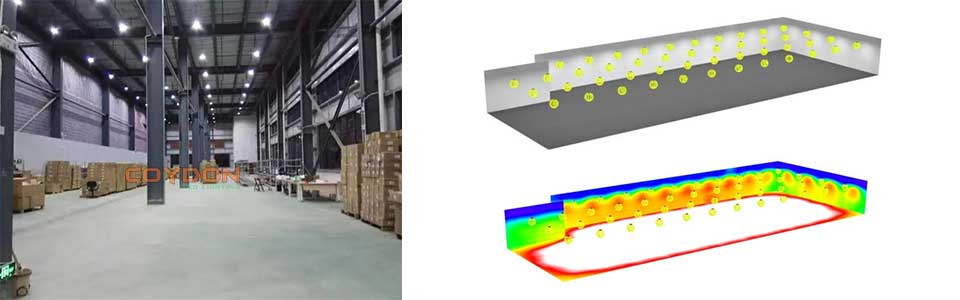
The calculation report: UFO LED high bay lights 150 watt x 46 piece ( Project 02 )
Let me show you a real project we worked on. A customer asked us to design lighting for their warehouse. The ceiling was 8 meters high, about 26 feet. We ran a Dialux simulation using 46 of our 150W UFO LED high bays. The average illuminance on the work plane was 338 lux. That is a solid number. Most warehouses only need 200 to 300 lux for normal tasks. The minimum was 131 lux. That means even the darkest spot is still bright enough. No dark corners under shelves. No shadows that hide pallets.
Now let me explain uniformity. It shows how even the light is across the floor. Perfect uniformity is 1.0, but that never happens in real life. Industry standard for warehouses is 0.33 or higher. Our simulation gave 0.389, which beats the standard. Workers will not walk from a bright area into a dark area. Everything looks smooth. That reduces eye strain and makes forklift driving safer. This simulation was done with Dialux, the same software professional engineers use worldwide. You can take our report to your contractor. They will trust it because it comes from real data, not guesses.
We also provide a pseudo-color map with every simulation. That map uses colors to show brightness levels. Red is bright. Blue is dark. You can see at a glance if your layout works. Want the same for your warehouse? Send us your ceiling height and floor dimensions. We will run a free Dialux simulation for you. No charge. No obligation. You get a PDF report you can use for bidding or installation. That is how we help customers light their spaces the right way.
5.2 200W UFO LED high bay light vs. 400W Metal Halide high bay light – 51% Energy Cut, Same Brightness
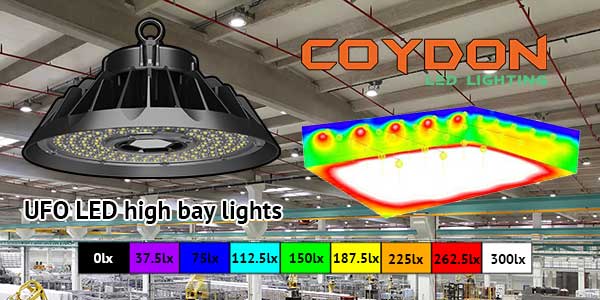
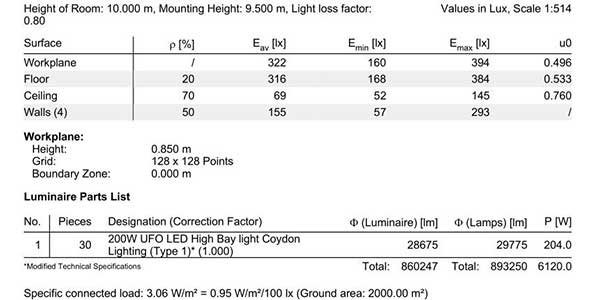
PDF file: 30 PCS 200 Watt UFO LED high bay lights
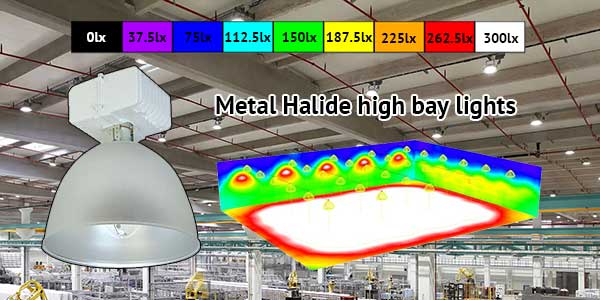
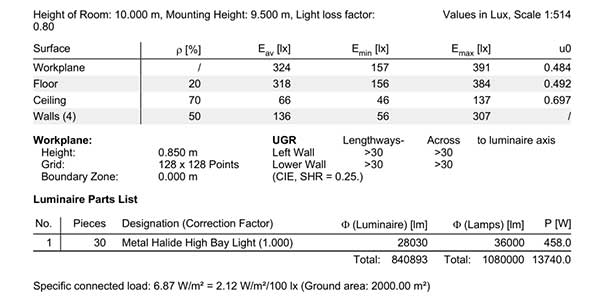
PDF file: 30 PCS 400 Watt Metal Halide high bay lights
Here is a real head to head test we ran. We compared our 200W LED against a 400W metal halide. Same warehouse. Same layout. The room was 50 meters by 40 meters. Ceiling height was 10 meters, about 33 feet. Mounting height was 9.5 meters. We used 30 of each light in the exact same positions. Then we measured the brightness on the work plane. The results came back, and they surprised some people.
The 200W LEDs gave 322 lux. The 400W metal halides gave 324 lux. That is a difference of only 2 lux. You will never see that with your eyes. So the LED matches the old light perfectly. But here is where it gets good. Total LED power was 6.73 kW. Total metal halide power was 13.74 kW. That is more than double. The LED saves 51% of the energy. Half the electricity for the same amount of light.
Let me do the math for you. Assume electricity costs $0.12 per kWh. That is about average in the US. Run the lights 12 hours a day, 312 days a year. That is a typical warehouse schedule with some weekends off. The metal halide costs $6,175 per year to run. The LED costs $3,025 per year. You save over $3,100 every single year. And that is just for 30 lights. A larger warehouse with 100 lights saves over $10,000 per year.
The LED also lasts much longer. Metal halide bulbs lose brightness after one year. You have to replace them every 12 to 18 months. That costs labor and parts. Our LEDs run for 50,000 hours or more. That is 10+ years of normal use. No bulb changes. No ballasts to fail. Just install them and forget about them. Want to see the full Dialux report for this test? Just ask us. We will send you the PDF. Then you can show your boss or your customer. Real numbers. Real savings. No tricks.
5.3 How to Get Your Own Free Dialux Report
You might be wondering, what is Dialux? It is a professional lighting design software. Engineers use it to simulate real light performance. No guessing. No math errors. Just accurate predictions of brightness and uniformity. Why does Coydon Lighting offer this for free? Because we want you to make the right choice. Even if you do not buy from us, you get a useful report. We believe good data builds trust. And trust builds long term relationships. Many customers come back years later because we helped them first.
Here is what you need to send us. Your room length and width. Your ceiling height. Your target lux if you know it. A simple sketch of your rack layout helps too. We take that information and run the simulation. You get a full PDF report. It shows the exact number of lights you need. It includes a layout drawing with positions. You get a pseudo color map of brightness. Red is bright. Blue is dark. You also get uniformity numbers and an energy table. So here is your next step. Click the “Inquiry Now” button. Attach your floor plan or just type in your room size. We will send you a free Dialux PDF report within 24 hours. No charge. No obligation. Just real help for your project.
6. Smart Features That Push Savings Even Further – Microwave Sensor And 1-10V Dimming
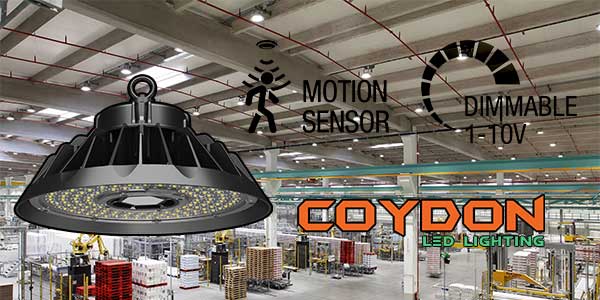
6.1 Microwave Motion Sensor – Up to 50% More Energy Savings
You already save money with our high efficiency LEDs. But you can save even more with a microwave motion sensor. How does it work? The sensor detects movement using radio waves. It goes through plastic and thin walls. When someone walks in, the light turns to 100% brightness. When no one moves for a set time, it dims down. The dim level is 10% to 30% of full power. That is just enough for security cameras. Not enough to waste electricity. When someone comes back, it jumps to 100% instantly. No delay. No flicker.
Where should you use this? Warehouses with low traffic. Storage areas where people come and go. Long aisles in cold storage. Break rooms, restrooms, and offices. Any place that is not busy 24 hours a day. The sensor pays for itself fast. Let me show you the math. A normal warehouse runs lights 12 hours per day. But people are only there for 4 hours of active work. The other 8 hours, the space is empty. With a sensor, you run full power for 4 hours. Then dim to 20% for 8 hours. That cuts your energy use by about 55%. Some customers report 60% savings. The sensor works on all our wattages. 100W, 150W, 200W, and 240W. Just ask us to add it to your order. It is a small upgrade with a big return.
6.2 1-10V Dimming – Fine-Tune Your Illuminance
A microwave sensor is automatic. But sometimes you want manual control. That is where 1-10V dimming comes in. It is a standard interface for LED drivers. You connect it to a simple rotary dial. Or you connect it to a smart building system. Then you can turn the brightness up or down anytime you want. Want 100% during the busy day shift? Turn it up. Want 30% after midnight for security only? Turn it down. It is that easy. No special tools. No complex programming.
Who needs this feature? Multi purpose spaces work best. Imagine a warehouse that does picking from 8am to 6pm. Full power during those hours. After 6pm, only security cameras need light. Dim to 20% and save a lot of power. Or think about a workshop with big windows. On sunny afternoons, you do not need full brightness. Dim the lights to 50%. On cloudy days, go back to 100%. You can also connect to a building automation system. Let the computer decide based on time of day or light sensors outside. That is the most hands off approach.
All Coydon Lighting UFO LED high bays support 1-10V dimming. That means 100W, 150W, 200W, and 240W. Every model works with it. Just tell us when you place your order. We will add the dimming wires for you. There is no extra cost for the option. You just need a dial or a controller on your side. That is it. You get to control your light. And you get to control your electricity bill. Want both automatic and manual? Get the microwave sensor plus 1-10V dimming together. They work fine side by side.
7. A Simple 4-Step Framework to Choose Your Perfect Wattage
- Step 1: Measure Your Ceiling Height
Grab a tape measure or a laser meter. Measure from the floor to the ceiling. That is your mounting height. Write that number down. Then use this simple rule. If your ceiling is below 15 feet, go with 100W. From 15 to 20 feet, choose 100W or 150W. From 20 to 30 feet, pick 150W. From 30 to 40 feet, go with 200W. Above 40 feet, take 240W. If you are between two ranges, pick the higher wattage. That gives you a safety margin. Or just contact us for help. That is your starting point. Do not skip this step. Height is the biggest factor.
- Step 2: Consider Your Task And Target Lux
Different jobs need different brightness levels. General storage only needs 150 to 200 lux. That is fine for walking and finding big boxes. Picking and packing areas need 300 to 500 lux. Workers need to read small labels quickly. Fine assembly or inspection needs 500 lux or more. That is for detailed work. Here is a simple formula you can use. Total lumens needed = area in square feet times target lux. Then divide by (efficacy times maintenance factor). Efficacy is 150 lumens per watt for our lights. Maintenance factor is 0.8 for most warehouses. That accounts for dust and aging. Do not worry if math is hard. We can run a free Dialux simulation for you. Just send us your numbers.
- Step 3: Choose Beam Angle Based on Aisle or Open Area
Beam angle controls how light spreads across your floor. Open floor areas with no tall racks? Use 90° or 120°. That spreads light wide and even. It covers more area per fixture. Narrow aisles with tall shelves on both sides? Use 60°. The narrow beam shoots straight down the aisle. It lights up the bottom shelves well. It also avoids casting shadows on the racks. Pick the wrong angle and you get dark spots between fixtures. Pick the right one and everything looks smooth and bright. If you have mixed areas, you can use different beam angles in different zones. That is a pro tip.
- Step 4: Validate With a Dialux Simulation
Do not order based on a guess. Even professional electricians use software to check their designs. Coydon Lighting gives you a free Dialux simulation. We check uniformity for you. It should be 0.33 or higher. We check for dark spots on the floor. We check for glare that hurts workers’ eyes. We also check that your target lux is met. You get a PDF report with all the numbers and a color map. That map shows brightness in red, yellow, green, and blue. Red is bright. Blue is dark. You can see at a glance if your layout works. Even if you do not buy from us, use our simulation to compare different products. That is how smart buyers shop. Click the “Inquiry Now” button. Send us your room size and ceiling height. We will do the rest within 24 hours. No charge. No obligation. Just real help.
8. Stop Overpaying and Start Lighting Smarter

Let us quickly recap what we learned in this guide. 100W is for ceilings under 20 feet. Use it in small warehouses, retail shops, barns, and parking garages. 150W is the sweet spot for 20 to 30 feet. Most warehouses and manufacturing shops use this wattage. 200W handles 30 to 40 feet. It directly replaces old 400W metal halide lights. Same brightness, half the power. 240W is for extreme heights up to 50 feet. Think airplane hangars and very tall warehouses. All four share the same 150 lm/W efficiency. All are IP65 rated for dust and water. All come with a 5 year warranty. You cannot go wrong with any of them. Just match the wattage to your ceiling height.
Now here is the best part. You do not have to guess which one you need. Coydon Lighting gives you a free Dialux simulation. We design your whole lighting layout using professional software. No charge. No obligation. Just send us your room dimensions and ceiling height. Tell us your target lux if you know it. We will send you a professional lighting design within 24 hours. You will see exactly how many lights you need and where to put them. You will also get a quote, but only if you like what you see. That is how we work. No pressure. Just real help.
Thousands of warehouse owners have already switched to Coydon Lighting. They stopped overpaying for electricity. They stopped dealing with dark aisles and harsh glare. Now it is your turn. Click the “Inquiry Now” button. Tell us your warehouse dimensions and ceiling height. We will do the rest. Real data. Real savings. Real simple. Let us light your warehouse the right way.