Low Bay vs. High Bay: Which One Does Your Warehouse Need?

Table of Contents
1. The Cost of a Wrong Ceiling Lighting Choice
1.1 The 20-Foot Misconception in Warehouse Lighting
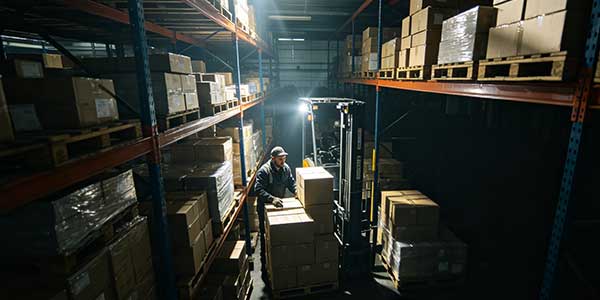
For decades, industrial buyers have relied on a rigid rule of thumb. They believe a 20-foot ceiling height is the single dividing line. If a building is called a warehouse, managers often blindly order high bay fixtures. This one-size-fits-all approach is a massive mistake for modern logistics facilities. It overlooks how modern optical engineering actually distributes lumens across a busy workspace.
Selecting lights based solely on a height number creates severe operational hazards. When you put high bay fixtures into lower clearances, intense hot spots appear. Workers experience blinding glare while looking at racking systems. Conversely, standard low bay fixtures on a high ceiling fail completely. The scattered light path fades before it ever reaches the floor.
A warehouse needs a precise balance of geometry and physics. True efficiency depends on beam angles, rack layouts, and task densities. Relying on an arbitrary 20-foot rule forces your facility into a costly compromise. You will end up with wasted energy, dark zones, or unsafe working conditions.
1.2 Why Your Warehouse Deserves More Than a “Standard” Solution
Procurement managers often treat industrial lighting as a basic, line-item commodity. They frequently rush to purchase the cheapest bulk fixtures available on the commercial market. However, this generic approach directly threatens your daily operational efficiency and long-term financial health. Installing a subpar lighting system creates a hostile environment across your entire facility.
The most immediate casualty of poor fixture selection is worker productivity. Low-grade warehouse lights often produce a high-frequency flicker that is invisible but harmful. This flicker, combined with intense unshielded glare, causes severe headaches for forklift operators. When workers experience constant eye strain, their spatial awareness and picking accuracy drop significantly. Misread labels inevitably lead to shipping delays, mixed-up orders, and expensive inventory corrections.
Furthermore, the financial penalties of choosing wrong fixtures extend far beyond the initial purchase price. Inappropriate wattages will cause your monthly industrial utility bills to skyrocket instantly. If your poorly planned layout fails local code compliance checks, you face massive secondary expenses. Tearing out newly installed units for a complete system replacement effectively doubles your labor and hardware costs.
As a professional manufacturer, Coydon Lighting views industrial illumination through an advanced engineering lens. High bay and low bay systems are not just about raw power or basic wattages. The true distinction lies in the absolute binding of spatial geometry and precision optical control. Every warehouse requires a tailored photometric approach to maximize light distribution, ensure safety, and optimize corporate financial returns.
2. Decoding Low Bay Lighting: Broad Coverage for Lower Clearances
2.1 Core Specifications: Mounting Heights and Lumen Densities
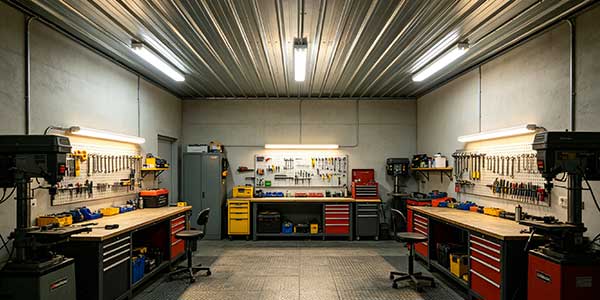
Low bay lighting has a distinct physical definition in industrial design. These fixtures are engineered for ceilings between 12 and 20 feet high. In metric terms, this range equals roughly 3.6 to 6 meters. Spaces like small workshops, packing zones, and light assembly lines typically feature these lower clearances.
Within these mounting heights, fixtures generally deliver 3,000 to 10,000 lumens of light output. This specific lumen density is ideal for low-ceiling environments. It provides sufficient brightness on work surfaces without overwhelming the eyes of your floor staff.
Maintaining moderate power levels in this zone is scientifically necessary. High clearances require intense light to pierce through deep space. However, low ceilings position the light source much closer to the human eye level.
Excessive wattages in low clearances create blinding hot spots on the floor. They also waste significant amounts of energy. Keeping lumens balanced ensures comfortable, compliant visual conditions while protecting your company from inflated utility bills.
2.2 Optical Engineering: Why Wide Beam Angles (120°) Matter
Low bay environments present a very specific optical challenge for commercial facility managers. Because the overhead clearance is structurally low, the physical distance between your lighting fixtures and the concrete floor is minimal. This severe spatial limitation forces industrial engineers to design around light dispersion rather than long-distance light punching. Achieving the necessary horizontal light spread requires an exact 120-degree wide beam angle.
A true 120-degree optical lens distributes raw lumens outward across a massive lateral surface area. In low clearance applications, this expansive spread creates a highly effective, overlapping field of illumination between adjacent fixtures. This broad distribution pattern ensures that emitted light waves reflect off side walls and inventory racks naturally. Consequently, this premium diffuse coverage eliminates dangerous geometric shadows, dark zones, and visual blind spots near the floor.
Furthermore, precise beam engineering actively prevents the problematic flashlight effect in lower work zones. Poorly designed narrow lenses push raw lumens straight down into small, highly concentrated pools of light. This compressed delivery creates intense, blinding hotspots directly underneath each lighting fixture. These localized bright spots cause immediate pupillary fatigue and severe eye strain for your active warehouse workforce.
By utilizing a uniform 120-degree distribution profile, the light path remains incredibly balanced. It smoothens out the sharp contrast boundaries between low-clearance storage aisles and active main gangways. This stable photometric environment optimizes workplace safety and delivers a predictable, highly productive industrial workspace for daily warehouse operations.
3. Demystifying High Bay Lighting: Piercing the Darkness from Above
3.1 Engineered for Heights: 20 to 40+ Feet Applications
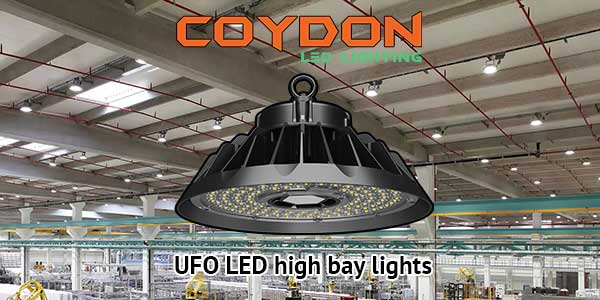
High bay lighting systems serve a very specific structural purpose in industrial architecture. These robust fixtures are explicitly engineered for expansive vertical spaces. They operate best within ceiling clearances ranging from 20 to over 40 feet. This height translates to approximately 6 to 12 meters in standard metric measurements.
Mounting fixtures at these extreme heights introduces a major physical obstacle. Light intensity naturally decreases over distance due to the Inverse-Square Law. This scientific principle dictates that usable brightness drops sharply as vertical distance increases. Consequently, a weak light source simply cannot deliver adequate illumination to the floor.
To overcome this rapid atmospheric attenuation, high bay lamps require immense raw power. These industrial units must consistently generate a high original output. They typically deliver well over 20,000 lumens per single fixture. This massive luminous volume forces the light beam downward through deep open space.
Ultimately, this heavy engineering design ensures that every lumen punches directly to the ground level. Your facility achieves the required lux levels on active work surfaces. This specific technical focus maintains maximum operational safety and visual clarity across deep vertical warehousing environments.
3.2 Advanced Beam Control: 60° and 90° Precision Lenses
High-ceiling industrial environments require strict, uncompromised control over light paths to remain energetically efficient. When you hang commercial illumination fixtures at extreme structural heights of 8 to 12 meters, standard wide-angle lenses fail completely. If your chosen light dispersion path is too broad, raw lumens scatter uselessly into upper walls and unoccupied ceiling space. According to established photometric physics, your ground-level illuminance drops sharply and exponentially over long vertical distances. This geometric scattering leaves the primary warehouse floor dim, unworkable, and highly dangerous for rapid industrial operations.
To prevent this massive waste of paid energy, advanced directional precision optics become an absolute operational necessity. Professional industrial high bay systems utilize dedicated 60-degree or 90-degree specialized optical lenses to manage light distribution. These narrow engineering configurations actively force raw, unmanaged lumens into tight, highly concentrated directional vertical columns. Instead of letting valuable light fade into empty mid-air space, these structural optics punch raw illumination directly down to the ground plane. This focused optical delivery ensures that high, compliant lux values reach your actual operational floor surfaces.
Consequently, your warehouse staff can easily read microscopic product tracking sheets, barcodes, and shipping labels anywhere. Furthermore, tighter beam control actively prevents expensive light from spilling onto the very tops of tall pallet racks. Investing in directional beam optics ultimately means buying fewer total industrial fixtures to cover your open layout. Your commercial facility achieves maximum directional target brightness while using significantly less utility power from the grid. This technical optimization establishes a highly productive industrial storage environment while keeping corporate energy overhead remarkably low.
4. Summary of Physical and Photometric Differences
| Technical Parameters | Low Bay Lighting Systems | High Bay Lighting Systems |
| Structural Mounting Height | 12 to 20 feet (3.6 to 6 meters) | 20 to 40+ feet (6 to 12+ meters) |
| Optical Beam Angles | Wide 120-degree distribution | Narrow 60-degree or 90-degree focus |
| Typical Lumen Density | 3,000 to 10,000 lumens per unit | Exceeds 20,000 lumens per unit |
| Primary Facility Application | Low-clearance workshops and packing lines | Deep vertical warehousing and bulk storage |
Selecting the correct industrial illumination framework requires a deep, comprehensive understanding of these specialized photometric variables. As structured above, the core physical differentiation extends far beyond simple wattage ratings or housing dimensions. The integration of precision-engineered optical lenses determines how effectively raw luminous flux travels through space. In lower workspaces, a wide 120-degree beam maximizes lateral reflection to keep work surfaces evenly illuminated. Conversely, high-ceiling installations must utilize tighter 60-degree or 90-degree angles to push light through heavy atmospheric dissipation.
Beyond beam mechanics, industrial operators must prioritize the Color Rendering Index (CRI) within intense distribution hubs. Professional LED lighting systems from Coydon Lighting deliver a high premium rating of CRI 80+ across all models. This superior rendering capability is absolutely vital for high-density modern warehouse environments. Standard low-CRI industrial lamps often distort subtle colors, turning dark blues, greens, and blacks into indistinguishable muddy tones. This optical distortion makes reading small printed barcodes, tracking labels, and shipping manifest sheets incredibly difficult for floor staff.
When logistics personnel operate under low-quality spectrums, their eyes must constantly straining to differentiate fine text. This constant visual accommodation triggers rapid pupillary fatigue, chronic headaches, and decreased spatial awareness during long shifts. By implementing a stable CRI 80+ high bay or low bay infrastructure, you ensure perfect visual clarity. Forklift operators can instantly identify tiny package codes from several meters away, minimizing expensive picking mistakes. This advanced photometric precision directly enhances baseline facility safety, maximizes corporate supply chain accuracy, and supports sustained worker efficiency.
5. The Costly Myth Exploded: 400W Metal Halide vs. 200W Coydon LED
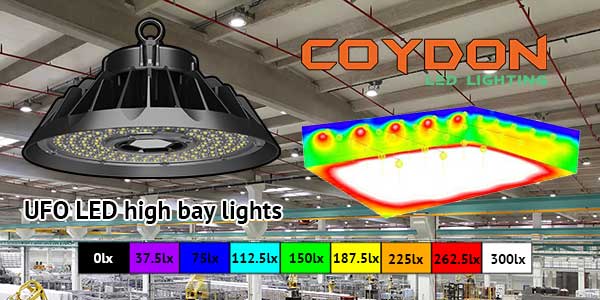
The Dialux Report:
30 PCS 200 Watt UFO LED high bay lights

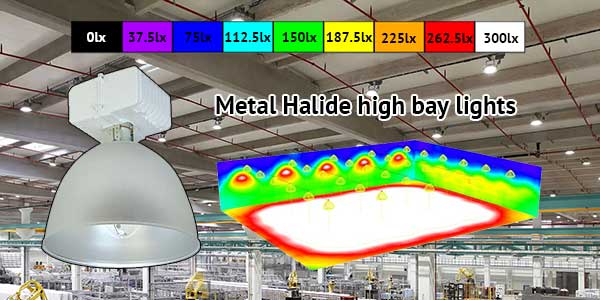
The Dialux Report:
30 PCS 400 Watt Metal Halide high bay lights
5.1 Analyzing the Efficiency Gap: Luminaire Output vs. Wasted Energy
Many generic retrofitting charts on the commercial market contain deeply misleading assumptions about high bay upgrades. These simplistic tables often suggest shifting to lower wattages based purely on mathematical guesswork. However, real industrial environments require precise, verifiable hardware data rather than superficial retail approximations. As an experienced manufacturer, Coydon Lighting relies on empirical laboratory testing to reveal true performance metrics. Our engineering team regularly audits old installations to calculate genuine, bottom-line energy losses.
The engineering flaws of a traditional 400W Metal Halide (MH) fixture stem from its basic optical construction. A standard 400W MH bulb consumes massive amounts of high-voltage electricity from your local power grid. Yet, official DIALux data sheets show a poor luminaire output efficiency (η) of only 78 percent. This low rating means nearly a quarter of all generated lumens never escape the fixture assembly. Instead, precious light waves are trapped inside the outdated, bulky aluminum reflector cone.
This trapped energy undergoes a highly destructive physical transformation within your warehouse ceiling space. The blocked light converts directly into intense radiant heat, raising ambient temperatures significantly. This thermal buildup degrades the internal ballast rapidly, causing frequent lamp failures and high maintenance fees. Furthermore, your facility facility must pay extra utility costs just to run localized air conditioning systems. Choosing cheap commercial replacements without checking true luminaire efficiency ultimately locks your business into an expensive cycle of waste.
5.2 The 1-to-1 Perfect Replacement Standard
Upgrading your industrial facility layout does not require a complex, expensive redesign of your existing ceiling grid map. Coydon Lighting establishes a rigorous engineering benchmark with our high-efficacy 200W UFO LED high bay fixture series. This advanced, heavy-duty hardware serves as a seamless, direct one-to-one replacement for obsolete, energy-draining 400W metal halide lamps. By implementing this exact system swap, your commercial facility immediately cuts its lighting energy consumption by a full 50 percent. This massive power reduction slashes your monthly operational utility expenses instantly without sacrificing any baseline ground-level floor brightness.
The scientific foundation of this massive efficiency gap lies within our advanced, precision-molded optical lens manufacturing technology. Our 200W UFO LED systems achieve an exceptional, verifiable luminaire output efficiency rating of 96 percent. This superior metric represents a massive engineering leap over old aluminum reflector cones that trap light waves inside. Furthermore, our specialized optical engineering scores exceptionally high under the rigorous international CIE flux code evaluation system. This optimization guarantees that nearly every single raw lumen produced by the premium internal LED chips escapes the solid housing properly.
Consequently, this highly controlled distribution pattern creates a much more uniform industrial light field across your concrete floor. Old 400W metal halide bulbs always project uneven, flickering pools of light separated by deep, dim shadows. In sharp contrast, our precision lenses spread a continuous stream of light evenly across active work bays and high-density racking aisles. This stable photometric distribution completely eliminates dangerous blind spots and significantly reduces worker eye fatigue during long shifts. Your facility gains perfect visual clarity, enhanced operational compliance, and permanent bottom-line energy savings from day one.
6. Real-World DIALux Simulation Case Study: A 2,400㎡ Warehouse Layout
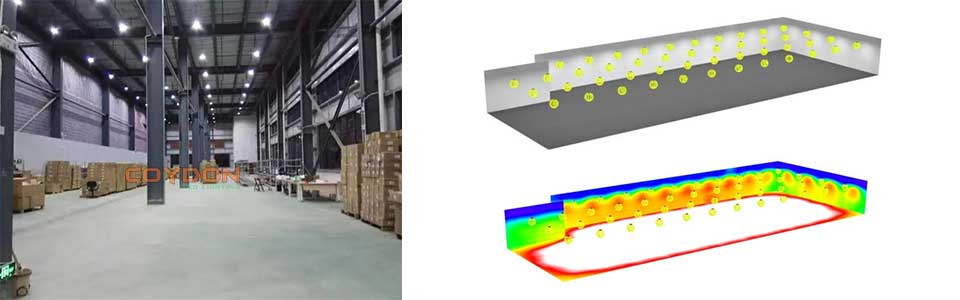
The calculation report: UFO LED high bay lights 150 watt x 46 piece ( Project 02 )
6.1 Project Background and Spatial Configuration
Demonstrating genuine engineering authority requires moving beyond basic product datasheets and abstract mathematical formulas. Professional buyers deserve verified, real-world visual proof before investing capital into bulk industrial hardware updates. To establish this high level of industrial trust, Coydon Lighting utilizes advanced DIALux software modeling. This professional optical simulation program replicates complex indoor environments with absolute geometric precision. By using this software, our engineering team eliminates all installation guesswork for global facility operators.
For this comprehensive technical case study, we configured a standard modern commercial warehouse space. The simulated building footprint features a total length of 80 meters and a width of 30 meters. This spatial layout creates a substantial, high-density industrial work zone encompassing exactly 2,400 square meters. Furthermore, the structural ceiling grid is set at a clear vertical mounting height of 10 meters. This specific architectural height represents a classic vertical environment where choosing correct lighting becomes highly critical.
Operating a storage facility within these large physical dimensions presents clear operational and photometric challenges. Standard open floor areas must be illuminated uniformly alongside dense, tall vertical pallet racking aisles. The selected industrial fixtures must possess enough raw power to pierce through a 10-meter air gap completely. Our DIALux model accounts for standard industrial surface reflection factors across the concrete floor and side walls. This precise configuration ensures that our calculated lux outputs precisely match real-world operational results.
6.2 Photometric Performance of 46 Units Coydon 150W UFO LEDs
Our advanced DIALux software simulation yields precise, empirical data for this standard 2,400 square meter warehouse layout. To illuminate the massive industrial space, the software map positions exactly 46 units of Coydon 150W UFO LED fixtures. This specialized layout creates an incredibly efficient energy footprint for the building operator. The entire facility network requires a total power consumption of only about 6.7 kilowatts. This minimal draw slashes overhead costs while delivering immense optical output to the floor.
The raw power of these premium industrial fixtures generates a combined luminous flux of 1,013,803 lumens. This massive volume of light pierces the 10-meter ceiling clearance easily to illuminate the active work zone below. Photometric calculations show the main work plane achieves a highly stable average illuminance of 338 lux. Simultaneously, the open concrete floor level maintains a reliable average brightness reading of 329 lux. These excellent light levels guarantee complete, crystal-clear visual coverage across all high-traffic warehouse zones.
Furthermore, this balanced configuration ensures exceptional lighting uniformity throughout the deep storage aisles. There are absolutely no dangerous dark zones, flickering spots, or visual blind areas between the tall racking structures. This high-performance optical profile fully complies with strict international safety guidelines and OSHA facility regulations. Forklift operators can navigate the open facility layout with total spatial awareness, maximizing safety and accuracy. Your business gains a compliant, bright industrial environment while enjoying deep, long-term utility savings.
6.3 Why 150 lm/W High Efficacy Trumps Retail-Grade Competitors
Industrial procurement managers often overlook the financial impact of basic lamp efficacy ratings during bulk factory upgrades. Cheap retail-grade warehouse lights usually deliver a low efficiency of only 110 to 120 lumens per watt. To generate a standard one-million lumen output across your floor, those low-tier fixtures draw nearly 9 kilowatts of continuous electricity. This heavy electrical load strains your local facility wiring and inflates monthly utility bills unnecessarily. Buying cheap retail units simply trades a low upfront purchase price for high, permanent operating liabilities over time.
In sharp contrast, the Coydon KD-HBD series utilizes premium commercial components to maximize real-world power conversion. Our heavy-duty industrial fixtures deliver a stable, verified luminous efficacy of 150 lumens per watt. This engineered upgrade produces maximum usable ground brightness while drawing minimal wall-plug wattage from your electrical grid system. Consequently, factory operators easily achieve their target floor lux targets using far less energy. This superior performance standard separates professional-grade hardware from common residential or commercial marketplace alternatives sold online today.
Furthermore, you must evaluate the actual installation density required to meet professional workplace lighting standards. Low-efficacy fixtures require you to purchase, mount, and wire more individual units to avoid dark zones. Coydon high-efficacy units emit a much stronger, punchier beam that spreads effectively across wide commercial layouts. This means you need fewer total light drops throughout your open ceiling grid plan. You immediately save a significant amount of money on raw material procurement costs and commercial electrical contractor labor fees.
Calculating the long-term factory payback shows how premium high-efficacy hardware directly cuts your facility operational overhead. Running the 150 lm/W KD-HBD series saves corporate clients an extra 25 percent on annual lighting energy bills. These cash savings accumulate rapidly across large, multi-shift logistics hubs and busy manufacturing plants worldwide. Furthermore, lower wattage consumption means less heat buildup near the warehouse ceiling, reducing ongoing industrial cooling costs. Choosing Coydon industrial engineering turns a standard facility asset into a reliable, predictable source of monthly financial cost savings.
7. Critical Decision Factors Beyond Ceiling Height
7.1 Racking Layouts vs. Open Floor Operations
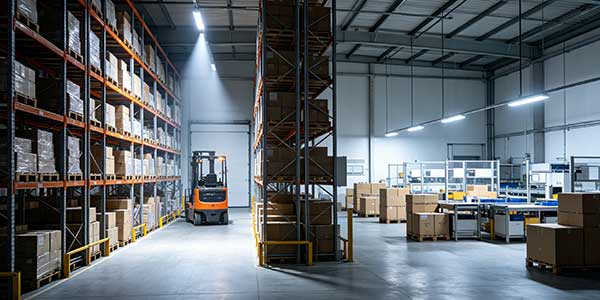
Warehouse managers must analyze internal material handling workflows before finalizing any industrial lighting asset procurement plans. Floor layout configurations dictate your precise beam distribution needs far more than basic structural ceiling height numbers. If you install wrong optics, you create dangerous dark zones and waste expensive electricity across your facility. Professional buyers must evaluate distinct warehouse architectural zones separately to achieve compliant, high-performance illumination fields.
High-density storage zones featuring vertical pallet racking arrays demand highly concentrated directional photometric management strategies. Even if your ceiling grid hangs at a modest twenty feet, standard wide-angle luminaires perform poorly here. Wide beams hit the tops of tall pallet racks, casting deep, unworkable shadows into narrow driving aisles. To solve this problem, you must deploy narrow-beam high bay fixtures directly over the center of forklift paths. This specific optical alignment forces lumens deep into tight floor spaces, ensuring clear label readability for operators.
Conversely, open floor operations like assembly, packing lines, and staging docks require a completely different engineering approach. These flat active work surfaces benefit most from wide-angle low bay fixtures or high-mounted wide UFO units. This configuration maximizes lateral light overlap to create an incredibly smooth, continuous light field across your team’s workspace. Wide dispersion rules out high-contrast glare hot spots that strain workers’ eyes during long, intensive packing shifts. Balancing these two optical styles across your concrete layout guarantees maximum facility safety and optimal operational output.
7.2 Maximizing ROI with Smart Controls: Microwave Sensors & 1-10V Dimming
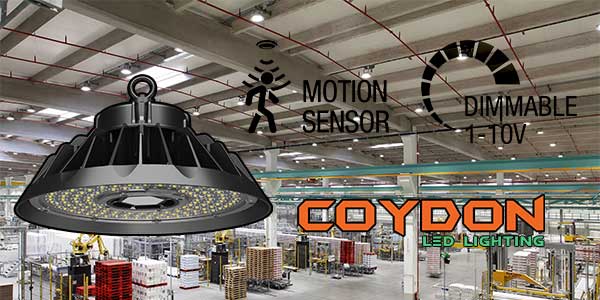
Savvy commercial warehouse owners look beyond baseline lumen efficacy numbers to maximize long-term infrastructure investment returns. The Coydon KD-HBD series incorporates optional advanced smart control features to unlock premium operational savings. Integrating integrated microwave motion sensors with standard 1-10V dimming leads to unmatched facility power management. These high-frequency smart components scan open floors and dense racking aisles with total electronic precision. They detect approaching forklifts or floor personnel instantly, raising light outputs to maximum brightness within milliseconds.
Traditional industrial setups keep heavy-duty lamps running at full power across completely empty facility zones all day. In sharp contrast, our smart microwave logic implements a highly responsive automated dimming schedule. When an aisle remains unoccupied for a set time, the fixture seamlessly drops to low standby power levels. This direct automated response cuts your secondary lighting electricity consumption by an extra 30 to 50 percent. Your corporate facility stops paying for unused light in vacant storage bays or quiet shipping areas.
Adding these smart control upgrades to your factory floor plan significantly accelerates your total financial investment payback period. You stack these additional energy reductions directly on top of the initial 50 percent LED power savings. This dual-layer efficiency approach converts standard warehouse overhead into real, measurable corporate cash flow very quickly. Furthermore, keeping fixtures dimmed during quiet hours extends internal LED driver lifespans and drops replacement maintenance costs. Choosing Coydon smart engineering guarantees a future-proof industrial ecosystem that actively defends your business profit margins.
8. Get Your Free Custom DIALux Lighting Design Today

Every industrial storage facility possesses completely unique layout challenges, aisle dimensions, and specific ceiling structure heights. Blindly purchasing bulk warehouse fixtures from retail marketplaces creates a massive, expensive risk of ongoing trial and error. Poorly planned setups often cause dangerous dark zones, weak ground lux levels, or high, unexpected installation labor costs. Industrial facility operators cannot afford to waste corporate capital on unverified hardware configurations that might fail safety audits. Partnering with a dedicated manufacturer removes this guessing game entirely from your next building upgrade project.
Coydon Lighting does far more than simply manufacture high-performance, heavy-duty industrial LED lighting hardware. We empower your business by providing complete, professional DIALux simulation reports absolutely free of charge. Our experienced factory lighting engineers analyze your specific facility blueprints to map out an optimized, custom deployment plan. This advanced technical report details exact fixture placement points, target lux counts, and precise beam angle distribution patterns. You see verified, scientific proof of your future workspace brightness before you spend a single dollar.
Ready to eliminate dark zones and permanently slash your monthly facility electricity expenses by half? Do not leave your warehouse safety compliance and corporate utility overhead to basic mathematical guesswork. Click the “Inquiry Now” button below right away to submit your specific building dimensions and ceiling mounting heights. Our engineering team will review your spatial data and deliver your custom, energy-saving plan within twenty-four hours. Secure your perfect, compliant industrial lighting framework and maximize your long-term business operational savings today.
9. Frequently Asked Questions: Warehouse Lighting Cleared Up

Q1: Can I use high bay fixtures in a warehouse with a 15-foot ceiling?
Installing narrow-beam high bay fixtures in a low fifteen-foot ceiling space causes immediate, severe visual problems. Standard high bays utilize tight sixty-degree or ninety-degree reflectors to push light down from extreme vertical heights. When dropped to fifteen feet, these concentrated light beams do not have enough distance to spread out properly. Consequently, the fixtures create blinding, intense white hot spots directly on your concrete warehouse floor. These localized bright zones are surrounded by deep, high-contrast dark shadows throughout your active working aisles.
This uneven distribution creates massive, dangerous glare issues for your local material handling staff and inventory pickers. Forklift operators driving under these low, intense beams experience sudden pupillary fatigue and temporary blind spots. This visual strain severely compromises facility safety, increasing the risk of expensive racking collisions or picking errors. To protect your workforce, you must avoid tight high bays in low-clearance areas entirely.
For a fifteen-foot clearance height, you should deploy wide-angle low bay fixtures with a 120-degree distribution pattern. Alternatively, selecting specialized broad-beam UFO LED lights ensures even lateral light overlap across the entire open area. This proper layout eliminates harsh blinding spots and fills the workspace with smooth, safe illumination. Your warehouse gains full safety compliance, better floor visibility, and an optimal working environment for daily operations.
Q2: Is a 200W UFO LED high bay truly enough to replace a 400W Metal Halide lamp?
Yes, a premium 200W UFO LED high bay easily outperforms an old 400W Metal Halide (MH) lamp. This direct swap cuts your energy billing footprint by exactly 50 percent from day one. Many procurement buyers wonder how half the wattage can deliver equivalent brightness across a large industrial workspace floor. The answer lies within the vast difference in optical delivery efficiency and long-term lumen depreciation rates.
Traditional 400W MH bulbs suffer from a poor luminaire output efficiency rating of only 78 percent. Their primitive bulb design fires light in all directions, trapping massive amounts of lumens inside the aluminum dome. This wasted energy quickly converts into destructive heat instead of useful downward floor illumination. Furthermore, legacy metal halide lamps decay rapidly, losing half their original brightness within the first few thousand operating hours.
In sharp contrast, the Coydon 200W UFO LED series utilizes advanced optical lens setups with 96 percent efficiency. Our heavy-duty fixtures deliver a brilliant, continuous output of 150 lumens per watt directly toward your active workforce. When tested within identical DIALux software simulation grid layouts, the 200W LED system delivers superior performance. It generates higher average floor lux levels and much better light uniformity than the old 400W halide setup. You achieve perfect visual clarity, eliminate dangerous dark aisle zones, and secure permanent power savings simultaneously.
Q3: How do microwave motion sensors and 1-10V dimming impact warehouse operational costs?
Standard warehouse lights must run at 100 percent maximum power all day, even across completely empty inventory zones. This rigid setup wastes massive amounts of expensive electricity and inflates your monthly facility utility bills unnecessarily. In sharp contrast, the Coydon KD-HBD series offers integrated microwave motion sensors paired with responsive 1-10V dimming technology. This advanced commercial upgrade automatically implements a highly efficient, money-saving “light on demand” workplace schedule. The internal sensors detect incoming forklifts or active warehouse workers instantly, raising light levels within milliseconds.
Once personnel exit the aisle, the smart fixture automatically dims down to a low twenty percent standby power level. This baseline setting keeps the storage bay safe and visible without pulling full wattage from your electrical grid. By cutting out this wasted energy during non-peak hours, you slice off an extra 30 to 50 percent of electricity overhead. These deep financial savings stack directly on top of the initial fifty percent power reduction from the LED upgrade.
For business owners, this dual-layer efficiency approach dramatically shortens your total capital infrastructure investment payback period. It actively compresses your real-world financial return on investment cycle down to twelve months or less. Furthermore, keeping your warehouse fixtures dimmed during quiet hours reduces internal component heat and extends driver lifespans. Choosing Coydon smart control engineering turns standard building overhead into predictable, long-term cash flow for your enterprise.
Q4: Why should I request a DIALux simulation report before ordering bulk lights?
Every commercial storage facility possesses completely unique internal layouts, rack placement heights, and side wall reflection factors. Relying on generic sizing charts found online introduces a massive, expensive risk of ongoing installation trial and error. If you order blind, you might end up with unsafe dark zones or high-contrast blinding glare. These unexpected optical errors lead to costly hardware return shipments, layout delays, and extra contractor labor fees. Professional procurement managers cannot afford to guess when deploying substantial capital for large-scale building upgrades.
Our free DIALux simulation reports remove all physical guesswork from your purchasing cycle before you spend any money. This advanced 3D architectural software builds a precise digital replica of your active factory floor layout. The calculated report demonstrates exactly how light waves distribute across your concrete floors and vertical storage racks. You see highly accurate data points showing verified average work plane brightness levels, such as 338 lux. This scientific planning ensures that your upcoming physical layout matches your exact target requirements from day one.
Reviewing this engineering data before manufacturing begins guarantees complete OSHA compliance and hassle-free local facility code sign-offs. You secure total aesthetic and optical layout certainty, ruling out the risk of post-purchase commercial fixture replacements. Our custom plans optimize every single fixture drop location to cut out unneeded hardware units from your invoice. Choosing Coydon industrial engineering gives your business verified data to back up your critical infrastructure purchasing decisions.