60° vs. 90° vs. 120° Beam Angle: Which UFO LED High Bay Light Is Best for Warehouse Aisles?

Table of Contents
1. The Hidden Cost of Choosing the Wrong Beam Angle in High-Bay Warehouses
1.1 Why 80% of warehouse lighting upgrades suffer from severe lumen waste
When upgrading facility systems, most operators focus only on wattage and raw luminous efficacy. They buy bright fixtures with impressive ratings. Yet they ignore the crucial role of optical beam spread. This single oversight ruins efficiency. High ratings mean very little without proper directional control inside tight aisles.
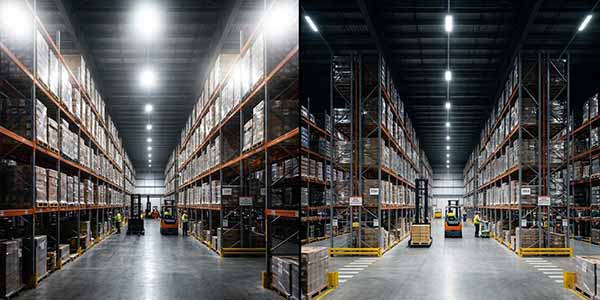
In tall racking environments, installing standard 120° wide fixtures causes immediate issues. Light spreads out too fast instead of traveling down toward the ground. Massive amounts of light hit the very top storage racks and ceiling beams. Powerful rays bounce off upper pallets or get completely trapped near the top.
This misdirected light never reaches key working areas. As a result, 30% to 50% of your paid lumen output disappears before touching floor paths. You pay full utility bills for energy that never illuminates your actual workspace. True performance depends on targeted optics, not raw output alone.
1.2 The dark aisle paradox: Bright ceilings, dim floor paths, and safety risks
Mismatched optics create a common operational issue known as the dark aisle paradox. Ceilings and upper shelves look blindingly bright. Yet lower rack levels and floor paths remain trapped in deep shadows. The upper space absorbs most light. Very little illumination actually filters down to the floor.
This severe light drop causes real productivity problems at ground level. Workers struggle to read inventory labels on bottom shelves. Handheld barcode scanners fail to read codes in the dim environment. Pickers waste valuable time re-scanning packages. Daily fulfillment speeds slow down across the board.
Harsh lighting contrast also creates major safety hazards throughout the facility. Bright upper glare combined with dark floor paths causes rapid eye fatigue. Operators experience headache risks and reduced alertness during long shifts. Forklift drivers miss low obstacles or misjudge aisle clearances. Poor visibility increases collision risks and trip hazards in busy aisles.
2. Beam Angle Selection Strategy at a Glance
Selecting the right optical distribution depends on mounting height, rack layout, and target application. The quick breakdown below shows the optimal setup for warehouse spaces.
| Beam Angle | Mounting Height | Ideal Warehouse Layout | Primary Application | Key Advantage |
| 60° Narrow | 9m – 15m (30ft – 50ft) | Very Narrow Aisles (VNA) & High Racks | Deep vertical penetration for tall pallet racks | Eliminates upper rack spill light and drives lux to the floor |
| 90° Medium | 6m – 9m (20ft – 30ft) | Standard Racking & Medium Aisles | Balanced aisle floor paths and rack storage | Delivers uniform floor lux with effective side-rack coverage |
| 120° Wide | 4.5m – 6m (15ft – 20ft) | Open Storage, Loading Docks & Flat Space | Wide open floor plans without vertical obstructions | Maximizes horizontal floor coverage with minimal overall fixtures |
Matching light distribution to aisle proportions prevents expensive energy waste. Tall racks need narrow beam punch. Open staging areas benefit from wide horizontal throw.
3. What Beam Angle (FWHM) Really Means for Warehouse Illumination
3.1 Beam angle vs. field angle: Why specification sheets can be misleading
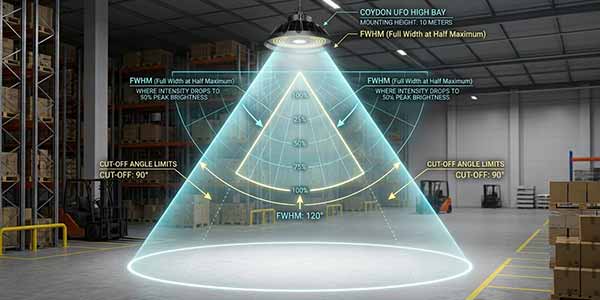
Understanding technical spec sheets requires knowing the difference between beam angle and field angle. Beam angle uses Full Width at Half Maximum (FWHM). This metric measures the spread where light intensity reaches 50% of peak center power. It defines your core useful illumination.
Field angle measures the beam spread out to 10% of peak intensity. Misleading spec sheets often highlight wide field angle figures instead of FWHM values. They advertise broad coverage numbers to make fixtures seem more powerful. In reality, light outside the FWHM range is weak, scattered spill light.
Buying fixtures based on field angle leads to dim, poorly lit working spaces. This weak outer light cannot illuminate floor paths or lower shelf labels effectively. Buyers mistake waste light for usable aisle illumination. Always verify true FWHM ratings to ensure strong, focused light distribution.
3.2 Inverse-square law & photometric spread in narrow vertical spaces
Physics dictates how light behaves over distance inside industrial spaces. The inverse-square law states that surface illuminance drops exponentially as distance from the source increases. Doubling the mounting height cuts floor light levels down to one-fourth. High ceilings naturally reduce raw illuminance.
In narrow aisles, wide beam angles aggravate this natural light drop. Wide light beams spread rapidly and strike tall side racks almost immediately. Energy scatters across upper shelf surfaces long before reaching the bottom floor. The light beam thins out significantly over long vertical distances.
Narrow beam optics solve this physical loss by gathering and focusing output. Tight lens angles concentrate raw lumens into a narrow vertical column. This tight beam path resists early dispersion along upper rack walls. Focused photons travel straight to floor paths, preserving target lux at ground level.
4. Deep Dive into the Three Main Beam Angles for High Bay Lights
4.1 60° Narrow beam angle: Deep penetration for high-racking narrow aisles
High-bay industrial storage facilities with elevated pallet racking present severe photometric challenges for modern facility operators. Mounting lighting fixtures at extreme heights between 9 and 15 meters requires precise, heavy-duty optical control. Standard wide distribution lenses fail completely in these tall vertical spaces. A concentrated beam spread becomes mandatory to push usable lumens deep into narrow, shadowed aisle corridors.
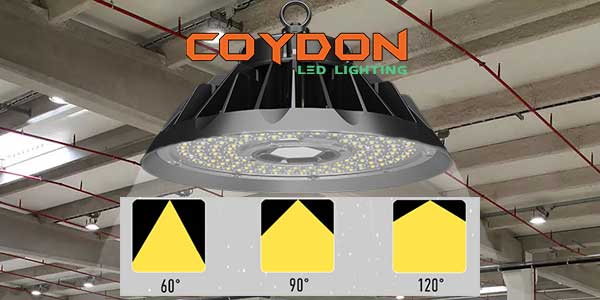
Equipped with specialized 60° precision PC lenses, the Coydon KD-HBD 200W and 240W models deliver exceptional optical penetration. Instead of scattering precious light onto top-tier shelf levels, the 60° optical lens gathers raw output into a narrow vertical column. This tight beam path cuts through open vertical space cleanly without losing valuable energy against high structural beams or upper storage pallets.
This deep optical penetration significantly boosts vertical illuminance across lower rack tiers. Mid-level and bottom shelf storage locations receive crisp, highly visible illumination. Forklift operators can easily identify small inventory tags and read barcodes on low pallets without experiencing eye strain. Ground-level floor paths maintain high lux values, eliminating dangerous dark spots across primary material handling lanes.
By directing lumens straight down to active working zones, the 60° optical lens prevents upper shelf obstruction. Energy stays focused exactly where warehouse logistics crews operate during daily shifts. The 200W and 240W KD-HBD UFO high bay series provides maximum optical efficiency for demanding, high-density industrial racking layouts.
4.2 90° Medium beam angle: The versatile workhorse for standard warehouse layouts
Standard industrial warehouses often feature rack clearance heights ranging between 6 and 9 meters. These common space proportions demand a balanced optical distribution pattern. Narrow beam lenses create intense hot spots under these medium ceiling heights. Meanwhile, extra wide distribution lenses cause excessive light spill on upper storage racks.
The Coydon KD-HBD 150W model utilizes a custom 90° medium optical lens to address these everyday facility setups. This intermediate distribution angle creates the ideal compromise for medium-height storage aisles. It projects sufficient downward punch to maintain target lux values on floor paths. Simultaneously, it spreads enough side light to cover vertical shelf surfaces effectively.
This balanced light spread improves overlapping illumination between neighboring fixtures along the aisle. The resulting light overlap eliminates deep, disruptive shadows on middle rack shelves. Material handlers can read small inventory labels clearly across all vertical storage levels. Ground transport paths achieve smooth, highly uniform illumination without harsh contrast or sudden dark patches.
For facility managers running standard pallet racking layouts, the 90° lens option delivers incredible practical versatility. It prevents costly lumen waste on upper shelves while maintaining excellent overall light uniformity. The UFO high bay fixture equipped with a 90° optical lens serves as an exceptional workhorse for general warehousing environments.
4.3 120° Wide beam angle: Maximum coverage for open storage & broad spaces
Open storage areas, staging bays, and active loading docks operate with expansive floor plans. These industrial zones usually have lower ceiling clearances between 4.5 and 6 meters. Vertical obstructions like tall pallet racks are completely absent in these open spaces. Lighting design here focuses on achieving maximum horizontal coverage across broad floor paths.
The Coydon KD-HBD 100W model features a specialized 120° wide optical lens engineered for these low-clearance environments. This broad distribution angle casts light evenly across large open floor areas. It significantly reduces the total number of fixtures required to meet target lux levels. Facility operators save on upfront equipment procurement costs and long-term installation labor.
In open sorting hubs and packing zones, wide illumination ensures a smooth visual transition across all active workstations. Material handlers and packaging crews benefit from bright, glare-free light throughout their shifts. Shadow formation remains minimal around moving pallets, sorting tables, and staging equipment. Ground-level operations run safely with consistent, edge-to-edge light coverage.
However, facility managers must never install 120° wide lenses inside narrow, high-bay racking aisles. In tall storage corridors, this wide beam pattern strikes upper shelf tiers almost immediately upon leaving the fixture housing. Over 40% of the light output scatters uselessly across top pallets and ceiling structures. Floor paths below remain dangerously dark, while forklift drivers suffer severe visual glare from exposed lenses.
Reserving the 120° wide optical lens for flat, open spaces protects your overall facility lighting efficiency. When paired with the 100W KD-HBD UFO high bay, this wide optical configuration delivers dependable, highly economical performance across open warehouse staging zones, shipping docks, and bulk storage floors.
5. Optical design efficiency: PC lens precision vs. traditional reflectors
Traditional metal halide fixtures relied on aluminum reflectors to shape light distribution. These outdated reflectors suffer from poor optical control and severe internal light loss. Secondary bounce reflections degrade beam intensity before light ever leaves the housing. Stray light scatters randomly across ceilings, causing noticeable glare and wasted energy.
Modern Coydon UFO LED high bays utilize high-grade optical polycarbonate (PC) lenses instead. These precision lenses achieve up to 96% light transmittance through direct refraction. Optical engineers shape the lens surface to bend every individual ray with extreme accuracy. Light directs exactly onto target working planes with virtually zero scattered waste.
Upgrading to precision PC optics eliminates secondary bounce losses entirely. Facility managers gain razor-sharp beam control across all aisle layouts. This optical efficiency cuts power consumption while delivering cleaner, more useful ground-level light.
6. Technical Comparison: Aisle Width, Ceiling Height, and Lux Distribution
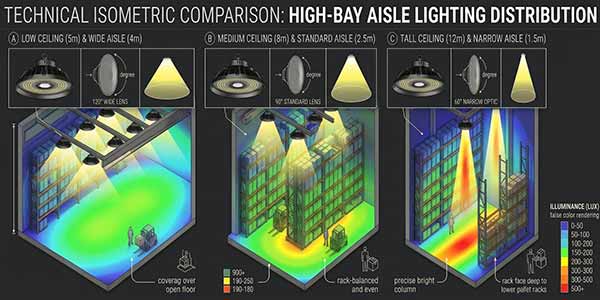
6.1 Mounting height matrix: Matching KD-HBD wattages with optical angles
Selecting the right industrial high bay requires pairing correct wattage with optimal beam angles. Mounting height determines how light travels before hitting floor paths and storage racks. Misjudging this relationship causes uneven light levels, glare, and wasted energy. The matrix below outlines optimal configurations for the Coydon KD-HBD series.
| Mounting Height | Fixture Wattage | Optical Lens | Target Application Area | Recommended Spacing |
| 4.5m – 6m (15ft – 20ft) | KD-HBD 100W | 120° Wide Lens | Open Storage & Loading Docks | 5m – 6m Center-to-Center |
| 6m – 9m (20ft – 30ft) | KD-HBD 150W | 90° Medium Lens | Standard Pallet Racking Aisles | 6m – 8m Center-to-Center |
| 9m – 15m (30ft – 50ft) | KD-HBD 200W / 240W | 60° Narrow Lens | Very Narrow Aisles & High Bays | 7m – 9m Center-to-Center |
For lower mounting heights, the 100W model with a 120° lens maximizes horizontal floor coverage. It reduces total fixture counts in flat staging areas and shipping hubs. At medium heights, the 150W model with a 90° lens balances vertical rack illumination and floor lux.
High-ceiling facilities between 9 and 15 meters demand maximum optical punch. The 200W and 240W KD-HBD models with 60° narrow lenses drive light straight down to ground level. This combination prevents early beam dispersion along upper racking tiers. Correct pairing guarantees long-term energy savings and optimal visual performance across every warehouse layout.
6.2 Vertical vs. horizontal illuminance: How to light up bottom rack labels
Warehouse lighting design often overemphasizes horizontal illuminance, which measures light landing on the floor. While bright walkways are essential for safety, inventory operations depend equally on vertical illuminance. Vertical light strikes vertical rack faces and storage boxes directly. Without adequate vertical light, bottom shelves become dark, unreadable zones.
Targeting proper vertical illuminance ensures that barcode scanners and warehouse workers read inventory tags easily. Pickers frequently struggle with low-tier stock when upper shelves cast heavy downward shadows. Achieving a balanced light ratio prevents scanning errors and speeds up order fulfillment. Modern facilities require clear visibility from top pallets straight down to ground-level storage bays.
Selecting narrow or medium beam angles directs light down the face of vertical racking systems. Overlapping beam patterns from neighboring fixtures help fill in deep shadows along bottom shelves. This strategy ensures uniform light distribution across both horizontal paths and vertical rack faces.
To optimize bottom shelf readability, maintain a minimum 1:2 ratio between vertical and horizontal illuminance. Pair proper fixture placement with precise optical lenses like 60° or 90° distributions. This configuration delivers crisp, glare-free light across all rack tiers, making bottom labels and QR codes effortless to scan.
7. Energy Retrofit ROI: Replacing 400W Metal Halide with 200W KD-HBD UFO LED
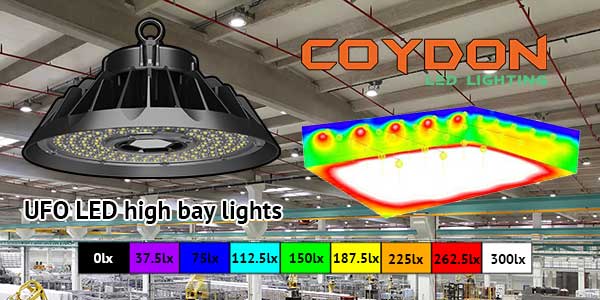
The Dialux Report:
30 PCS 200 Watt UFO LED high bay lights

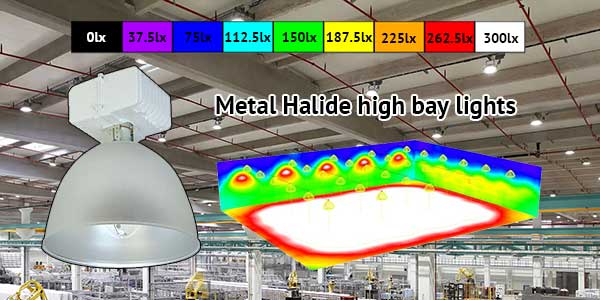
The Dialux Report:
30 PCS 400 Watt Metal Halide high bay lights
7.1 55%+ direct energy reduction: Real-world DIALux simulation proof
Concrete photometric calculations prove the massive financial savings of modern LED retrofits over legacy systems. Traditional 400W metal halide fixtures draw significantly more power than their nominal rating suggests. Internal magnetic ballasts consume substantial extra electricity during daily operation. A standard 400W metal halide fitting actually draws 458W per unit.
In a typical 2,000 square meter warehouse layout, operating 30 traditional metal halide lights requires 13.74 kW of total system power. This outdated industrial setup results in an excessively high power density of 6.87 W/m². Utility bills mount quickly under these inefficient operating parameters.
Replacing those legacy fixtures with 30 Coydon 200W KD-HBD UFO high bays drastically reduces total electrical load. Each modern high bay fixture draws just 204W, bringing total system power consumption down to 6.12 kW. The overall lighting power density drops instantly to a lean 3.06 W/m².
This direct optical upgrade yields an immediate 55.5% reduction in electricity consumption across the facility. Assuming standard warehouse operation of 4,000 annual running hours, facility managers save 30,480 kWh every single year. Precision PC optics combined with high LED efficiency deliver superior ground lux while slashing operating expenses.
7.2 Superior optical performance: Higher uniformity and zero light waste
Industrial lighting upgrades must deliver high optical quality alongside direct power savings. Traditional metal halide systems suffer from severe internal optical inefficiency. Legacy reflectors capture only 78% of generated light, scattering remaining lumens randomly across upper ceiling structures. Internal housing absorption creates substantial light loss before rays ever reach storage aisles.
DIALux photometric simulations demonstrate clear optical advantages with Coydon high bay retrofits. Legacy metal halide setups produce an average floor illuminance of 324 lux with a mediocre 0.484 overall uniformity rating. In contrast, the Coydon KD-HBD system achieves a virtually identical 322 lux average floor illuminance. Crucially, lighting uniformity increases to a superior 0.496 across working planes.
This refined optical delivery stems from advanced fixture engineering. Coydon UFO high bays combine high-efficiency 150 lm/W LED chips with precision PC lenses operating at 96% light transmittance. Direct refraction bends every lumen toward active target zones without wasteful scattering.
Higher uniformity eliminates harsh hot spots and deep shadows between fixtures. Material handlers enjoy crisp visibility across every rack tier. Precision optics ensure complete lumen utilization while slashing operating costs.
8. Smart Aisle Lighting: Maximizing Energy Savings with Controls
8.1 Microwave motion sensors for high-rack occupancy detection
High-bay warehouse racking systems create severe physical line-of-sight obstructions for conventional occupancy sensors. Traditional passive infrared (PIR) detectors frequently fail at mounting heights above 9 meters. Tall steel racks block heat signatures from approaching workers and moving forklifts. Unreliable detection leaves storage aisles dark or forces fixtures to run continuously at full output.
High-frequency microwave motion sensors overcome these physical sensing barriers. Radar signals penetrate thin non-metallic obstructions and detect movement around racking corners reliably. Motion triggers immediate full light output as soon as personnel enter the aisle. When forklifts exit, fixtures automatically dim down to a low standby level.
This dynamic power adjustment unlocks significant secondary energy savings. Fixtures consume minimal electricity during empty aisle cycles while maintaining safe baseline visibility. Microwave sensing pairs seamlessly with Coydon UFO high bays for maximized operational efficiency.
8.2 1-10V continuous dimming for daylight harvesting in warehouse skylights
Industrial buildings often put translucent roof panels in place to bring natural sunlight right down onto the floor. Standard high bays waste serious power here because they keep running at full power even with sunlight streaming in. Adding daylight harvesting solves that problem by tying fixture output directly to incoming natural light.
Coydon high bays use 1-10V dimming drivers hooked up to simple photocells near the roof. When sun shines through the roof panels, the photocell signals the driver to trim power back. The fixture output drops smoothly so workers on the floor never notice sudden light shifts. Work areas stay right at their target lux line all day long.
On clear afternoons, high bays run at low wattage and cut operating costs fast. When clouds roll in or night shifts start, the drivers ramp power back up to full output. Tying 1-10V dimming to natural roof daylight cuts utility bills without compromising floor visibility for warehouse crews.
9. DIALux photometric simulations in modern lighting design
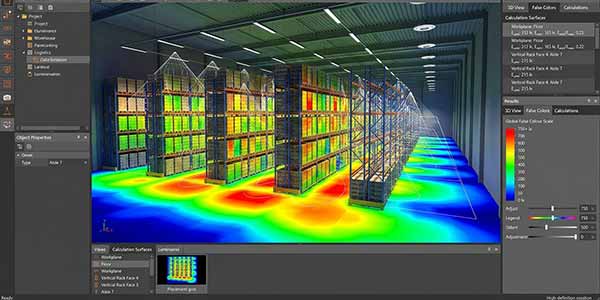
Buying industrial lighting based on guesswork or rough rules of thumb usually leads to costly field mistakes. Facility managers often order standard high bays without testing beam spread or mounting heights first. They end up with dark shadows along lower rack shelves, severe floor glare, or massive energy waste. Modern high bay projects demand precise optical planning rather than broad assumptions.
Running a DIALux 3D photometric simulation before issuing purchase orders eliminates these operational risks completely. DIALux software creates a precise digital twin of your actual warehouse layout. The program factors in exact room dimensions, ceiling clearance heights, wall reflectances, and pallet rack spacing. Engineers import real IES photometric files to plot light behavior before mounting a single fixture on site.
The simulation output provides verified numerical proof for every critical optical metric across the facility floor. It calculates precise average lux levels, min-to-max uniformity ratios, and vertical illuminance along storage rack faces. Facility teams can test different optical lens angles, wattages, and spacing grids virtually. You can swap a 120° wide lens for a 60° narrow optic inside the software to see floor impact instantly.
This data-driven engineering process guarantees that your chosen lighting layout meets project specs before spending capital. It prevents over-specifying fixture counts or buying incorrect optical lenses. Facility owners avoid expensive field retrofits and re-wiring labor caused by poor initial planning. Correct modeling verifies that every aisle receives uniform lighting without hot spots or dark zones.
DIALux modeling transforms warehouse lighting projects from a risky trial-and-error guess into an exact science. Coydon provides complete, complimentary DIALux simulation reports for every client project. Our optical engineers build detailed layout models so you know your exact floor lux before placing an order. Having accurate photometric reports simplifies internal budget approvals and secures long-term operational success for your warehouse. These detailed simulations give contractor teams clear installation layouts and positioning guidance right from day one.
10. Step-by-step selection guide: How to determine your perfect beam angle

Finding the right high bay lighting setup requires a systematic optical selection method. Facility managers can follow this simple four-step process to ensure target light levels across all storage areas.
- Step 1: Measure aisle width and rack height
First, record exact building dimensions, clear ceiling height, and aisle widths. Note the precise vertical height of your storage racks and top shelf clearances. Narrow aisles with tall racks demand tight optics, while open floors allow wider beam spreads.
- Step 2: Define target lux levels using ANSI/IES standards
Consult ANSI/IES standards to set required illuminance levels for your operational needs. Active picking aisles typically need 150 to 200 lux on floor paths. Fine detail inspection zones or packing tables require 300 to 500 lux for clear visibility.
- Step 3: Match Coydon KD-HBD wattage and optical lenses
Select your fixture power and beam angle using facility measurements and lux targets. Pair low ceilings with 100W 120° wide optics for flat storage areas. Match 150W 90° medium lenses for standard racks, or use 200W 60° narrow optics for tall bays.
- Step 4: Request a complimentary DIALux simulation
Submit your layout dimensions to Coydon for digital photometric verification before ordering. Our optical engineers build a 3D model to confirm floor lux and overall uniformity. This final data check guarantees optimal visual performance across every warehouse aisle.
11. Why top warehouse operators choose Coydon lighting KD-HBD series

Factory floor environments test industrial lighting fixtures hard every single day. Top warehouse operators routinely choose Coydon KD-HBD high bays because these units hold up under punishing work conditions.
Inside every fixture, heavy-duty OSRAM LED chips push out a solid 150 lm/W light output. That high efficiency slashes monthly electric bills fast without dropping floor light levels anywhere. The thick aluminum alloy body pulls internal heat away from critical driver electronics immediately. Up front, tough PC optical lenses keep light beam patterns tight without yellowing or cracking after years of continuous heat exposure.
Harsh warehouse dust, airborne dirt, and humidity stay completely out thanks to a full IP65 ingress seal. The built-in power supply handles AC90-305V wide voltage ranges without a hitch. That broad voltage margin stops grid spikes from killing fixtures during peak factory operating hours.
Coydon backs every single KD-HBD unit with a direct 5-year factory warranty commitment. Facility managers get reliable illuminance levels, zero maintenance headaches, and long-term cost savings across every single aisle.
12. Optimize your warehouse lighting today – get your free DIALux simulation

Do not leave your industrial lighting performance to random guesswork or basic rules of thumb. Upgrading your warehouse lighting requires accurate optical planning to secure optimal foot-candles and maximum energy efficiency.
Take all the risk out of your upcoming fixture procurement process today. Simply send us your exact building layout, rack heights, and target lux goals. Our experienced Coydon optical engineers will build a complete 3D DIALux simulation tailored specifically to your site. You will receive a detailed photometric analysis report showing exact floor lux and fixture layouts within 24 hours.
Seeing your exact optical coverage before placing an order saves time, prevents costly field mistakes, and guarantees real performance. You can verify light distribution across every storage aisle before spending a single dollar on hardware. This photometric data gives your management team complete confidence during project budget approvals.
Click the Inquiry Now button at the top of this page to submit your facility dimensions. Let our engineering team deliver your free, custom DIALux 3D layout today.
13. Frequently Asked Questions

Q1. Can I mix different beam angles in the same warehouse?
Yes, mixing different optical beam angles across a single facility is standard engineering practice. Different functional warehouse zones demand specific light distribution patterns to ensure optimal visibility and minimum glare.
High-rack storage aisles require 60° narrow or 90° medium optical lenses. These tight distributions drive light straight down to ground level without washing out upper shelving tiers. Conversely, open staging docks, packing stations, and low-ceiling flats perform best with 120° wide lenses. Wide optics spread light evenly across open spaces to maximize fixture coverage and reduce total pole counts.
Tailoring optical lenses by specific zone prevents energy waste and maximizes floor illumination. Mixing beam angles gives facility operators the most cost-effective, high-performance lighting design possible.
Q2. What is the ideal mounting height for 60°, 90°, and 120° beam angles?
Mounting height drives lens selection every time. Pick the wrong beam spread and you end up wasting power or dropping dark patches onto active work areas.
Stick with 120° wide optics for low hangs from 4.5 to 6 meters (15 to 20 feet). That extra spread pushes light across open loading bays and short storage spaces without creating blinding hot spots.
Move to 90° medium lenses once your ceiling hits 6 to 9 meters (20 to 30 feet). This option handles mid-height warehouse layouts well and keeps floor lux solid.
Put 60° narrow optics on tall racks hung 9 to 15 meters (30 to 50 feet) high. That tight angle forces light straight down between high shelves without getting swallowed by upper pallets.
Q3. How does beam angle affect light glare and operator safety in high-bay aisles?
Putting a 120° wide lens in high racking aisles creates direct glare for forklift drivers. Wide light beams spill sideways into operator sight lines when drivers look up at top pallet shelves. That harsh glare causes quick visual fatigue, slows down material handling, and increases collision risks.
Narrower optics protect driver eyes by controlling output distribution. Using a 60° or 90° lens directs light straight down toward the aisle floor instead of scattering horizontally. This sharp cut-off angle blocks direct glare outside the main beam path.
Controlled beam angles keep aisle pathways bright while keeping driver sight lines clear. Reduced eye strain creates a safer work environment and prevents costly warehouse accidents during high-lift movements.
Q4. Does changing the beam angle affect the fixture’s power consumption or total lumens?
Swapping optical lenses changes light spread, not total power draw or lumen output. A 150W high bay produces the same wattage and lumens whether you run a 60° or 120° lens.
Angles shift lux density across your working area instead. Narrow lenses pack lumens tightly together, raising lux levels on narrow floor paths and vertical rack faces.
Coydon uses high-efficiency PC lenses with 96% light transmission to minimize optical loss. Directing light exactly where workers need it cuts total fixture counts across your building. That precise lens targeting lowers overall facility energy consumption without reducing light quality.