Warehouse Lighting 101: A Complete Guide to LED High Bay Solutions

Table of Contents
1. Introduction: Why Warehouse Lighting Matters More Than You Think
1.1 The Hidden Costs of Poor Lighting – Safety, Productivity, and Bills
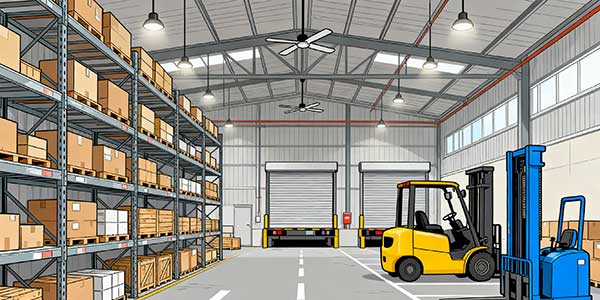
Poor lighting is a silent profit killer. It causes eye strain and fatigue. Workers take longer to find items. They make more picking errors. Dark corners hide trip hazards. Forklifts struggle to see pedestrians. Accidents increase. So do insurance claims. Old lighting also wastes energy. Metal halide fixtures lose efficiency over time. You pay for heat, not visibility. Replacing lamps at 30 feet is dangerous. It requires lifts and shutdowns. These hidden costs rarely appear on one bill. But they add up fast. Bad lighting steals your profit every day.
1.2 A Real-World Problem: Outdated Metal Halide Systems Are Draining Your Budget
Metal halide was once the standard. Not anymore. A 400W metal halide high bay draws much more power than an LED. It also produces excessive heat. Restarting takes 10–15 minutes. Light quality drops after a few months. We see this problem everywhere. One customer ran 30 metal halide fixtures. Each used 458W. Total power was 13,740W. The light output was only 28,030 lm per fixture. Utility bills were extremely high. Maintenance costs added more pain. The customer wanted a better way. The solution was simple. Replace each 400W metal halide with a 200W LED high bay. Our KD-HBD series delivers 150 lm/W. That means better light with half the energy. The customer now saves over 55% on lighting energy. They also enjoy instant on/off and zero warm-up time. No more waiting for lights to brighten.
2. Understanding LED High Bay Lighting: The Modern Solution
2.1 What Are LED High Bay Lights and Where Are They Used?
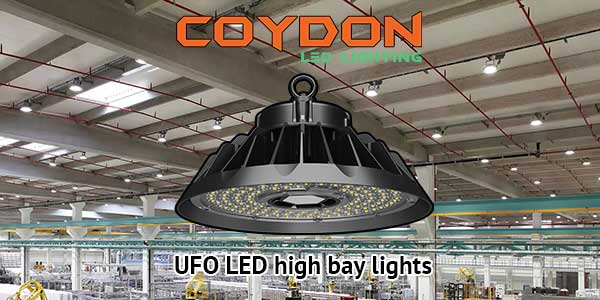
LED high bay lights are powerful fixtures for tall ceilings. They work best at heights of 15 to 50 feet. These lights deliver bright, even illumination across large areas. Common applications include warehouses, distribution centers, and factories. You also find them in gymnasiums, hangars, and big-box retail stores. Unlike old bulbs, LEDs use semiconductor chips. They convert most energy into light, not heat. This makes them highly efficient. A typical LED high bay lasts 50,000 hours or more. That means years of maintenance-free operation. Our KD-HBD series takes this further. It achieves 150 lumens per watt. This is nearly double the efficacy of metal halide. LED lights also turn on instantly. No warm-up time. No restrike delay. Your operations never wait for light. Plus, LEDs produce less heat. This lowers your air conditioning costs. They also contain no mercury or hazardous materials. Switching to LED is safer for your workers and the environment.
2.2 UFO vs. Linear – Why UFO LED High Bays Are the Top Choice for Warehouses
UFO high bays have a round, compact shape. They look like flying saucers. Linear high bays are long and rectangular. UFO fixtures offer better beam control. You can choose 60°, 90°, or 120° optics. This flexibility fits any warehouse layout. UFO lights are also easier to install. One person can hang them quickly. They take up less ceiling space. Their aluminum housing dissipates heat well. This protects the LED chips and driver. Linear fixtures work well for narrow aisles. But UFO lights perform better in open areas. They provide symmetrical light distribution. Shadows are minimal. Our KD-HBD series uses OSRAM SMD 2835 chips. This ensures reliability and high output. Most warehouses now choose UFO over linear. The reason is simple: more light, less hassle. Additionally, UFO lights have better glare control. Your workers will experience less eye strain. They can focus on tasks longer without fatigue. UFO design also allows optional sensors. You can add microwave motion detection or 1-10V dimming easily.
2.3 Key Specifications That Matter: Lumens, Wattage, Efficacy, and Beam Angle
Lumens measure total light output. More lumens mean brighter light. Wattage tells you how much power the fixture uses. Do not compare wattage alone. Always look at lumens per watt. This is efficacy. Our KD-HBD series delivers 150 lm/W. That is excellent for industrial lighting. A 200W UFO produces about 30,000 lumens. This matches a 400W metal halide. But it uses half the power. Beam angle is also critical. Narrow 60° beams work for very high ceilings. They focus light straight down. Wide 120° beams spread light evenly. They are good for lower mounting heights. Choose 90° for general warehouse use. Matching these specs to your space saves money. It also improves visibility. Let us give you an example. A 30-foot ceiling needs a 150W or 200W UFO. A 15-foot ceiling works well with 100W. Our KD-HBD series offers 100W, 150W, 200W, and 240W options. Each matches a specific mounting height range. This makes selection simple.
3. LED vs. Metal Halide: A Data-Driven Comparison
3.1 Energy Consumption: One 200W LED Replaces One 400W Metal Halide
We ran a real test. 30 metal halide lights. Each used 458 watts. Total power was 13,740 watts. Then we swapped them. We installed 30 LED UFOs from our KD-HBD series. Each LED used only 204 watts. Total power dropped to 6,120 watts. That is a 55.5% reduction. One 200W LED replaces one 400W metal halide. Same light output. Less than half the power. Think about your electric bill. Run your lights 16 hours a day. 365 days a year. The savings add up fast. Our KD-HBD gives 150 lumens per watt. Old metal halide gives about 70. That is a huge gap. Less power also means less heat. Your air conditioner works less. So you save even more money. This is not a small improvement. It changes your operating costs completely.
3.2 Light Output and Uniformity: Better Visibility with Less Power
What about actual brightness? We measured lux on the floor. Metal halide gave 324 lux average. LED gave 322 lux. Almost identical. So you lose no brightness at all. But uniformity is better with LED. Uniformity (u0) was 0.484 for metal halide. LED hit 0.496. Higher is better. Why does this matter to you? Fewer dark spots appear on your floor. Less shadows between racks and shelves. Your workers see better. They make fewer picking errors. Eye strain goes down. Safety goes up. Our KD-HBD series lets you pick beam angles. Choose 60°, 90°, or 120°. You can tune the light for your exact layout. Better visibility with less power. That is the real LED advantage. No trade-offs. Just better performance.
3.3 Lifespan and Maintenance: Stop Changing Bulbs at 30-Foot Heights
Metal halide bulbs die fast. About 15,000 to 20,000 hours. Then you need a new one. Changing a bulb at 30 feet is a real pain. You need a lift or scaffolding. You have to shut down the aisle. It costs time and money. Your workers could get hurt. LED high bays last much longer. Our KD-HBD series lasts 50,000 hours or more. We use OSRAM chips. They are reliable and tough. Run your lights 16 hours a day. 50,000 hours is over 8 years. Some LEDs go to 100,000 hours. That is 17 years. In that same time, metal halide would need 4 or 5 replacements. Each replacement costs you labor and lift rental. LEDs don’t suddenly fail. They just get a little dimmer over time. You can plan ahead. No more emergency calls. No more working at dangerous heights.
3.4 Real ROI Calculation: 30-Fixture Warehouse Example
Let us do the math together. You have 30 metal halide fixtures. Each pulls 458 watts. Total is 13.74 kW. Run 16 hours a day. 300 working days a year. That uses 65,952 kWh per year. At $0.12 per kWh, you pay $7,914 a year. Now switch to 30 LEDs. Each pulls 204 watts. Total is 6.12 kW. Same hours. Same days. That uses 29,376 kWh per year. Your new cost is $3,525. You save $4,389 every year. That is 55.5% less energy. Now add maintenance costs. Over 5 years, metal halide needs two bulb changes. Each change costs $50 per fixture for labor and lift. That is $3,000 total. LEDs need zero changes. So your 5-year savings are: $4,389 x 5 = $21,945 from energy, plus $3,000 from maintenance. Total $24,945. Your payback time? About 1.5 years. After that, every dollar is pure profit. That is a smart investment.
4. Real-World Performance: Dialux Simulation Results from Coydon Lighting
4.1 Case Study 1 – 46 x 146.3W UFO LED High Bays in an 8m Warehouse
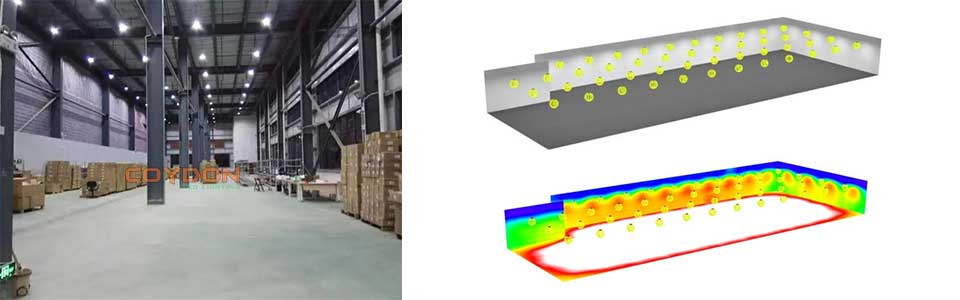
The calculation report: UFO LED high bay lights 150 watt x 46 piece ( Project 02 )
We did a real Dialux simulation for a customer. Their warehouse was 8 meters high. That is about 26 feet. Floor area was 2323 square meters. That is roughly 25,000 square feet. We used 46 of our KD-HBD UFO LED high bays. Each one used only 146.3 watts. Total power for all lights was 6729.8 watts. That is just 2.9 watts per square meter. The average illuminance on the working plane was 338 lux. Uniformity (u0) was 0.389. This means light spreads evenly across the floor. There are no dark spots. Workers can see labels clearly. Forklift drivers have good visibility. The customer was very happy with the result. They saved a lot of energy compared to their old metal halide lights. No more dark corners. No more shadows between racks. This simulation proves our product performs well. We can do the same for your warehouse. Just send us your room size and ceiling height. We will run a free Dialux report for you.
4.2 Case Study 2 – 30 x 200W LED vs. 30 x 400W MH in a 10m Facility
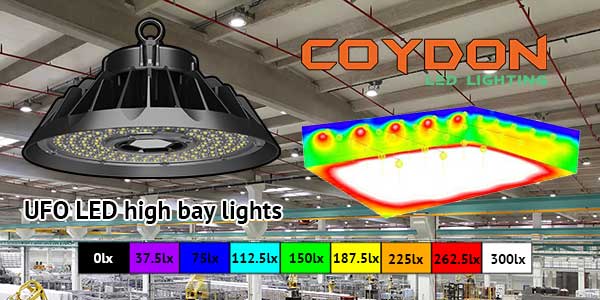
The Dialux Report:
30 PCS 200 Watt UFO LED high bay lights

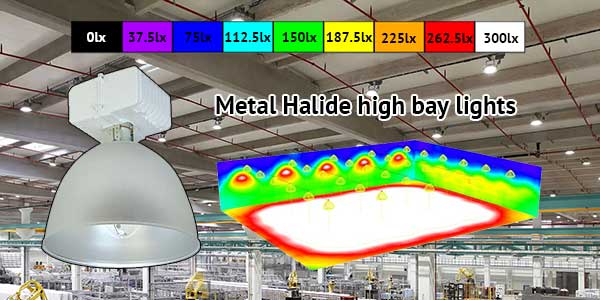
The Dialux Report:
30 PCS 400 Watt Metal Halide high bay lights
We ran another comparison for a different customer. The room was 10 meters high. That is about 33 feet. Floor area was 2000 square meters. That is about 21,500 square feet. We tested 30 metal halide lights against 30 LED UFOs. Metal halide used 458 watts each. Total power was 13,740 watts. LED used only 204 watts each. Total power was 6,120 watts. That is a 55.5% reduction in energy use. Now let us look at brightness. Metal halide gave 324 lux average on the floor. LED gave 322 lux. Almost identical. So you lose no brightness. But uniformity was better with LED. Uniformity (u0) was 0.496 for LED. Metal halide was only 0.484. Higher is better. That means fewer dark spots and less eye strain. The customer now saves over $4,000 per year on electricity. They also avoid dangerous bulb changes at height. This is a real example from our work. Our KD-HBD series made it happen.
4.3 How Coydon Lighting Provides Free Dialux Reports for Your Facility
You do not need to guess your lighting layout. Guessing leads to mistakes. You might buy too many lights. Or you might buy too few. Coydon Lighting offers free Dialux simulations to help you. Here is how it works. First, you tell us your warehouse size. Give us length, width, and ceiling height. Tell us your mounting height. That is how high the lights will hang. Also tell us what tasks your workers do. Picking? Packing? Assembly? Each task needs different light levels. We then build a digital model of your space. We place our KD-HBD UFO lights in the model. The software calculates exact illuminance. You get a report with lux values and uniformity numbers. You also see power density. This report helps you buy the right number of lights. No overbuying. No underlighting. We have done this for many customers. The two case studies above are real examples. Our service is fast and completely free. Just send us your room dimensions. We will reply with a Dialux report. Then you can compare before buying. That is real professional support from Coydon Lighting.
5. Advanced Features to Maximize Efficiency and Control
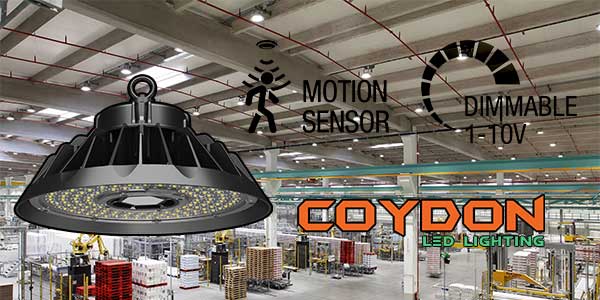
5.1 Microwave Sensor – Intelligent On/Off and Daylight Harvesting
Our KD-HBD series can add a microwave sensor. This sensor detects motion from far away. It works through plastic, glass, and thin walls. When no one is around, the lights dim or turn off completely. When someone walks in, the lights turn on instantly. No delay. No flicker. This saves a lot of energy. Warehouses have many empty aisles. Why light them when nobody is there? The sensor also does daylight harvesting. If sunlight comes through windows or skylights, the sensor dims the LED. You get just enough light for the task. No more wasting electricity on bright sunny days. The microwave sensor is more sensitive than infrared. It does not need a clear line of sight. You can mount it inside the fixture. Everything looks clean and simple. This feature alone pays for itself in a few months. Your workers will love the convenience.
5.2 1-10V Dimming – Seamless Integration with Building Automation Systems
Our KD-HBD series supports 1-10V dimming. This is an industry standard. You can connect the lights to your building automation system. Set different light levels for different times of day. Dim the lights to 10% during lunch breaks. Run them at 50% during cleaning hours. Go to 100% only during peak work times. You can also group fixtures by zone. Dim the loading dock at night. Keep the packing area bright. Keep the shipping office fully lit. The 1-10V signal works with most dimmers and controllers. It is simple and reliable. No special software needed. No complex programming. Your facility manager will love the control. You can also integrate with occupancy sensors. The system becomes fully automatic. And you will love the extra energy savings. Dimming adds 20% to 30% more savings on top of LED efficiency. That is real money.
5.3 Choose Your Beam Angle (60°/90°/120°) and Color Temperature
Every warehouse is different. Ceiling heights vary. Rack layouts vary. Task needs vary. That is why we offer choices. Our KD-HBD series lets you pick one beam angle before we build it. 60° is for very high ceilings above 40 feet. It focuses light straight down like a spotlight. 90° is for general warehouse use from 20 to 40 feet. It balances spread and intensity well. 120° is for lower ceilings under 20 feet. It spreads light wide and even. You also pick one color temperature. 3000K gives warm light. 4500K gives neutral white light. 6000K gives cool daylight. Most warehouses pick 4500K or 5000K. Cool light helps workers stay alert. It makes labels and barcodes easier to read. Tell us your ceiling height and layout. We recommend the best fixed beam angle for you. You choose the color temperature you like. No need to guess. Get the right single configuration for your specific space.
6. How to Choose the Right LED High Bay for Your Warehouse
Step 1 – Calculate Your Mounting Height and Lumen Requirements
First, measure your ceiling height. This is the most important step. Higher ceilings need more lumens. For a 15-foot ceiling, aim for 10,000 lumens per fixture. For a 20-foot ceiling, aim for 15,000 lumens. For a 30-foot ceiling, aim for 25,000 lumens. For a 40-foot ceiling, aim for 35,000 lumens. For a 50-foot ceiling, aim for 45,000 lumens. You also need even spacing. Place lights 15 to 20 feet apart. This avoids dark spots. Our KD-HBD series gives 150 lumens per watt. So a 200W fixture gives about 30,000 lumens. That works well for 30 to 40 foot ceilings. Use this as your starting point.
Step 2 – Match Wattage to Ceiling Height: KD-HBD Selection Guide
Our KD-HBD series makes selection simple. Use this guide based on your ceiling height. 100W works for 15 to 20 feet. 150W works for 20 to 30 feet. 200W works for 30 to 40 feet. 240W works for 40 to 50 feet. Each wattage delivers about 150 lumens per watt. So a 100W fixture gives roughly 15,000 lumens. A 200W fixture gives roughly 30,000 lumens. This matches a 400W metal halide. But you save over 55% energy. Do not guess. Pick the wattage that matches your height. If your ceiling is 25 feet, choose 150W. If it is 35 feet, choose 200W. Simple.
Step 3 – Decide on Optional Controls (Microwave Sensor / 1-10V Dimming)
Now choose your controls. Both options save extra energy. A microwave sensor detects motion. It turns lights on when someone walks in. It dims or turns off when the area is empty. It also does daylight harvesting. If sunlight is bright, the sensor dims the LED. This works best for aisles with low traffic. 1-10V dimming connects to your building system. You can set schedules. Use 100% during peak hours. Drop to 30% overnight. You can also add both options together. Tell us your needs. We will configure your KD-HBD lights correctly before shipping.
Step 4 – Request a Free Dialux Simulation for Precision
Do not guess your lighting layout. Guessing leads to mistakes. You might buy too many lights. Or too few. Coydon Lighting offers free Dialux simulations. Send us your room dimensions. Tell us ceiling height and mounting height. Describe your racking and work areas. We build a digital model of your space. The software calculates exact lux and uniformity. You get a professional report. This report tells you exactly how many lights to buy. It also shows the best beam angle. No waste. No dark corners. No over-spending. Request your free simulation today. We usually reply within 24 hours.
7. The Financial Case: Why Upgrading to LED Pays for Itself
7.1 Energy Savings Breakdown – LED vs. Metal Halide
Let us look at 30 lights. Metal halide uses 458W each. Total power is 13,740W. LED uses 204W each. Total power is 6,120W. Run 16 hours a day. 300 days a year. Metal halide uses 65,952 kWh per year. LED uses 29,376 kWh. At $0.12 per kWh, metal halide costs $7,914 per year. LED costs $3,525. That is a saving of $4,389 every year. Over 5 years, you save $21,945 just on electricity. That is real money back in your pocket. Your utility bill drops by more than half. You will see the difference on your first monthly statement. This saving alone makes the upgrade worth it.
7.2 Maintenance Savings – No More Frequent Replacements
Metal halide bulbs burn out every 15,000 to 20,000 hours. That is about every 2 to 3 years. Changing a bulb at 30 feet is expensive. You need a lift or scaffolding. You need a trained worker. You need to shut down the aisle. Each change costs about $50 per fixture in labor and rental. For 30 lights, that is $1,500 per change. Over 5 years, you pay for 2 changes. That is $3,000. LED lights last 50,000 hours or more. Our KD-HBD series uses OSRAM chips. No changes needed for over 8 years. That $3,000 stays in your budget. You also avoid downtime and safety risks.
7.3 Typical Payback Period – 1 to 2 Years
What is your total upfront cost? For 30 KD-HBD LED fixtures, it is about $4,500 to $6,000 installed. Your annual energy saving is $4,389. Your payback is just over one year. Add maintenance savings of $1,500 every 2.5 years. Your effective annual saving becomes about $4,989. Payback drops to about 14 months. After that, every dollar you save is pure profit. LED prices are low now. Energy prices keep rising. The longer you wait, the more money you lose. Upgrade now and start saving immediately. Most customers see full return in under 2 years. Some see it in just one year.
8. Why Choose Coydon Lighting for Your Warehouse LED Upgrade?

8.1 Proven Performance with Real Photometric Data and Dialux Reports
We do not guess. We test. Every KD-HBD fixture comes with real photometric data. Our Dialux simulations show exactly how your warehouse will look. The case studies in this guide are real. 46 lights in an 8m warehouse. 30 lights in a 10m facility. You saw the numbers. 338 lux average. 55.5% energy saving. We share this data freely. Many suppliers cannot do that. We can. You get confidence before you buy. No surprises after installation. That is real proof, not just marketing. You can trust our numbers.
8.2 Custom Solutions – Microwave Sensor and 1-10V Dimming Ready
Your warehouse is unique. Your lighting should be too. Our KD-HBD series gives you real choices. Add a microwave sensor for automatic on/off and daylight harvesting. Add 1-10V dimming to connect with your building system. Or add both options together. We configure each fixture before shipping. You do not need to open anything. You do not need extra wiring guides. Just tell us what you want. We deliver lights ready to install and use. Simple and custom. No extra work for your electrician.
8.3 Free Dialux Support and Fast Response – We Speak Your Language
You need answers fast. We reply within 24 hours. Send us your room dimensions. We send back a free Dialux report. No hidden fees. No long contracts. We are Coydon Lighting. We have been doing this for years. We know warehouses. We know LED high bays. We know what works. You do not need to be a lighting expert. We help you choose the right KD-HBD fixtures. Then we support you after the sale. That is our promise. Contact us today. Let us light your warehouse.
9. Ready to Transform Your Warehouse Lighting?

You have seen the data. LED saves energy. LED cuts maintenance. LED pays back fast. Now it is your turn. Contact Coydon Lighting today. Send us your warehouse dimensions. Tell us your ceiling height. We will run a free Dialux simulation for you. You will get a professional report. No cost. No obligation. We will also send you a custom quote for our KD-HBD series. Choose your wattage. Choose your beam angle. Choose your controls. We build exactly what you need.
Click the Inquiry Now button. Or email us directly. Our team replies within 24 hours. Let us help you save money. Let us help you light your warehouse the right way. Do not wait. Energy prices are not going down. Every month you wait costs you money. Make the switch today.