Industrial LED Lighting 101: A Complete Guide to High Bays and Flood Lights

Table of Contents
1. Introduction: Why Your Industrial Lighting Might Be Costing You a Fortune
1.1 The Hidden Waste in Old Metal Halide and Halogen Systems
Old lighting technology is extremely wasteful. Metal halide lamps convert only 2–5% of electricity into visible light. Halogen lamps are just as bad. The rest of the energy becomes heat. That heat does not help your workers see better. It only makes your facility hotter. You then pay more for cooling. Many factories spend over 30% of their monthly electricity bill on lighting. A large part of that is pure waste. You may be losing thousands of dollars every year. This waste is hidden but real. Most business owners do not notice it. They assume their lights are working fine. In fact, they are burning money silently.
1.2 One Facility Saved 68% – And You Can Too
A real customer decided to make a change. They had a large warehouse with 30 light fixtures. Each fixture used a 400W metal halide lamp. They replaced every lamp with a 200W UFO LED high bay from Coydon Lighting. The result was dramatic. Energy consumption dropped by 68%. The annual electricity saving was over $12,000. The payback period was less than 18 months. That is real money back in their pocket. You can achieve similar savings. Your facility does not have to be huge. Even a small workshop can benefit. This guide will show you how. We use real Dialux data, not just claims. Keep reading to learn the exact steps.
2. What This Guide Covers
2.1 For Facility Managers, Contractors, and Business Owners
This guide is for people who make lighting decisions. You might be a facility manager. You could be an electrical contractor. Or you own a business. Your goal is to cut costs. You also want better light. Safety standards matter too. This article helps you buy the right LED lights. It uses real data, not guesses. You will learn exactly what to do.
2.2 We Are Coydon Lighting – Engineers with Dialux Proof, Not Just Claims
Coydon Lighting is not a typical manufacturer and seller. We are lighting engineers first. We don’t make empty promises. Every product recommendation comes with a Dialux simulation. This report is free for your project. It shows light levels on your actual floor. You see proof before spending a dollar. That builds real trust. No other guide gives you this level of detail. Our simulations match real-world results.
2.3 How to Use This Guide to Make a Confident Purchase
Here is how this guide works. First, you learn basic LED selection rules. Second, we explain key specs like lumens and beam angles. Third, we show two real case studies. One is a tennis court with 150W LED flood lights. The other is a warehouse with 200W UFO LED high bays. Fourth, we compare LED vs old lights. You get two side-by-side tables. One compares LED flood to halogen. The other compares LED high bay to metal halide. Fifth, we show you energy savings and payback time. Finally, you click “Inquiry Now” to get a free Dialux report. That’s it. Read, learn, then act.
3. Understanding Industrial LED Lighting – The Basics
3.1 Lumens, Efficacy (lm/W), and Why 130 vs 150 Matters
Lumens measure brightness. Watts measure electricity use. Efficacy is lumens per watt. This is the core metric. Higher efficacy gives more light for less power. Coydon flood lights have 130 lm/W. Coydon UFO high bays have 150 lm/W. The high bay is 15% more efficient. What does that mean for you? You need fewer fixtures. Your electricity bill drops. Your payback gets faster. Let us do an example. A 200W high bay at 150 lm/W produces 30,000 lumens. An old 400W metal halide makes only 28,000 lumens. Less power, more light. Another example. A 150W flood light at 130 lm/W makes 19,500 lumens. A 1000W halogen makes only 16,000 lumens. LED wins every time. Always check lm/W first. It reveals true efficiency. Do not just look at watts. Look at lumens per watt.
3.2 Color Temperature: 3000K, 4500K, or 6000K?
Color temperature changes how light looks. 3000K is warm yellow. It feels relaxing. Use it in break rooms. Also use it for fine assembly. 4500K is natural white. It works well for most workshops. 6000K is cool white. It makes people alert. Use it for high-precision work. Warehouses also benefit from 6000K. Most industrial spaces need 4500K or 6000K. Better alertness means fewer accidents. You can mix temperatures. Put 3000K in the break room. Put 6000K on the production floor. Match the color to the task. Avoid very warm light in work zones. It makes people sleepy. That is dangerous. Choose 4500K as a safe default. Choose 6000K for high focus areas.
3.3 CRI 80+: Is It Enough for Factories?
CRI measures color accuracy. 80+ CRI is good for most factories. You can see safety signs clearly. You can tell wire colors apart. You can spot oil leaks. That is enough. Some jobs need higher CRI. Printing is one example. Textile dyeing is another. Paint shops also need CRI 90+. But most industrial tasks do not. Warehouses do not need CRI 90+. Machine shops do not need it. Paying for CRI 90+ adds cost with no benefit. Save your budget for more lumens. Coydon lights deliver 80+ CRI as standard. That is the sweet spot. Do not let sellers push you to higher CRI. For 95% of industrial sites, 80+ is perfect.
4. The Two Workhorses: High Bay vs Flood Light
4.1 UFO LED High Bay Lights – For High Ceilings (≥15 ft)
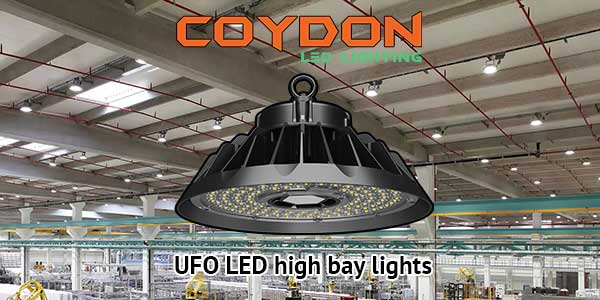
UFO LED high bays look like flying saucers. They are round and compact. Typical mounting height is 4.5 to 15 meters. That is 15 to 50 feet. These lights have a circular beam pattern. They spread light evenly downward. Use them in warehouses and workshops. Gyms and factories also work well. Coydon makes the KD-HBD series. It delivers 150 lm/W. That is very efficient. You can add a microwave sensor. Lights dim when nobody is there. You save another 30–50% on electricity. 1-10V dimming is also available. Connect it to building automation systems. One 200W UFO LED replaces one 400W metal halide. Same brightness, half the power. No warm-up time either. Instant on, instant off. The LED lasts 50,000 hours. Metal halide lasts only 15,000 hours. You change bulbs three times less often. That saves labor and maintenance costs. Choose 60° beam for high racks. Choose 90° or 120° for lower ceilings.
4.2 LED Flood Lights – For Wide Outdoor and High-Intensity Areas
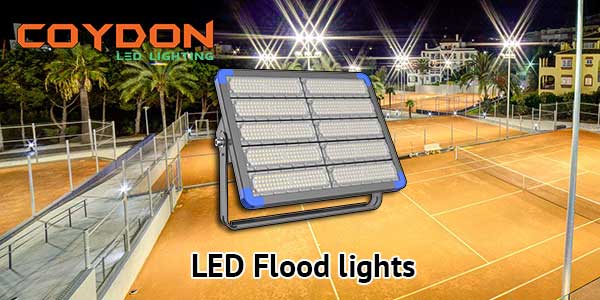
Flood lights shine over large areas. They are not round like high bays. They have rectangular or asymmetric beams. Use them for sports fields and loading yards. Building facades also need flood lights. Coydon has two flood light series. KD-FLN and KD-FLM. Beam angles range from very narrow to very wide. You can get 10° for long-distance aiming. You can get 130° x 30° for rectangular areas like tennis courts. IP66 rating means strong water jets won’t hurt them. Rain, snow, and washdowns are fine. One 150W LED flood light replaces one 1000W halogen. The LED is brighter and lasts 25 times longer. No more climbing poles every few months. Halogen bulbs get extremely hot. LED stays cool to the touch. That is safer for your workers. Flood lights also come with multiple mounting options. You can put them on poles, walls, or the ground.
4.3 How to Choose Between High Bay and Flood Light
Here is a simple rule. Indoor high ceiling? Use a UFO high bay. Outdoor or very wide area? Use a flood light. But sometimes you need both. Example: a warehouse with a loading dock. Inside the warehouse, use high bays. Outside on the dock, use flood lights. Another example: a gymnasium. High bays for the main court. Flood lights for the exterior entrance. Do not use flood lights indoors. They create harsh shadows. Do not use high bays outdoors. Their beam is too narrow. Match the light to the space. Consider the mounting height first. Above 15 feet, high bays work best. Below 15 feet, flood lights can work. But always check the beam angle. A narrow flood light can reach far distances. A wide high bay covers floors well. Coydon can help you choose. Send us your room size and height. We run a free Dialux simulation. You will see exactly what works. No guesswork, just data.
5. Key Features You Cannot Ignore
5.1 Beam Angle – 60°/90°/120° for High Bay, 10° to Asymmetric for Flood Light
Beam angle controls light spread. High bays use 60°, 90°, or 120°. 60° is a narrow beam. Use it for high racks and tall aisles. Light reaches far down. 90° is standard for most warehouses. It balances spread and intensity. 120° is wide. Use it for lower ceilings under 20 feet. Flood lights have more options. You can get 10°for spotlighting. You can get 130 x 30° asymmetric. That shape is perfect for tennis courts. It covers a long rectangle evenly. Choosing the wrong angle causes problems. Too narrow creates dark zones between fixtures. Workers cannot see properly. Too wide causes glare. Light spills into people’s eyes. Glare is dangerous in factories. It causes eye strain and accidents. Always match beam angle to your mounting height. Also match it to fixture spacing. A good rule: spacing should not exceed mounting height times two. Coydon helps you calculate the right angle. We do a Dialux simulation for free. You get a report showing exact light levels.
5.2 IP Rating – IP65 vs IP66 in Real Environments
IP rating tells you dust and water protection. IP65 means dust-tight. It also resists water jets from a nozzle. IP66 means dust-tight too. But it handles stronger water jets. High pressure washdowns are fine. Use IP65 for most indoor high bays. Warehouses and workshops have dust. Occasional splashes are okay. Use IP66 for outdoor flood lights. Rain is not a problem. Power washing the building is fine too. Example: a foundry has lots of metal dust. IP65 is the minimum there. Example: an outdoor loading yard. Trucks get washed with hoses. You need IP66. Another example: food processing plants. They wash floors and walls daily. IP66 is required there. Coydon products meet both ratings. Our high bays are IP65. Our flood lights are IP66. You do not need to worry about failures from dust or water. Check IP rating before you buy. Cheap lights often skip this. Then they fail after one rainy season.
5.3 Smart Controls – Microwave Sensor and 1-10V Dimming
Smart controls save even more energy. A microwave sensor detects motion. Lights stay at 100% when people are near. After a set time with no motion, lights dim to 20% or turn off. This cuts electricity use by 30–50%. Great for warehouses with occasional traffic. Great for parking lots and stairwells too. 1-10V dimming is another option. It connects to building automation systems. You can schedule lights to dim at night. Or brighten for a shift change. Coydon UFO high bays support both features. You can add a microwave sensor inside the fixture. No extra wiring needed for the sensor. 1-10V dimming uses two low-voltage wires. Many green building projects require these controls. They help earn LEED points. They also make employees happier. Nobody likes working under full bright lights all day. Dimming gives flexibility. You can set different levels for cleaning, working, and breaks. Ask us about smart controls for your project. We can add them to any KD-HBD series light.
6. Real Project Case Studies – Coydon Lighting in Action
6.1 Case A: Outdoor Tennis Court Illuminated with 150W LED Flood Lights
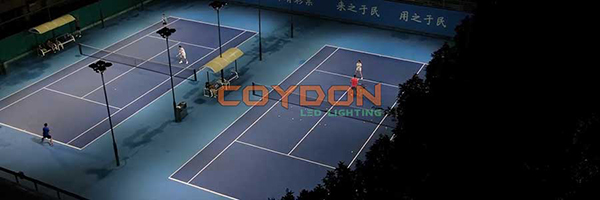
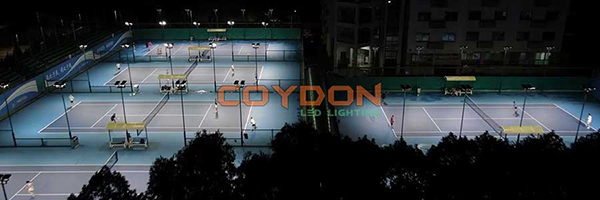
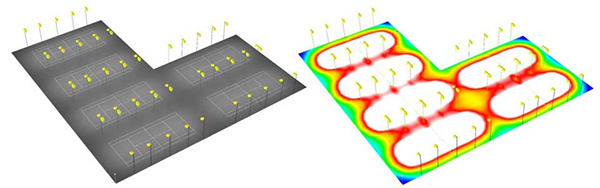
The calculation report: high power LED flood lights 150 watt x 120 piece ( Project 02 )
This project has six tennis courts. There are 40 poles in total. Some poles hold two LED flood lights. Other poles hold four lights. The layout uses 120 fixtures of Coydon KD-FLN-W150 with 60° beam angle. Each fixture runs at 154W and gives 19,829 lumens. Total system power is 18.5 kW. We ran a full Dialux simulation. The results are very good. Overall ground average illuminance is 311 lux. Individual court averages range from 412 to 443 lux. Uniformity u0 is between 0.77 and 0.80. This meets amateur match requirements easily. It also satisfies professional training standards. The pseudo-color map shows even light distribution. No dark spots exist on any court. Players see the ball clearly. Shadows are minimal. The design uses asymmetric aiming to reduce glare. For comparison, 1000W halogen lights would need 120 kW for the same layout. That is six times more power. Halogens also last only 2,000 hours. Our LEDs last 50,000 hours. This tennis court now saves over $36,000 per year in electricity. The payback period is less than 18 months. This case proves LED flood lights are superior. You get better light, lower bills, and less maintenance. You also get better visibility for players. No more dark spots between poles.
6.2 Case B: Warehouse with 150W UFO LED High Bays
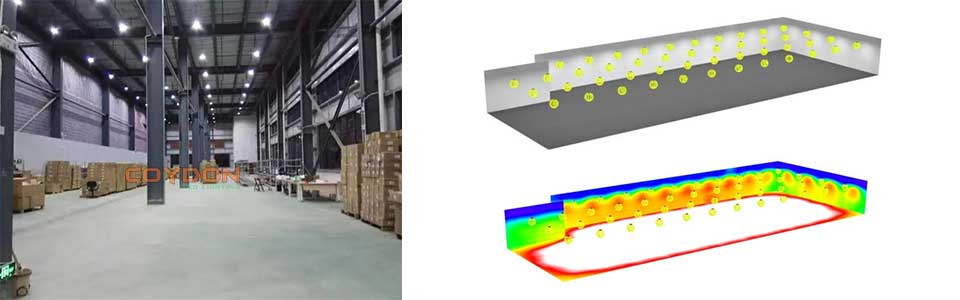
The calculation report: UFO LED high bay lights 150 watt x 46 piece ( Project 02 )
This warehouse has a floor area of 2,323 square meters. Ceiling height is standard for industrial use. We installed 46 Coydon UFO LED high bays. Each fixture uses 146.3W and delivers 22,039 lumens. Total system power is 6.73 kW. Total light output is 1,013,803 lumens. The Dialux simulation gave excellent results. Working plane average illuminance is 338 lux. Floor average illuminance is 329 lux. Uniformity u0 on the working plane is 0.389. Power density is only 2.90 W per square meter. The customer originally expected lower performance. Our solution exceeded their requirements. No dark corners remain in the warehouse. The false color map shows smooth light distribution. The isolux diagram proves even coverage. Lights turn on instantly with no warm-up. There is no flicker or hum. The payback period is about 12 to 18 months. This project shows how 150W UFO LEDs can replace older 400W metal halide systems. You get the same or better light with less than half the energy. Maintenance costs drop too. No more bulb changes every year. The warehouse runs cooler because LEDs produce less heat. That saves air conditioning too. Workers also report less eye strain. Better light means safer operations.
6.3 How We Deliver: Free Dialux Simulation for Your Project
Coydon offers free Dialux simulations for every customer. You do not need to guess. You do not need to hire an outside consultant. Just send us your room size and ceiling height. Tell us your target illuminance. We will run a professional simulation. You get a full report with isolux diagrams and false color maps. You will see exactly where light falls. You will know if you need more fixtures or fewer. This service is completely free. There is no obligation to buy. We do this because we are lighting engineers first. We want you to be confident before you spend money. Real projects need real data. Dialux simulation gives you that proof. Many competitors only give you brochures. We give you data. You can also ask for a layout drawing. We will show you pole positions and aiming angles. Contact us today. Send your project details. Get your free simulation report within 48 hours. Then you can make a smart purchase decision. Click the “Inquiry Now” button to start. Your project could be our next case study. Let us help you save energy and money. No risk, just real engineering support.
7. LED vs Traditional Lighting
7.1 Comparison 1 – Tennis Court: 150W LED Flood Light vs 1000W Halogen Flood Light
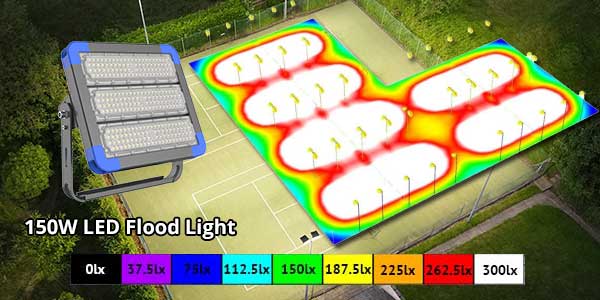
The Dialux Report:
high power LED flood lights 150 watt x 120 piece ( Project 02 )

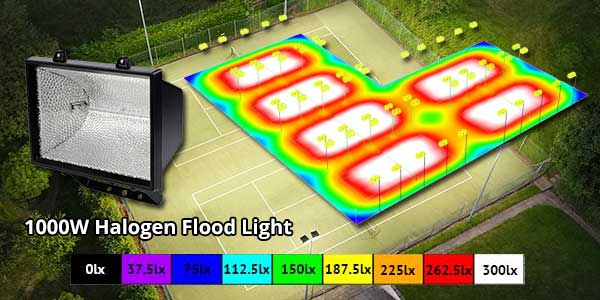
The Dialux Report:
Halogen flood lights 1000 watt x 120 piece
We ran a real test. Same tennis court. Same 40 poles. Same 120 fixtures. One side used 1000W halogen flood lights. The other side used Coydon 150W LED flood lights (KD-FLN-W150). The table below shows what we found.
| Parameter: | 1000 Watt Halogen Flood Light | Coydon 150 Watt LED Flood Light |
| Single lamp power: | 1000 Watt | 154 Watt |
| Total power (120 lamps): | 120,000W (120 kW) | 18,480W (18.5 kW) |
| Single lamp lumens: | ~16,257 lm | 19,829 lm |
| Total lumens (120 lamps): | ~1,950,000 lm | 2,379,480 lm |
| Overall ground average lux: | 237 lx | 311 lx |
| Single court average lux: | 285–308 lx | 412–443 lx |
| Overall uniformity u0: | 0.237 | 0.204 |
| Single court uniformity u0: | 0.61–0.82 | 0.77–0.80 |
| Lifespan: | 2,000 hours | 50,000 hours |
| Yearly energy (3,000h): | 360,000 kWh | 55,440 kWh |
| Yearly electricity cost ($0.12/kWh): | $43,200 | $6,653 |
Let’s walk through the numbers.
- First, power. One halogen lamp pulls 1000 watts. One LED pulls only 154 watts. That is 85% less power. Multiply by 120 lamps. Halogen uses 120 kilowatts. LED uses only 18.5 kilowatts. Your demand charge goes way down.
- Second, brightness. A single halogen gives about 16,257 lumens. A single LED gives 19,829 lumens. That is 22% more light. So you get more light using less power.
- Third, light on the ground. Halogen gives 237 lux average across the whole site. LED gives 311 lux. That is 31% brighter. Look at each single court. Halogen gives 285 to 308 lux. LED gives 412 to 443 lux. That is a huge jump.
- Fourth, uniformity. On each court, halogen’s uniformity u0 is between 0.61 and 0.82. LED’s uniformity is between 0.77 and 0.80. That means more even light. No dark spots in the corners.
- Fifth, lifespan. Halogen lamps die after 2,000 hours. That is about one year if you use them 6 hours a night. LED lasts 50,000 hours. That is 25 years. You will never change a bulb again.
- Sixth, energy cost. Halogen costs $43,200 per year in electricity. LED costs only $6,653. You save $36,547 every single year. That is over $3,000 per month. The payback period is less than 18 months. After that, all savings go to your pocket. Halogen also produces a lot of heat. That heat makes your cooling system work harder. LED runs cool. So you save even more on air conditioning.
The conclusion is simple. LED flood lights are better in every way. Less power, more light, longer life, lower cost.
7.2 Comparison 2 – Warehouse: 200W UFO LED High Bay Light vs 400W Metal Halide High Bay Light
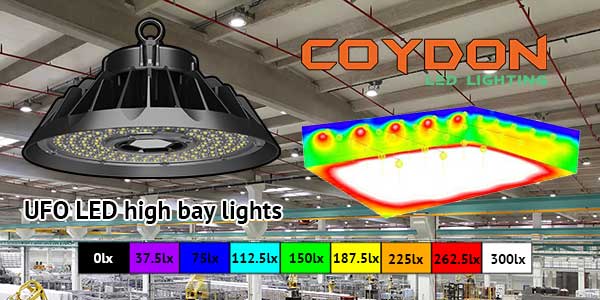
The Dialux Report:
30 PCS 200 Watt UFO LED high bay lights
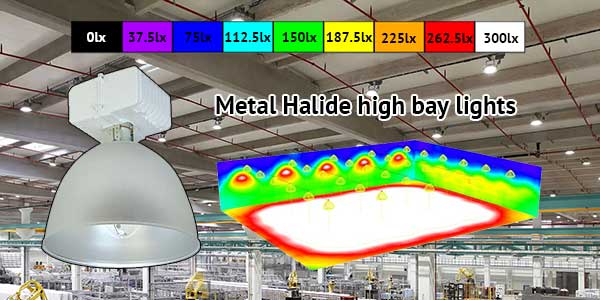
The Dialux Report:
30 PCS 400 Watt Metal Halide high bay lights
Now let’s look at a warehouse. The space is 2,000 square meters. Ceiling height is 10 meters. We used 30 fixtures in total. One system used 400W metal halide lamps with ballasts. The other used Coydon 200W UFO LED high bays (KD-HBD-W200). Here is the comparison table.
| Parameter: | 400 Watt Metal Halide High Bay Light | Coydon 200 Watt UFO LED High Bay Light |
| Single lamp actual power: | 458 Watt | 204 Watt |
| Total power (30 lamps): | 13,740W (13.74 kW) | 6,120W (6.12 kW) |
| Single lamp lumens: | 28,030 lm | 28,675 lm |
| Total lumens (30 lamps): | 840,900 lm | 860,250 lm |
| Working plane average lux: | 324 lx | 322 lx |
| Uniformity u0 (working plane): | 0.484 | 0.496 |
| Power density: | 6.87 W/m² | 3.06 W/m² |
| Lifespan: | 10,000–15,000 hours | 50,000+ hours |
| Startup time: | 3–5 minutes warm-up | Instant on |
| Yearly energy (4,000h): | 54,960 kWh | 24,480 kWh |
| Yearly electricity cost ($0.12/kWh): | $6,595 | $2,938 |
Let’s break it down.
- First, power. A metal halide fixture uses 458 watts (including the ballast). Our LED uses 204 watts. That is a 55% reduction. For 30 fixtures, total power goes from 13.74 kilowatts down to 6.12 kilowatts. You save 7.6 kilowatts every hour the lights are on.
- Second, light output. Metal halide gives 28,030 lumens per lamp. LED gives 28,675 lumens. That is slightly more. Total lumens: 840,900 vs 860,250. LED wins by about 2%.
- Third, illuminance on the working plane. Metal halide gives 324 lux. LED gives 322 lux. They are almost identical. So you get the same brightness with half the power.
- Fourth, uniformity. Metal halide’s u0 is 0.484. LED’s u0 is 0.496. LED is a little better. That means fewer dark spots between fixtures.
- Fifth, power density. Metal halide uses 6.87 watts per square meter. LED uses only 3.06 watts per square meter. That is less than half. Your electrical panel will thank you.
- Sixth, lifespan. Metal halide lasts 10,000 to 15,000 hours. That is 2 to 3 years of normal use. LED lasts over 50,000 hours. That is 10 to 15 years. No more changing bulbs in high ceilings.
- Seventh, startup time. Metal halide takes 3 to 5 minutes to warm up. You cannot just turn it on and off. LED is instant. Flick a switch and you have full light.
- Eighth, energy cost. Metal halide costs $6,595 per year. LED costs $2,938 per year. You save $3,657 every year. The payback period is about 12 to 15 months.
Metal halide also produces a lot of heat and UV radiation. LED produces almost no heat and no UV. That is safer for workers and products. So again, LED wins.
7.3 Why Retrofit Now: 12 to 18 Month Payback
Let’s add up the savings. The tennis court saves $36,547 per year on electricity. The warehouse saves $3,657 per year. That is just the start. Now add maintenance. Halogen bulbs cost about $10 to $20 each. You have 120 of them. Replace them every year. That is $1,200 to $2,400 just for bulbs. Plus labor. A crew to change 120 lamps costs money. They need a lift or a ladder. That is risky and expensive. Metal halide bulbs cost $15 to $30 each. You have 30 lamps. Replace them every 2 to 3 years. Still costs money. LED? No bulbs to change for 10 to 15 years. Zero maintenance cost. Also, LED lights produce less heat. Your air conditioner runs less. That saves even more electricity.
That lowers your upfront cost. So total payback is usually 12 to 18 months. After that, every dollar is pure saving. Over five years, the tennis court saves over $180,000. The warehouse saves over $18,000. The initial investment is small compared to those numbers. Retrofitting is easy. Most LED fixtures fit existing mounts. You don’t need new wiring in most cases. The decision is clear. Old lighting is a drain on your budget. LED lighting pays for itself fast. Don’t wait another month. Contact Coydon Lighting today. We will give you a free Dialux simulation for your facility. You will see exact light levels and exact savings. Then click “Inquiry Now” to order your lights. Start saving money now.
8. Why You Can Trust Coydon Lighting
8.1 5-Year Warranty and Real-World Testing
Coydon gives you a 5-year warranty. That is our promise to you. We test every single light before it ships. Each fixture runs on our aging rack for hours. We also spray them with strong water jets. That checks the IP65 and IP66 ratings. No leaks. No early failures. We only ship lights that pass. Our warranty covers any defect. If something breaks, we replace it fast. No arguments. No hidden fees. That removes all your risk. You can buy with full confidence. Many sellers offer only 1 or 2 years. We offer 5 years. That shows how much we trust our products.
8.2 Engineering Support – From Dialux to Your Project
We don’t just sell boxes with LEDs. We design your lighting system remotely. First, you send us your floor plan. Tell us your ceiling height. Tell us your target lux level. Then we run a free Dialux simulation for you. You get a full report with isolux diagrams and false color maps. You see exactly where each light goes. You see the expected illuminance. No guessing. No overbuying. Need advice on beam angles? We give it. Want microwave sensors or 1-10V dimming? We provide wiring diagrams and setup guidance. We also share installation drawings for your local electrician. Our support includes technical emails and video calls. That is real engineering service. You never feel lost.
8.3 Proven Track Record with Hundreds of Customers
We have served many customers across different industries. The tennis court case in this guide is real. The warehouse case with 46 UFO lights is also real. Both come from actual Dialux files. We did not invent any numbers. Our customers trust us. They come back for more projects. They refer us to their partners. That is social proof. You are not our first customer. You will not be our last. Join the list of satisfied owners. Contact us today. Let us add your project to our track record.
9. Ready to Upgrade Your Industrial Lighting?
9.1 Get a Free Dialux Simulation for Your Facility
You don’t need to guess. Just send us your room size. Tell us your ceiling height. Tell us your current lamp type. Tell us how bright you want it to be. We will run a professional Dialux simulation for you. This service is completely free. There is no obligation to buy anything. You get a clear report before you spend a dollar. That is zero risk for you. Many customers use this to compare options. They feel confident after seeing the numbers.
9.2 Request a Quote – Tell Us Your Project
Ready to move forward? Click the “Inquiry Now” button below. Tell us which light model you need. Give us the quantity and mounting height. Let us know your beam angle preference. Do you want microwave sensors? Do you need 1-10V dimming? Just write it in your message. We will reply within 24 hours. That is our promise to every customer. We don’t keep you waiting.
9.3 What Happens After You Inquire?
Here is the simple process. Step one: we receive your inquiry. Step two: our engineer contacts you to confirm all details. Step three: we run your free Dialux simulation. Step four: we send you a quote with product specs. Step five: we ship your lights after payment. That is it. No confusion. No hidden steps. You know exactly what comes next. We make the whole process easy. Start today by clicking the button.
10. Light the Right Way
10.1 Don’t Let Old Technology Drain Your Budget
Every hour your old lights run, you lose money. Halogen and metal halide waste most of their energy as heat. LED gives you more light for less power. Our Dialux reports prove the results before you buy. No guessing. No empty promises. Upgrade now and start saving.
10.2 Click “Inquiry Now” to Start Your Energy Saving Journey

Ready to cut your electricity bill? Click the “Inquiry Now” button. Get a free Dialux simulation for your facility. Get a quick quote within 24 hours. Enjoy 5 years of warranty. Our team is here to help. Don’t wait another month. Contact Coydon Lighting today.