130 lm/W and 150 lm/W: Understanding Industrial LED Efficiency for High Bays and Flood Lights

Table of Contents
1: The Industrial LED Efficacy Dilemma: Why lm/W Matters More Than Ever
1.1: The Hidden Costs of Misleading Efficacy Metrics
Industrial LED procurement has a dirty little secret. Most suppliers quote raw LED chip outputs recorded in laboratory cold tests. They omit total system luminaire lumens on their spec sheets. What looks great on a catalog page rarely translates to actual performance once mounted overhead.
Inside sealed light housings, operational efficiency takes a sharp hit. Junction temperature climbs rapidly around circuit boards. Polycarbonate optics block part of the light beam. Internal drivers waste power as heat. Add these up, and actual light output plummets.
This inflation leaves site managers stranded with under-lit work floors. Warehouse racks cast heavy shadows, and open aisles miss minimum lux targets. Darkness on the floor forces workers to slow down, raising safety concerns for forklift drivers.
Fixing this later means buying extra fixtures you never budgeted for. Adding new units requires paying electricians for extra conduit runs and labor hours. Your monthly electric bill jumps because total connected wattage went up.
Fake efficiency ratings eat into your operating margins over five years. You keep paying power companies for energy that never turns into useful floor lumens. Always demand verified LM-79 reports before making bulk purchasing commitments.
1.2: 130 lm/W vs. 150 lm/W: Matching Efficacy to Application Dynamics
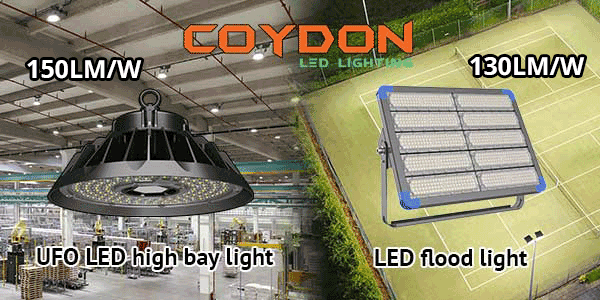
Big spec numbers sell well on paper, yet real industrial sites rarely care about pure catalog optics. What works on factory floors depends entirely on site conditions, not raw rating figures. Testing at Coydon Lighting proves indoor and outdoor setups demand vastly different design priorities.
Consider indoor logistics hubs, where hanging 150 lm/W UFO high bays pays off fast. Operating twenty-four-seven in relatively clean spaces, these units run continuously. Squeezing out extra lumens cuts power bills significantly, all without thermal damage to internal boards.
Outdoor heavy-duty floodlights face an entirely different battle against nature. Moisture, dust storms, and heavy power surges kill weak driver chips fast. Building true IP66 housing demands thick PC lenses alongside dense alloy castings. Naturally, these heavy shields block a small fraction of light.
Thus, 130 lm/W stands as the ideal engineering balance for outdoor floods. Pushing an exterior fixture to 150 lm/W often forces makers to thin out lenses or trim surge modules. Never trade structural protection for a tiny bump in energy ratings.
At Coydon, our shop team builds gear that survives brutal field use. We spec high bays for maximum efficiency and floods for sheer structural toughness. Striking this balance keeps your long-term replacement costs down.
2: The Physics of Efficacy: Why High Bays and Flood Lights Differ
2.1: Deconstructing System Efficacy: Driver, Optical, and Thermal Losses
Ever wonder why a 180 lm/W chip setup never yields 180 lm/W on factory floors? Standard specs tell half the story. In real life, light output bleeds out at three physical choke points.
Take a standard driver first. Converting incoming high-voltage AC into steady DC power isn’t lossless. Top-grade industrial power units hit around ninety-two percent efficiency. That leaves eight percent of your power turning straight into wasted heat inside the electrical box. Cheap power supplies bleed even more, wasting extra power before diodes even light up.
Next, watch what happens when light hits optics. Bare LED chips scatter beams every which way without control. To focus that output onto work zones, secondary optics are necessary. Yet even high-transmittance PC lenses or tempered glass covers absorb three to eight percent of useful lumens through surface reflection.
Heat forms the third barrier inside sealed metal bodies. As current runs, diode junction temperature climbs fast on the board. Poor heatsinks can’t flush that heat quickly enough away from chips. When junction temps stay hot, LED output naturally drops another five to ten percent.
Add up these driver drops, optical hits, and junction heat losses. Suddenly, that fancy 180 lm/W chip delivers only 130 to 150 lm/W as a finished fixture. Knowing these real-world losses keeps procurement teams from overpaying for paper-only numbers.
2.2: Outdoor Sealing vs. Indoor Heat Dissipation: The Engineering Trade-off
Cooling LEDs inside a completely sealed outdoor fixture isn’t easy. Heavy rubber gaskets and thick glass plates block rain, humidity, and dirt effectively. While these IP65 or IP66 seals withstand bad weather, they trap heat inside. Zero internal airflow leaves thermal energy nowhere to go during long shifts.
Without air moving across circuit boards, metal conduction does all the heavy thermal lifting. Solid cast aluminum fins absorb that trapped heat slowly. Diode junction temps stay warm on the board as a result. Running lower drive currents protects sensitive internal components, effectively capping fixture output near 130 lm/W.
Indoor UFO high bays play by very different physical thermal rules. Operating in clean factory air allows open body castings with hollow air channels. Hot air off the board rises quickly through central housing vents. Cooler air near the floor gets sucked upward automatically, creating a chimney effect.
This continuous vertical air breeze flushes board heat directly out into room space. Cooler junction temps mean factory engineers can drive chips harder safely. Thanks to that passive convective airflow, high bays reach 150 lm/W without risking early diode failure or color shifting.
Outdoor floods trade raw efficacy for total weather defense and IP protection. High bays trade heavy sealing for maximum air cooling and high lumen output. Each lighting design aligns thermal management directly with real-world job site needs.
3: Deep Dive into UFO LED High Bays: The 150 lm/W Benchmark
3.1: Technical Analysis of Coydon KD-HBD Series High Bays
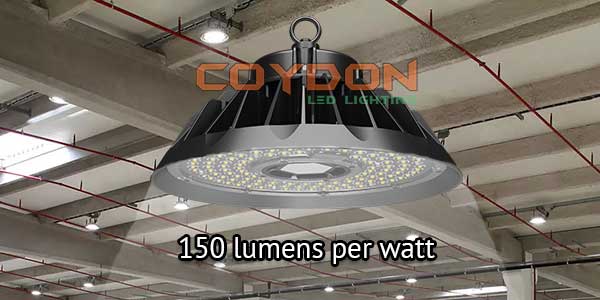
Maintaining a true 150 lm/W rating on factory floors takes more than sticking high-efficiency diodes onto a circuit board. With the Coydon KD-HBD high bay series, our team targets real facility needs across 100W, 150W, and 200W or 240W options. Tailoring wattage directly to ceiling clearance keeps work surfaces bright without wasting power on empty walkways.
We build these light engines around OSRAM SMD 2835 LED chips soldered onto thick metal core boards. These specific diodes handle heavy thermal loads smoothly while keeping system output at a clean 150 lm/W. With a color rendering index exceeding CRI 80, assembly line workers inspect fine machine parts and distinguish wiring colors without eye strain.
Heavy machinery starts and power grid surges kill cheap drivers fast. To prevent early driver failure, the KD-HBD relies on isolated AC 90V to 305V wide-voltage power units. Built-in surge suppression dampens dangerous voltage spikes before raw power reaches diode junctions, protecting lumen output across long factory shifts.
Choosing lens angles depends entirely on mounting height and aisle spacing. Coydon supplies the KD-HBD family with 60°, 90°, and 120° optical lenses. A narrow 60° beam drives light straight down into tall warehouse racking, whereas a wide 120° lens covers expansive, open manufacturing floors evenly.
Dust, floating oil mist, and ambient moisture ruin unprotected indoor lights over time. We house the KD-HBD in a heavy IP65 aluminum casing designed to block shop spray. Thick die-cast cooling fins channel heat away from diode junctions quickly, locking in that 150 lm/W performance over years of daily operation.
3.2: Mounting Height Optimization and Lumen Preservation
Industrial plant ceilings usually measure anywhere from 15 to 50 feet overhead—roughly 4.5 to 15 meters. Lighting high clearances requires careful photometric planning. Upgrading ceiling specs to high efficacy 150 lm/W UFO bays changes fixture layout math completely. Delivering more usable lumens directly down to task surfaces lets design engineers specify far fewer total fixtures while hitting target foot-candle levels easily.
Dropping total fixture counts slashes initial hardware invoices immediately. Electrical installation crews pull less heavy copper wire, fit fewer junction boxes, run less EMT conduit, and log fewer billable scissor lift hours. On a typical fifty thousand square foot warehouse build, removing twenty light points cuts major equipment costs and contractor labor upfront.
Changing out dead high bays hanging forty feet up disrupts factory production lines and drains maintenance cash. High catalog efficacy claims lose value quickly if chip output plummets after two years of hot daily running. That makes verified long-term lumen maintenance just as critical as initial lumen ratings.
Coydon demands certified LM-80 test reports spanning six thousand continuous test hours for every LED chip batch. We plug those raw chip degradation metrics directly into official TM-21 mathematical extrapolation models to project real-world lumen retention. Low board operating temperatures allow our high bays to retain over ninety percent initial light output past fifty thousand operating hours.
Choosing 150 lm/W high bays supported by certified TM-21 calculations protects long-term facility investments. Plant managers achieve required floor lux levels using fewer total ceiling drop points, avoiding gradual lumen loss over years of daily service.
4: Deep Dive into Industrial LED Flood Lights: The 130 lm/W Standard
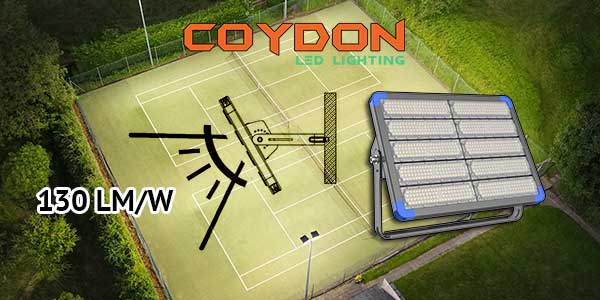
4.1: Technical Analysis of Coydon KD-FLN & KD-FLM Series
Heavy-duty outdoor floodlighting demands high thermal capacity to survive nonstop night work. Coydon builds the versatile KD-FLN series for perimeter fences and storage yards from 50W up to 600W. When projects call for massive high-mast ports or sports stadiums, our heavy KD-FLM series steps up wattage options from 750W to 1250W.
Both floodlight series rely on high-output Lumileds SMD 3030 LED packages for primary light generation. Diodes sit directly on thick metal core circuit boards so heat moves away fast. Driven by constant-current power units, these LED arrays maintain steady floor illumination through long, hot operational shifts.
Harsh weather ruins cheap outdoor luminaires quickly. That is why Coydon enforces full IP66 ingress protection across all KD-FLN and KD-FLM aluminum housings. Thick silicone rubber gaskets seal housing joints tight, blocking driving rain, salt spray, and fine dust from reaching sensitive electronics inside.
Distributing lumens across large spaces requires durable lens materials. Coydon fits die-cast aluminum cooling fins with impact-resistant polycarbonate optical lenses. These clear PC optics deliver high light transmission while standing up to harsh sun exposure without yellowing over time. Precision optics let engineers target light right where work crews need it.
We support the complete KD-FLN and KD-FLM product line with a standard 5-year factory warranty. This coverage provides direct luminaire replacement if LED drivers, diode chips, or housing seals fail under regular site operating conditions.
4.2: The Crucial Role of Multi-Angle & Asymmetric Optics in Floodlighting
Broad symmetrical light beams often waste raw lumen output on unintended off-site areas. Coydon equips the KD-FLN series with flexible optical choices ranging from 15° to 90° for standard yard posts. For narrow long-throw high masts, our heavy KD-FLM lineup extends beam options down to a tight 10°.
Asymmetric optical lenses prove essential for perimeter boundary lines and outdoor sports venues. These specialized directional lenses throw light forward onto target spaces without tilting the heavy fixture housing. Keeping luminaires mounted completely flat avoids off-site glare and stops spill light from troubling neighboring properties.
Looking only at raw catalog efficacy figures like 150 lm/W often tricks project engineers. Standard unoptimized 150 lm/W luminaires scatter light rays upward into empty night air. Only a small portion of that raw output hits active ground zones where site technicians work.
A targeted 130 lm/W fixture with precise optical distribution channels light directly onto target surfaces. Detailed photometric DIALux simulation reports confirm that targeted beam control yields far higher effective foot-candles or ground lux. High optical utilization efficiency beats high raw chip efficiency every single time.
Proper beam shaping allows facility engineers to hit required lux levels using fewer total fixtures. Industrial plant operators reduce overall hardware costs while improving light uniformity across critical working areas. Selecting exact multi-angle and asymmetric optics delivers maximum usable illumination right where industrial sites need it.
5: Real-World Case Studies: Quantifying Efficacy and ROI
5.1: Project Case 1: Industrial Warehouse High-Bay Retrofit (150W KD-HBD)
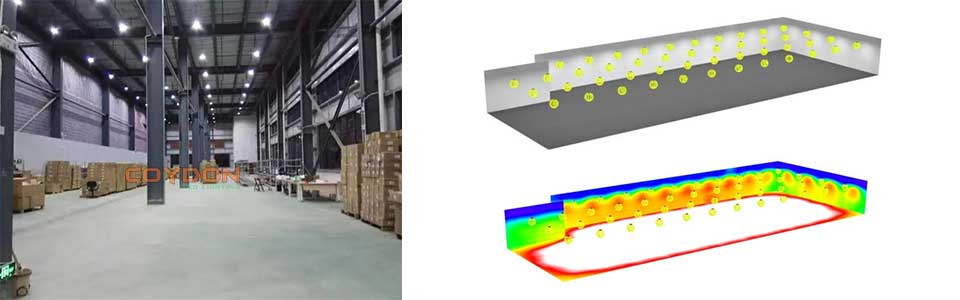
The calculation report: UFO LED high bay lights 150 watt x 46 piece ( Project 02 )
A busy logistics hub needed better ground light levels along tall storage racks. Coydon supplied 150W KD-HBD UFO high bays for this facility, mounting them nine meters above the concrete slab. Our engineering team selected a 90-degree optic lens to push lumens down into narrow packing aisles without wasting output on top shelf edges.
Contractors checked all target lux levels in DIALux software before running main electrical conduits. Simulation runs returned 310 average ground lux across active working floor zones. Photometric calculations gave an overall uniformity ratio of 0.68, which clears out dark shadows between high pallet racks and improves forklift operator visibility.
Site crews mounted these round aluminum lights straight onto ceiling steel beams using heavy steel ring hooks and safety steel cables. Power meters logged total electrical draw at 6.9 kilowatts for the whole 2,500 square meter storage bay. That brings real site power density down to 2.7 watts per square meter, which aligns with standard CIBSE industrial warehouse rules.
Smart lens selection meant required ceiling drop points dropped across the building installation grid. Electrical teams bypassed eight junction boxes compared to standard layouts, yet ground lux stayed right on target. Skipping those extra drop locations reduced copper wire usage, shortened EMT conduit runs, simplified AC input wiring, and saved contractor installation hours.
This logistics warehouse project shows why clean optical distribution matters on real job sites. Industrial plant owners keep required floor light high while cutting monthly power costs. Reliable high-bay optics deliver long-term industrial performance while making future routine maintenance quick and simple for site operators.
5.2: Project Case 2: Outdoor Sports & Commercial Floodlighting (150W KD-FLN)
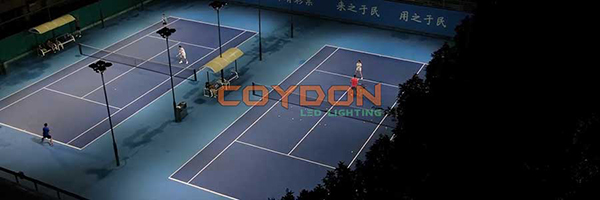
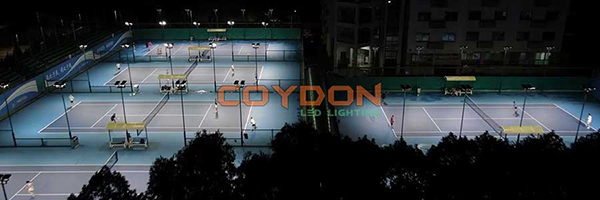
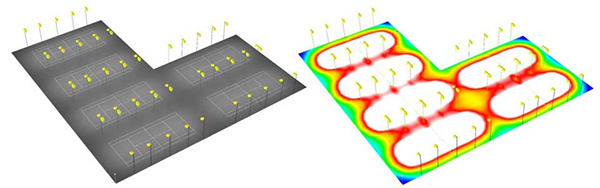
The calculation report: high power LED flood lights 150 watt x 120 piece ( Project 02 )
An outdoor tennis facility needed bright court lighting without disturbing surrounding residential neighborhood houses. Coydon supplied high-output 150W KD-FLN series LED floodlights mounted on eight-meter perimeter steel poles. Our optical team picked specialized asymmetric optical lenses to project lumens directly onto main court playing zones.
Contractors mapped out full photometric coverage in DIALux software before laying underground power cables. Simulation runs showed 130 lm/W optic efficiency providing 350 average lux across active court floor spaces. Asymmetric optical shaping cut upward light bleed, stopping unwanted glare from blinding drivers on nearby perimeter roads.
Site crews clamped these IP66 waterproof floodlights onto pole crossarms using thick steel brackets and heavy anchor bolts. Installers wired internal surge protection modules into each driver box to block high voltage lightning spikes. Light meter checks verified zero dark spots between side fence lines, baseline boundaries, and net posts. High Ra80+ color rendering ratings with steady 5000K daylight color tones helped night players track fast yellow tennis balls easily.
Asymmetric optical control stopped direct blinding light when players tracked high lob serves overhead. Facility planners cut total fixture counts compared to old 400W metal halide floodlight installations. Mounting fewer luminaires lowered upfront hardware costs and reduced future high-pole boom lift rental expenses for site maintenance teams.
This commercial sports lighting project proves how high efficacy optics maximize real playing court performance. Facility operators maintain required competition lux levels while holding night power consumption remarkably low. Advanced floodlight distribution delivers professional sports quality without creating intrusive light pollution in surrounding local neighborhoods.
6: Eliminating Guesswork with Professional DIALux Photometric Simulations
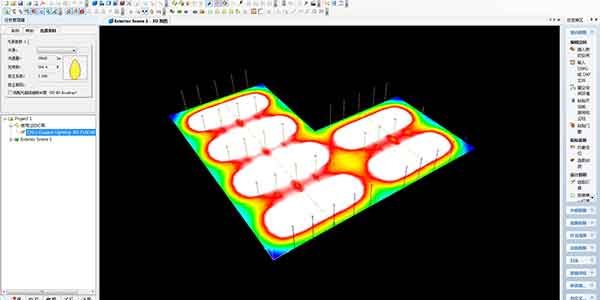
6.1: Why DIALux Simulation is the Gold Standard for B2B Procurement
Electrical installers waste serious money replacing wrong fixtures when real ground lux fails site inspection. Running DIALux 3D software simulations before buying factory stock removes guesswork during industrial lighting procurement.
Our design team imports actual IES photometric files directly into digital facility layouts. We set ceiling heights, wall reflectance levels, and storage rack positions inside the model. Photometric calculations show exact lux levels across floor work zones and narrow aisle paths.
Finding dark shadows or high-glare hot spots during early layout planning prevents costly installation delay. Contractors test beam angles and mounting height options inside the simulation model virtually. That digital test run makes sure physical luminaire positioning hits job specs on day one.
Simulations stop buyers from over-ordering extra lights, saving thousands in unneeded fixture and cable costs. Generated 3D photometric reports give site owners official compliance proof for local building code inspectors. Procurement teams place factory volume orders with total confidence, knowing project light outputs match calculated design targets.
6.2: How Coydon Lighting Delivers Tailored DIALux Reports for Your Project
Coydon Lighting provides free customized DIALux layout designs to ensure optimal fixture placement before order placement. Our experienced lighting engineering team builds accurate digital facility models based on your project floor plans.
We test different layout options using our high-efficiency 130 lm/W and 150 lm/W industrial LED luminaires. Engineers generate clear false color renderings that map out precise foot-candle and lux variations across work surfaces. These visual heat maps help client teams instantly check light uniformity and spot potential low-lux zones.
Full 3D rendering views show realistic light beams hitting storage racks, production equipment, and facility floors. This advanced visual layout proof confirms that your site meets strict commercial building codes without light clutter.
Clients receive complete PDF photometric simulation packages detailing spacing distances, total wattage, and calculated light levels. Our technical team works alongside your contractors to fine-tune fixture angles for optimal performance. Partnering with Coydon ensures your project gets precise, high-efficiency illumination tailored to your budget requirements.
7: Comparative Selection Matrix: 130 lm/W vs. 150 lm/W
7.1: Comprehensive Feature & Application Comparison Table
Field crews check structural mounting points before selecting luminaire families. The comparison matrix below details hardware ratings for Coydon KD-HBD high bays and KD-FLN/FLM outdoor floodlights.
| Spec Parameter | KD-HBD High Bay Series | KD-FLN & KD-FLM Floodlight Series |
| Housing Design | Round aluminum die-cast UFO body. | Modular heavy duty aluminum enclosure. |
| LED Light Engine | OSRAM Opto semiconductors inside. | High lumen Lumileds LED array chips. |
| System Efficacy | Reaches 150 lm/W fixture efficiency. | Reaches 130 lm/W fixture efficiency. |
| Ingress Rating | IP65 dust and water sealed. | IP66 heavy waterproof outdoor rating. |
| Optic Spread | Symmetrical 60°, 90°, and 120° lenses. | Symmetrical 30°/60°/90° or asymmetric 60°x120°. |
| Primary Use | High bay warehouses and plant floors. | Tennis courts, high poles, and facades. |
Site electricians hang KD-HBD high bays straight onto steel ceiling trusses in open production bays. These 150 lm/W UFO units lower monthly energy draw while holding target working lux high on floor surfaces.
Outdoors, installation teams clamp KD-FLN and heavy KD-FLM floodlights onto tall perimeter poles. Specialized beam shaping throws clean uniform foot-candles across court surfaces, stopping stray light spill onto adjacent residential streets.
7.2: Key Procurement Checklist for Facility Managers and Contractors
Plant buyers review hardware specs before issuing POs for high bay fixtures. Checking site layout details early saves installation crews from real headache.
We look at independent LM-79 sphere test sheets to check true fixture efficiency and LM-80 chip lumen depreciation curves. Skip glossy sales sheets that lack certified sphere data.
Planners pick optics based on clear hook height. Narrow 60-degree glass throws light down past ten meters, whereas broad 120-degree covers low racks.
Get full DIALux layout files before cutting factory PO checks. That calculation report proves floor lux uniformity across aisles before spending site money.
Check silicon seal gaskets around housing corners. Proper IP65 or IP66 glands stop hose washdown spray from ruining driver boards.
Lastly, inspect driver brand specs directly. Quality internal power supplies prevent premature driver burnout and lower routine maintenance costs.
8: Partner with Coydon Lighting for Your Next Industrial Project

8.1: Factory-Direct Manufacturing Quality and 5-Year Warranty Assurance
Buying directly from Coydon Lighting guarantees strict factory quality control on every LED luminaire order. Our production facility maintains total oversight from raw aluminum casting to final box packing.
Assembly line technicians inspect raw driver components and aluminum heat sinks before physical mounting begins. QC staff burn in completed luminaires for forty-eight straight hours on test racks.
Crews dunk floodlight housings in water tanks to test IP66 silicone gaskets. Test bench workers hit power drivers with high surge voltage spikes while optical integrating spheres record total light output.
Factory engineers also run vibration shaker tests to ensure heavy mounting brackets stay secure during site transport. Direct manufacturing cuts distributor markups while ensuring total component batch traceability.
We back our complete commercial product catalog with an ironclad five-year full replacement warranty. Buying straight from Coydon keeps project hardware budgets accountable. Every shipment carries solid warranty coverage backed by real factory engineers on call.
8.2: Request Your Free Customized DIALux Lighting Plan Today
Upgrading industrial facility lighting requires zero guesswork. Our engineering team prepares complete DIALux 3D layout simulations for warehouse and factory projects at no charge.
Simply send us your building dimensions, ceiling hook heights, and target floor lux requirements today. Click the Inquiry Now button on this page to submit your site details directly to our design group.
Our technical staff models precise light coverage across production aisles and storage racks within twenty-four hours. You receive complete false-color rendering maps, IES files, average lux calculations, and fixture count recommendations tailored to your exact floor plan.
Every customized layout package includes transparent factory-direct unit pricing for Coydon KD-HBD high bays or KD-FLN/FLM floodlights. Eliminating middleman markups ensures your commercial lighting project stays well within allocated hardware budgets.
Take action today to upgrade your facility lighting efficiency without financial risk. Reach out now to claim your free customized DIALux simulation report and competitive direct manufacturer price quote.
9: Frequently Asked Questions

Q1: How quickly can Coydon provide custom DIALux simulations for site projects?
Our technical team delivers complete DIALux lighting layout reports within twenty-four hours. Simply send us your warehouse or field dimensions alongside target lux requirements.
Q2: What is the main structural difference between IP65 and IP66 fixtures?
IP65 units resist low-pressure water jets inside indoor plant bays. IP66 housings feature thick silicone gaskets built for harsh high-pressure hose washdown environments.
Q3: How does Coydon handle warranty replacement claims if drivers fail on site?
We send new replacement power drivers or complete light heads directly via door-to-door air shipment. Factory engineers review failed hardware photos without forcing long site shutdown delays.
Q4: Can contractors order custom beam angles or private branding for KD-FLN/FLM floodlights?
Yes, we customize optical beam distributions, laser-etched corporate logos, and specialized mounting brackets for project orders. Contact our sales engineers to confirm specific project minimums.