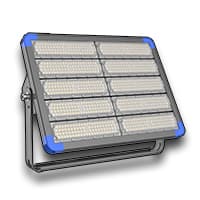
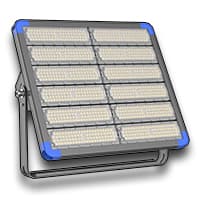
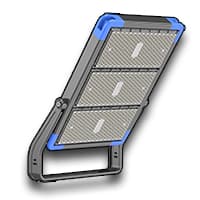
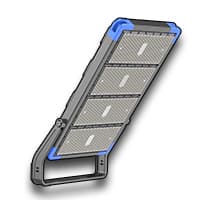
Part 1. Understanding the Core – What Are LED Flood Lights?
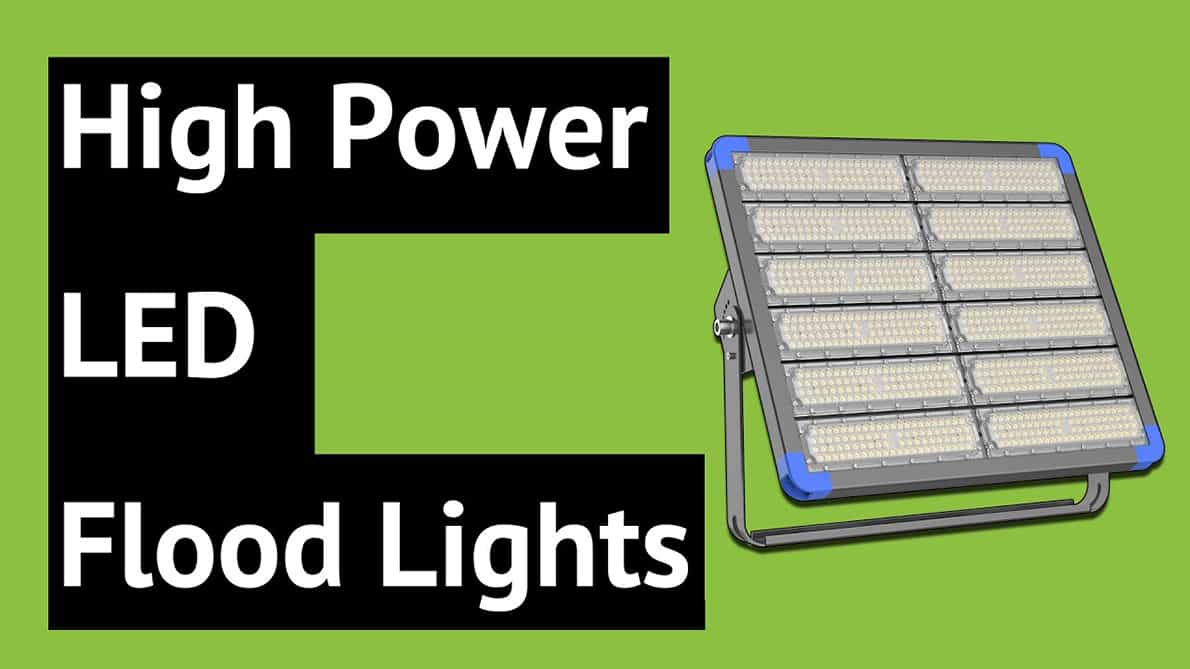
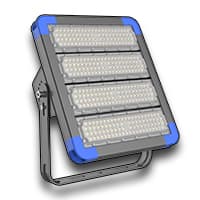
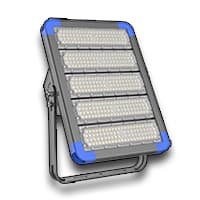
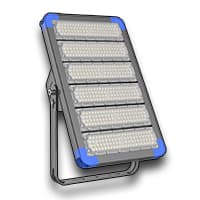
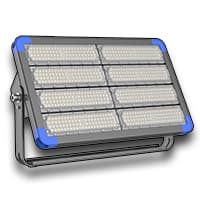
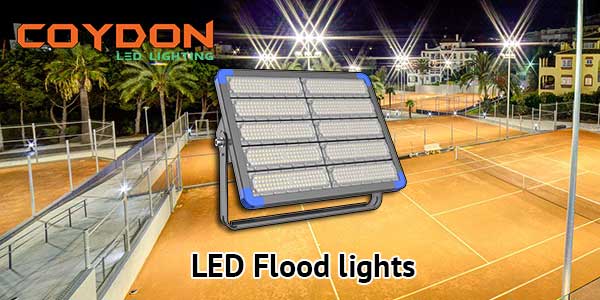
LED Flood Lights are high-intensity, wide-beam luminaires. They are designed for outdoor use. Their primary function is area lighting. They illuminate large spaces uniformly and efficiently.
The name “Flood Light” is very descriptive. It comes from the word “flood,” meaning to cover or fill. This perfectly describes how the light works. It floods a target area with bright, even illumination. Unlike spotlights, flood lights have a wider beam angle.
This wide beam spreads light over a broad surface. It minimizes shadows and dark spots. Common applications include lighting sports fields, parking lots, and building facades. They ensure safety, security, and visibility during nighttime.
1.1 From Halogens to LEDs: A Technological Leap
Outdoor lighting has evolved significantly. Traditional options included halogen and metal halide lamps. These technologies were once the standard. However, they had major drawbacks. They were extremely inefficient. They converted most energy into heat, not light.
Their lifespans were also very short. Frequent replacements drove up maintenance costs. LED technology marked a revolutionary change. It introduced a fundamentally different way to generate light. This is called solid-state lighting.
LEDs are far more efficient at converting electricity into light. They also last exponentially longer. This shift has completely reshaped expectations. Performance, longevity, and efficiency are now standard demands.
1.2 The Modern LED Flood Light: A Complete Solution
Today’s LED Flood Lights are sophisticated systems. They integrate efficiency, durability, and control. They are no longer simple “bulbs in a housing.” They represent a comprehensive lighting solution.
High efficiency means drastically lower energy bills. Superior durability ensures reliable operation for years. Advanced designs allow for precise light distribution. This minimizes wasted light and reduces light pollution.
Coydon Lighting specializes in these advanced solutions. We are committed to providing high-performance products. Our KD-FLN series exemplifies this commitment. It is engineered to meet the toughest outdoor challenges. It delivers exceptional value and performance.
Part 2. Deep Dive – Nine Key Specifications That Define Performance
Choosing a professional LED flood light requires a deep understanding of its technical specifications. These numbers and ratings are not just data. They directly define the product’s true performance in the field. They determine its suitability for your specific application. They also predict its long-term value and reliability.
Each parameter tells a critical part of the story. Together, they form a complete picture of quality and capability. Ignoring them can lead to poor performance, high costs, and disappointment. Mastering them empowers you to make an intelligent, cost-effective investment.
From luminous efficacy to ingress protection, every detail matters. Let’s examine each of the nine core specifications in detail. We will explore what they mean, why they are important, and how Coydon Lighting’s KD-FLN and KD-FLM series are engineered to meet the highest industry standards.
2.1 Input Voltage – The Foundation of Versatility and Compatibility
Definition and Principle
Input voltage defines the electrical power range for a light. It is the span of voltage the driver accepts. This range ensures correct and safe operation. A wide voltage design is a key feature. It showcases advanced power supply engineering. The internal driver circuit is highly adaptable.
This circuit intelligently regulates incoming power. It compensates for both high and low voltage. This automatic adjustment prevents flicker or shutdown. Consistent light output is maintained. This technological feature is essential for modern LEDs. It protects the LEDs from electrical stress. Long-term reliability is significantly enhanced.
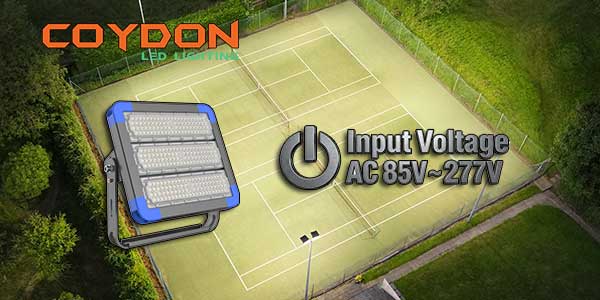
Specification Details (AC 85V ~ 277V)
The specification AC 85V-277V is exceptionally broad. It comprehensively covers global mains voltages. Common standards like 120V and 230V are included. The 85V lower limit is critically important. It provides a large buffer for brownout conditions. Voltage can drop in weak grids without causing failure.
The fixture will start and run reliably. The 277V upper limit serves a specific purpose. It is the standard for commercial lighting in North America. Buildings use 277V derived from 480V three-phase systems. Our lights connect directly to these circuits. This eliminates the need for a step-down transformer. Installation costs and complexity are reduced.
Application Advantages
The universal voltage input delivers major strategic advantages. Logistics and inventory management become much simpler. Distributors can stock a single global model. This reduces complexity and overhead costs. Project planners gain tremendous flexibility. The same fixture can be used across different sites. Even sites within one country can have varying supplies.
Installation is faster and more fault-tolerant. Electricians do not need to verify specific voltage first. This speeds up the commissioning process. Operational reliability is greatly improved in challenging environments. Factories, ports, and rural areas often have dirty power. Our fixtures are built to withstand these conditions. This leads to fewer service calls and lower lifetime costs.
For large international projects, this feature is indispensable. Lighting layouts can be standardized globally. Procurement and maintenance procedures are unified. Coydon Lighting’s KD-FLN and KD-FLM series offer this robustness. They are truly designed for a connected world.
2.2 Colour Temperature – Defining the Mood and Function of Light
Scientific Definition
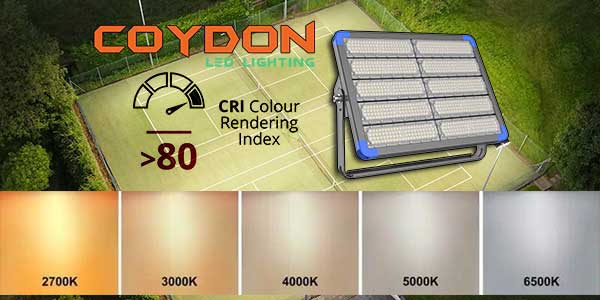
Colour temperature is measured in Kelvin (K). It describes light’s visual warmth or coolness. This is a perceptual metric, not the lamp’s physical heat. It relates to the light’s spectral characteristics. Lower values produce a warm, yellowish glow. Higher values emit a cool, bluish-white light. This scale helps quantify our visual experience.
Understanding this concept is crucial. It affects how we perceive an environment. Warm light feels inviting and relaxing. Cool light appears alert and focused. The right choice enhances any application’s purpose. It is a fundamental tool in lighting design.
Option Analysis (3000K / 4500K / 6000K)
Coydon Lighting offers three primary colour temperatures. Each serves distinct functional and aesthetic roles.
3000K Warm White creates a cozy, welcoming atmosphere. It is perfect for hospitality and leisure spaces. Hotels, restaurant patios, and residential plazas benefit greatly. It makes people feel comfortable and at ease.
4500K Natural White provides clear, neutral illumination. It minimizes visual strain during extended tasks. This balanced light is highly versatile. Parking lots and warehouse aisles are ideal applications. It ensures accurate visibility without harshness. Security and logistics operations rely on this clarity.
6000K Cool White delivers bright, energetic light. It heightens alertness and visual acuity. Sports stadiums and athletic courts often use it. It ensures players and spectators see details clearly. Industrial work zones and perimeter security also utilize it. This temperature promotes safety and precision in demanding tasks.
Selection Guide
Choosing the correct colour temperature is strategic. First, identify the primary goal of the space. Is it relaxation, precise work, or safety? For ambiance and comfort, lean towards 3000K. For general task lighting, 4500K is the most reliable choice. For high-alert and high-accuracy areas, 6000K is superior.
Consider the surrounding environment as well. Match or complement existing architectural lighting. Coydon Lighting’s range of 3000K, 4500K, and 6000K options provides this flexibility. It allows designers to tailor light for function and feel. This ensures every project achieves its intended visual and practical outcome.
2.3 Color Rendering Index (CRI) – The Scale for Color Authenticity
Concept Explanation
The Color Rendering Index measures a light source’s ability. It shows how accurately it reveals object colors. The scale ranges from 0 to 100. A higher number indicates better color fidelity. Sunlight has a perfect CRI of 100 by definition. It serves as the ideal reference point.
High-CRI lighting makes colors look natural. Objects appear as they would under noon daylight. This metric is vital for visual accuracy. It goes beyond simple brightness. It defines the quality of the light itself. Poor CRI can distort colors significantly.
Standard Interpretation (80+)
A CRI of 80+ is a key professional benchmark. It represents a commitment to quality lighting. This standard ensures rich and distinct colors. It provides excellent color saturation and depth. Human skin tones look healthy and recognizable. Vehicles and goods show their true colors.
This level is essential for critical applications. Security and surveillance systems rely on it. License plates and facial features must be clear. Retail displays depend on accurate color. Customers need to see products truthfully. Sports broadcasting requires it for vibrant field colors.
It is not just a technical specification. It is a functional requirement for many tasks. Coydon Lighting fixtures meet or exceed this 80+ standard. They deliver reliable color performance in all conditions.
Value Proposition
High CRI offers significant practical value. It is a mark of superior product quality. More importantly, it provides essential functional benefits. Visual clarity and accuracy are greatly improved. Decision-making is faster and more confident. Mistakes from color misidentification are reduced.
It creates a safer and more pleasant environment. People feel more comfortable under true-color light. Work efficiency and enjoyment can increase. In commercial settings, it enhances product appeal. For sports, it ensures an optimal viewer experience.
Choosing high-CRI lighting is a smart investment. It improves outcomes across many applications. The KD-FLN and KD-FLM series uphold the 80+ standard. They guarantee a professional and authentic visual experience for users.
2.4 LED Type – The Core of Superior Lighting Quality
Core Component
The LED chip is the heart of any fixture. Its quality dictates overall performance completely. It directly influences luminous efficacy and lifespan. It also controls the rate of lumen depreciation. Choosing a premium brand chip is non-negotiable.
It is the foundational guarantee for high performance. Inferior chips lead to premature failure. They also cause inconsistent color and brightness. Our commitment starts at this core component level. We select only proven, top-tier LED suppliers.
Specification Details (LED SMD 3030)
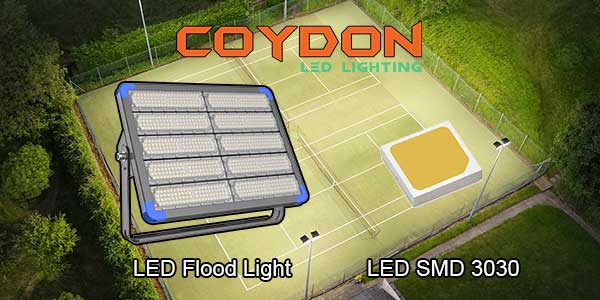
“LED SMD 3030” describes a specific chip package. SMD stands for Surface-Mounted Device. The “3030” refers to its dimensions: 3.0mm by 3.0mm. This size offers an optimal balance for outdoor lights. It provides strong light output from a compact source.
Thermal management is more efficient at this scale. Heat can dissipate effectively from the chip. This is crucial for maintaining performance and longevity. The package also ensures excellent mechanical stability. It can withstand vibration and thermal cycling.
We specify LEDs from Lumileds. This brand was formerly Philips Lumileds. It is a globally recognized leader in LED technology. Their chips are renowned for exceptional efficiency. They offer outstanding reliability over long periods. Color consistency from chip to chip is also superb.
Quality Commitment
Using Lumileds chips is a deliberate choice. It represents our commitment to peak performance. Initial luminous efficacy is maximized from day one. The controlled lumen depreciation curve is far superior. Light output remains stable for many more years.
Color consistency is maintained across all fixtures. This is vital for large-scale lighting projects. Uniform appearance is guaranteed over time and distance. This choice ensures exceptional performance at the source. It translates directly into long-term value for our customers.
Coydon Lighting’s KD-FLN and KD-FLM series benefit from this. They deliver reliable, high-quality illumination consistently. The foundation is a world-class LED component. This is a core reason for their industry-leading durability.
2.5 Ingress Protection (IP) Grade – The Armor Against Harsh Environments
System Interpretation
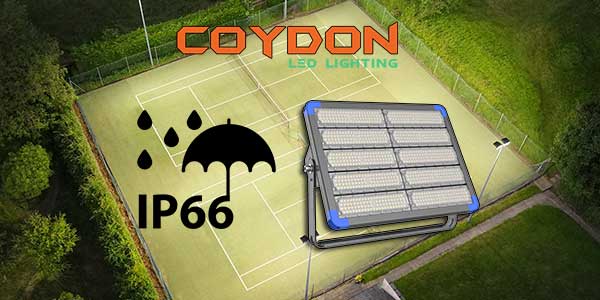
The IP Code is an international standard. It classifies a product’s protection levels. The code consists of two characteristic numerals. The first digit indicates protection against solids. This includes dust and other foreign objects. Its scale ranges from 0 (no protection) to 6 (dust-tight).
The second digit indicates protection against liquids. This primarily refers to water ingress. Its scale ranges from 0 (no protection) to 8 (protected against continuous submersion). Together, these digits form a clear performance promise. They tell users exactly what conditions the fixture can withstand.
In-Depth Analysis (IP66)
An IP66 rating is exceptionally robust for outdoor use. Let’s break down its meaning precisely.
IP6X: The first digit ‘6’ is the highest for solids. It guarantees complete protection against dust ingress. No harmful dust quantity can enter the enclosure. This is vital for longevity in dusty or sandy areas.
IPX6: The second digit ‘6’ is for powerful water jets. The fixture can resist water projected from a nozzle. This simulates heavy seas or powerful spray. Water jets come from all directions with 12.5mm nozzle. No harmful effects shall occur under these conditions. It ensures operation during storms or high-pressure cleaning.
This dual protection is a comprehensive shield. It defends against both particulate and liquid threats. Our fixtures are tested and certified to meet this standard. This is not a marketing claim but a verified fact.
Significance for Reliability
The IP66 certification is a non-negotiable requirement. It is the hard guarantee for long-term outdoor reliability. The fixture’s internal components are highly sensitive. Drivers, LEDs, and optics need a clean, dry environment. The IP66 enclosure provides this protective microclimate.
It directly impacts product durability and maintenance needs. Fixtures last much longer without internal corrosion. They require far fewer service interventions over their lifespan. This translates into lower total cost of ownership. Unexpected downtime and replacement costs are minimized.
For any serious outdoor application, IP66 is essential. It separates professional-grade equipment from consumer products. Coydon Lighting’s KD-FLN and KD-FLM series carry this rating. They are built to perform reliably for years, anywhere.
2.6 Material Composition – The Physical Guarantee of Heat Dissipation and Durability
Structural Analysis (Aluminium + PC Lens)
Housing (Aluminium): Die-cast aluminium alloy is the primary material. It is the high-end industry standard for outdoor fixtures. This choice is based on three critical advantages. First, it has exceptional thermal conductivity. Heat from the LED chips transfers away rapidly.
Efficient heat dissipation is absolutely crucial. It maintains high luminous efficacy over time. It also ensures a very long operational lifespan. Second, it provides immense structural strength. The housing can withstand physical impacts and vibrations. This is vital for transport, installation, and service.
Third, it offers excellent corrosion resistance. Proper surface treatment enhances this property. The fixture endures sun, rain, and salty air for years. The integrity and appearance remain intact throughout.
Lens (PC Lens): The lens is made of Polycarbonate (PC). This engineering plastic is the optimal choice. It delivers a perfect balance of optical and mechanical properties. It maintains very high light transmittance over time. Minimal light is absorbed or scattered by the material.
Its impact resistance is remarkably high. It does not shatter under blunt force or hail. This ensures safety and longevity in public spaces. It also has superb weatherability. It resists yellowing and degradation from UV exposure. Optical clarity and efficiency are preserved for the long term.
Integrated Performance
This material combination achieves a perfect balance. It addresses all core requirements for professional lighting. Aluminium manages the critical thermal load. This protects the LED’s performance and longevity. It also provides a robust and durable physical shell.
The PC lens protects the delicate optical system. It ensures consistent, high-quality light output. Together, they form a synergistic protective barrier. This defends against heat, impact, weather, and corrosion.
It is the classic configuration for a reason. It has been proven in countless demanding applications worldwide. Coydon Lighting’s KD-FLN and KD-FLM series utilize this proven design. They deliver unmatched reliability and consistent performance. This is the physical foundation of their value proposition.
2.7 Luminous Efficiency – The Core Metric of the Energy Efficiency Revolution
Definition and Importance
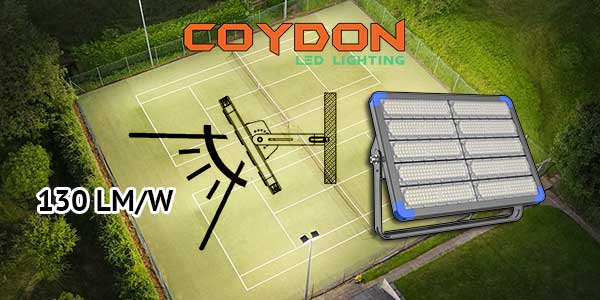
Luminous efficiency measures light output per electrical input. Its unit is lumens per watt (lm/W). This is the most direct metric for energy conversion. It shows how efficiently a fixture produces light. Higher values indicate less energy is wasted as heat.
This number directly correlates with operating costs. It is the primary factor in electricity bills for lighting. Choosing a high-efficiency fixture is crucial. It determines long-term financial and environmental impact. Understanding this specification is essential for smart procurement.
Data Interpretation (130 Lumens per watt)
A rating of 130 lm/W represents leading performance. It is a benchmark for modern high-output LED flood lights. To understand its significance, consider traditional technologies. Incandescent or halogen lights achieve only 15-20 lm/W. High-Pressure Sodium lamps reach about 80-100 lm/W.
This means our fixtures are vastly more efficient. They produce the same brightness with far less power. Compared to halogen, energy use is reduced by about 85%. This is an extraordinary leap in performance. It transforms the economics of large-scale outdoor lighting.
The savings are immediate and substantial. It is not a marginal improvement but a fundamental change. This level of efficiency was unthinkable a decade ago. It is now a standard we deliver in our products.
Economic and Environmental Impact
High luminous efficiency delivers rapid financial returns. The reduction in energy consumption is dramatic. For a large installation, savings accumulate quickly. The payback period through lower electricity bills is often short. The initial investment is recovered in a few years.
After that, the savings contribute directly to operational profit. This makes it a financially sound decision from day one. Furthermore, the environmental benefit is equally significant. Lower energy use means reduced carbon dioxide emissions.
It also decreases the demand on power plants. This supports corporate sustainability goals effectively. Choosing 130 lm/W fixtures is a responsible action. It benefits both the bottom line and the planet. Coydon Lighting’s KD-FLN and KD-FLM series embody this principle. They offer top-tier efficiency without compromising on light quality or durability.
2.8 Beam Angle – The Science of Precise Light Control
Concept Explanation
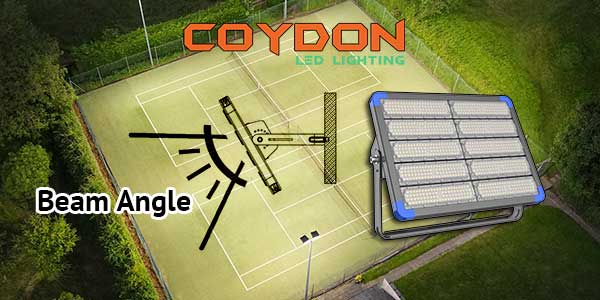
Beam angle is a core optical specification. It defines the spread of light from a fixture. Technically, it is the angle between points where light intensity is 50% of the center. A narrow beam concentrates light into a focused spot. A wide beam disperses light over a broad area.
This parameter dictates light throw distance and coverage. It is fundamental for application-specific design. Choosing the correct beam angle is critical. It ensures efficiency and prevents light pollution. Every project has an optimal beam angle solution.
Series Options Breakdown
Coydon Lighting offers two distinct series. Each provides tailored beam distributions. The choice depends on the target area’s shape and needs.
KD-FLN Series (Standard Symmetric):
This series offers five classic symmetric angles. They are 15°, 30°, 45°, 60°, and 90°. The 15° beam is for extreme long-throw spotlighting. The 90° beam is for very wide, close-range flood lighting. Intermediate angles cover most general area lighting tasks. This range suits square or round zones perfectly.
KD-FLM Series (Professional And Asymmetric):
This series includes specialized options. It features 10°, 25°, 45°, 60°, and 90° beams. It also introduces unique asymmetric distributions. The 65×25° beam is a rectangular pattern. It is engineered for long, narrow areas. Roads, tennis courts, and runways are ideal applications.
The 130×30° beam offers extra-wide horizontal coverage. It lights wide intersections or station platforms efficiently. These asymmetric beams match light to the target shape. They maximize useful light on the ground. They drastically reduce spill light and energy waste.
Application Strategy and Value
Selecting the beam angle is a strategic decision. First, analyze the area geometry and lighting goals. Symmetric areas pair with the KD-FLN series. Rectangular or linear areas demand the KD-FLM asymmetric beams.
Correct selection delivers multiple benefits. It achieves perfect illumination uniformity. It minimizes uplight and obtrusive light to neighbors. It also reduces the total number of fixtures needed. This lowers both initial and operational costs.
Our extensive beam angle portfolio is a key advantage. It enables truly customized, high-performance lighting plans. Coydon Lighting provides the right optical tool for every challenge. This ensures optimal results for safety, functionality, and efficiency.
2.9 Warranty – A Solemn Commitment for Long-Term Confidence
Promise Interpretation (5 Years)
A five-year warranty is a strong statement. It far exceeds common industry standards. This period is not just a repair promise. It represents deep confidence in product engineering. It proves belief in material quality and manufacturing process.
The manufacturer stands behind the product fully. This confidence is built on extensive testing. It is also based on years of field performance data. Such a warranty eliminates customer uncertainty. It transforms a purchase into a secured long-term investment.
Customer Value
A long warranty delivers immense practical value. It significantly reduces long-term ownership risk. Potential repair and replacement costs are transferred. They move from the owner to the manufacturer. This provides financial predictability for projects.
It also ensures operational peace of mind. Lighting failure will not cause unexpected downtime or expense. Maintenance budgets become more stable and manageable. The total cost of ownership becomes clearer from the start. This is crucial for investors and facility managers.
It is a powerful tool for risk management. It protects the asset’s performance over its lifespan. This assurance is invaluable for large-scale installations. It makes the procurement decision much simpler and safer.
Brand Responsibility
Offering a five-year warranty imposes strict discipline. It forces the brand to excel at every stage. Product design must prioritize durability and reliability. Component selection must use only high-grade, proven materials. Manufacturing quality control must be flawless.
This commitment drives continuous improvement internally. It aligns the company’s goals with the customer’s long-term success. The warranty is the final proof of this dedication. It is the ultimate endorsement of product quality and brand professionalism.
Coydon Lighting proudly offers this five-year warranty. It applies to our KD-FLN and KD-FLM series. This reflects our unwavering commitment to excellence. We share the long-term risk with our customers. This partnership approach builds trust and ensures satisfaction for years.
Part 3: Real-World Validation – Professional Case Studies Based on Dialux Simulation
True professional lighting begins with precise design. It relies on accurate simulation and calculation. Coydon Lighting provides more than just high-quality fixtures. We offer professional Dialux lighting design software support. This service delivers scientific pre-verification for every project.
Our approach transforms technical specifications into guaranteed performance. The following three real case studies demonstrate this process. Their Dialux simulation reports provide clear, objective evidence. They show how our products achieve outstanding results on site.
This data-driven methodology eliminates guesswork. It ensures project success from the very first planning stage. Client confidence is built on solid, verifiable engineering data.
Case Study 1: Large Outdoor Basketball Court Lighting
This project involved lighting a major outdoor sports facility. The facility contained six standard basketball courts. The primary objective was ensuring uniform court illumination. Glare control was absolutely essential for player comfort and safety. The lighting needed to support various activities effectively. These included evening training sessions and amateur competitions.
Energy efficiency was a paramount concern for the owner. The system had to minimize long-term operational costs. Maintenance requirements also needed to be very low. Durability in an open outdoor environment was crucial. The solution had to withstand weather year-round.
Coydon Solution And Configuration
We designed a solution using 108 KD-FLN-W150 fixtures. This 150W LED flood light is highly efficient. Each unit produces 22,639 lumens at full operation. The combined system output is 2,444,992 lumens. Total connected power is approximately 16.2 kilowatts.
The layout was engineered using precise coordinates. Twenty-seven pole positions were strategically determined. This provided complete coverage of the playing area. The total site dimensions are 97 by 36.83 meters. Fixture aiming and beam angles were carefully selected. This optimized light spread and minimized spill beyond the courts.
Dialux Simulation Performance Validation
Detailed Dialux simulation validated the design thoroughly. Calculation grids were analyzed for each individual court. The average horizontal illuminance (Eav) results were excellent. Values consistently ranged between 450 and 476 lux. This performance suits training and recreational play perfectly.
The uniformity ratio (U0) was a key success metric. All courts achieved ratios between 0.65 and 0.80. This confirms a very even distribution of light. No significant dark zones or excessive bright spots exist. The false-color rendering diagrams provide clear visual proof. They show smooth gradients and consistent light across the entire complex.
The project demonstrates a significant technological advancement. It delivers superior visual performance for athletes. Simultaneously, it achieves extraordinary energy savings. Compared to legacy lighting technology, savings exceed 70%. This reduces both electricity costs and environmental impact substantially. The client received a future-proof, high-performance lighting system.
Case Study 2: Intensive Tennis Club Lighting Upgrade
This project involved a private tennis club facility. It contained multiple courts in a condensed layout. The existing lighting was outdated and inefficient. It produced poor uniformity and significant glare issues. The club required a modern, high-performance system. Key goals included superior court illumination for evening matches.
Minimizing light spill between adjacent courts was critical. This ensured games on one court didn’t disrupt others. Energy consumption reduction was another major objective. The owner wanted a clear return on investment. We proposed two tailored design concepts for comparison. This highlighted our adaptive engineering capabilities.
Solution Detailed Analysis
The first design concept employed 120 LED flood lights. We selected the KD-FLN-W150 model with a wide 60° beam. This configuration prioritizes broad and uniform light spread. The system’s total light output was 2,379,499 lumens. Total electrical power consumption was 18.5 kilowatts.
Pole placement was carefully optimized using simulation. Fixtures were positioned at 40 specific locations. These points were along the court sidelines and behind baselines. This symmetric layout creates overlapping light cones. It eliminates shadows and provides consistent vertical illumination.
Each fixture’s aiming angle was individually calculated. This precision ensures light is directed onto the playing surface. It prevents wasteful upward light and reduces spill. The design philosophy values meticulous control. It uses more fixtures at lower individual power.
Dialux Simulation Results Analysis
We analyzed the simulation for a central court (Tennis 1). The calculated average illuminance was 412 lux. This level is ideal for competitive recreational play. It allows players to track the ball clearly at high speed.
The achieved uniformity (U0) was an excellent 0.77. This number confirms a very homogeneous light field. Players experience no distracting bright or dark patches. The isolux diagram visualizes this consistent coverage. Contour lines are smooth and evenly spaced across the court.
This scheme proves the effectiveness of a distributed approach. It excels in applications demanding minimal glare. The lower per-fixture intensity reduces direct visual discomfort. It is a superb choice for member-focused sports clubs. The solution balances performance, comfort, and efficiency perfectly. It meets the highest standards for player experience.
Case Study 3: High-Efficiency Tennis Center with Side-Lighting Scheme
This project featured a larger tennis center complex. The site length extended approximately 126 meters. The design goal emphasized maximum efficiency and economy. We aimed to achieve premium lighting standards with fewer fixtures. This reduces material, installation, and long-term energy costs.
The innovative approach utilized a side-lighting configuration. Traditional two-side lighting was not optimal here. The new layout focused on concentrated light output and strategic placement. It represents a smart engineering solution for elongated sites.
Coydon High-Efficiency Solution
The proposed solution deployed 72 powerful LED flood lights. We selected the high-output KD-FLN-W250 (250W) model. Each fixture delivers an impressive 39,062 lumens. The total system luminous flux reached 2,812,499 lumens. The total connected load was approximately 18.1 kilowatts.
Layout diagrams and coordinate lists reveal the strategy. Fixtures were primarily positioned in a side-lighting arrangement. They were placed along one side or at the court ends. This significantly reduced the total number of poles required. It simplified infrastructure and minimized visual clutter.
Dialux Simulation Exceptional Results
The simulation confirmed outstanding performance outcomes. Calculation grid data from multiple courts was analyzed. Average horizontal illuminance (Eav) was notably high. It consistently ranged from 500 to 533 lux across courts.
Uniformity ratios (U0) were also excellent. Most courts achieved values between 0.72 and 0.81. For example, Court “Tennis 3” showed an Eav of 533 lux. Its minimum illuminance was 406 lux, indicating superb uniformity.
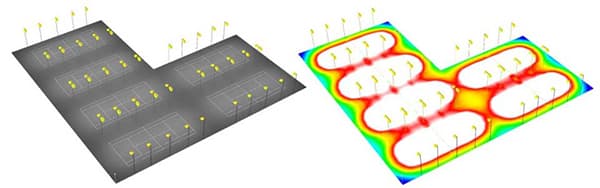
False-color renderings visually demonstrated the coverage. Despite using fewer fixtures, light distribution was highly effective. The high-lumen output and optimized placement created focused, efficient pools of light. This design eliminates dark zones and ensures consistent playability.
This case study perfectly illustrates a key principle. Intelligent product selection combined with expert design yields superior results. It achieves top-tier lighting quality while maximizing energy efficiency. It also optimizes the total project cost and long-term value for the client.
Part 4: Application Panorama – For Every Corner That Needs Light
Airport
Billboard
Construction Site
Outdoor basketball court
Outdoor football court
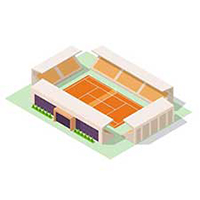
Outdoor Stadium
Outdoor tennis court
Outdoor warehouse district
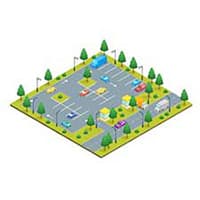
Parking lot
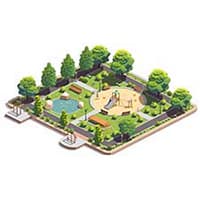
Plaza
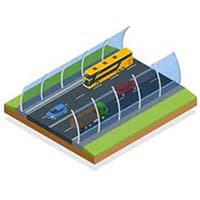
Tunnel
Wharf
4.1 Comprehensive Coverage
High-performance LED flood lights serve countless applications. They illuminate airport runways and aprons for safe operations. They light up port terminals and cargo handling zones at night. Construction sites and outdoor storage yards rely on their robust light. Sports arenas, football fields, and tennis courts use them for events.
Parking lots and city squares depend on them for safety. Tunnels and underpasses require their consistent brightness. Billboards and facades utilize them for visual impact. These lights are fundamental to modern infrastructure. They are the essential “cornerstone of light” for cities and industries.
4.2 Demand Matching
Every application has unique lighting requirements. Sports venues demand high illuminance and perfect uniformity. Industrial zones need extreme durability and wide-area coverage. Commercial and public spaces prioritize safety, aesthetics, and low upkeep.
Coydon Lighting’s KD-FLN and KD-FLM series meet these diverse needs. They offer a wide power range from 50W to 1250W. Precise beam angles allow for customized light distribution. Superior IP66 protection ensures reliability in harsh conditions.
This versatility covers the entire spectrum of lighting tasks. It supports everything from detailed work to vast area illumination. The right fixture exists for every specific challenge. Our portfolio provides the perfect tool for the job.
4.3 Value Elevation
Professional lighting is a critical success factor. It directly enhances operational efficiency and productivity. It fundamentally guarantees nighttime safety and security. It actively creates comfortable and inviting atmospheres. It powerfully shapes city image and brand identity.
Choosing the correct lighting solution is a strategic decision. It means laying a solid foundation for your project’s visual environment. It is an investment in performance, sustainability, and quality. Coydon Lighting partners with you to achieve this goal. We provide the technology and expertise to illuminate your success.
Part 5: Take Action Now – Partner with Coydon to Illuminate the Future
Choosing Coydon Lighting represents an investment in quality. You acquire more than basic lighting equipment. You gain access to industry-leading 130 lm/W efficiency. This translates directly to measurable cost savings. You receive products built for maximum durability. The IP66 rating ensures all-weather performance. Our five-year warranty provides long-term peace of mind.
Our service delivers exceptional value beyond the products. We offer complete professional lighting design support. This includes detailed Dialux simulation and planning. Our experts guide you through the entire specification process. We ensure the perfect solution for your unique requirements. This comprehensive approach guarantees optimal results.
Now is the moment to transform your lighting vision. Move beyond the planning stage into decisive action. Superior illumination technology is ready for your project. It delivers both outstanding performance and remarkable efficiency. Do not settle for inadequate or outdated lighting solutions.
Take the simple step to secure your project’s future. Click the prominent [Inquiry Now] button immediately. Provide basic details about your application or needs. Our dedicated lighting team will respond within one day. You will receive expert consultation tailored to your situation.
We will also prepare a preliminary Dialux simulation report. This shows the expected lighting performance visually. You can review and approve the design with confidence. Achieve exceptional illumination before installation even starts. Partner with Coydon Lighting to illuminate success brilliantly.